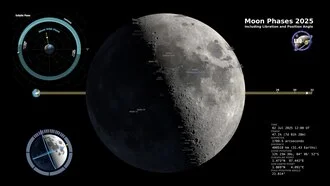
Understanding the moon phase today is more than a matter of curiosity. The lunar cycle influences tides, wildlife behavior, agricultural practices, and cultural traditions around the world. Whether you are a skywatcher, a gardener, or simply someone who glanced up at the night sky, knowing how to read the current phase of the moon offers genuine insight into natural rhythms that have guided humanity for thousands of years.
What Are Moon Phases and How Do They Work?
The moon does not produce its own light. What we see from Earth is sunlight reflecting off the lunar surface. As the moon orbits our planet over the course of approximately 29.5 days — a period known as the synodic month — the angle between the Earth, moon, and sun constantly changes. This shifting geometry determines how much of the illuminated side of the moon is visible from Earth at any given moment.
The Eight Primary Phases
Astronomers divide the lunar cycle into eight distinct phases:
- New Moon – The moon is positioned between Earth and the sun, making it invisible from Earth's surface.
- Waxing Crescent – A small sliver of light becomes visible on the right side of the moon.
- First Quarter – Half of the moon's face is illuminated, marking the one-quarter point of the cycle.
- Waxing Gibbous – More than half the moon is lit, and brightness continues to grow.
- Full Moon – The entire face of the moon is illuminated, rising at sunset and setting at sunrise.
- Waning Gibbous – The illuminated portion begins to shrink after the full moon.
- Last Quarter – Once again, half the moon is visible, now on the left side.
- Waning Crescent – A thin sliver remains before the cycle resets with the next new moon.
To find out the moon phase today, numerous apps, websites, and almanacs provide real-time lunar data based on your geographic location and time zone.
How to Track the Current Moon Phase
Tracking today's lunar phase has never been simpler, thanks to digital tools and scientific resources. NASA's official website provides daily lunar data, including the percentage of illumination and exact rise and set times. Mobile applications such as Moon Phase Calendar, Sky Map, and Lunar Calendar offer interactive displays that update in real time.
Reading a Lunar Calendar
A lunar calendar marks each day with the corresponding moon phase icon, allowing users to plan weeks or months in advance. These calendars are especially useful for:
- Astronomers and astrophotographers, who schedule observations around the new moon to minimize light interference.
- Fishermen and hunters, who often follow moon phase charts to predict animal activity patterns.
- Gardeners following biodynamic principles, who plant, prune, and harvest according to the lunar cycle.
When consulting a lunar calendar, it is important to note the time zone used, as a full moon occurring at midnight UTC may fall on a different calendar date depending on your local time.
The Real-World Effects of Lunar Phases
The moon's gravitational pull is a measurable force that shapes life on Earth in several concrete ways. Understanding these effects helps explain why many people pay close attention to the moon phase today and throughout each month.
Tides and Ocean Activity
The most well-documented influence of the moon is its effect on Earth's tides. The gravitational attraction between the moon and Earth causes ocean water to bulge on both the side facing the moon and the opposite side. During new and full moons, the sun, Earth, and moon align, producing stronger tidal forces known as spring tides. During the first and last quarter phases, the sun and moon pull at right angles, resulting in weaker neap tides.
Wildlife and Ecological Patterns
Scientific studies have documented lunar influences on a range of animal behaviors. Coral reefs in tropical oceans synchronize mass spawning events with specific moon phases. Certain species of fish are more active around the full and new moons. Sea turtles use lunar light as a navigational cue during nesting season. Even some nocturnal mammals adjust their foraging habits based on moonlight availability.
Cultural and Agricultural Traditions
For centuries, agricultural societies have used the lunar calendar to guide planting schedules. Biodynamic farming, a method developed in the early 20th century, categorizes crops and assigns specific tasks to root days, flower days, fruit days, and leaf days — each correlated with the moon's position and phase. While scientific consensus on these practices remains mixed, their historical roots reflect a deep human connection to lunar cycles.
Staying Informed About the Moon Phase Today
Monitoring the current phase of the moon is straightforward with the right resources. Government space agencies, university astronomy departments, and dedicated lunar tracking platforms provide accurate, up-to-date information. Whether your interest is scientific, agricultural, or simply observational, paying attention to the moon phase today connects you to a natural cycle that has measured time and inspired wonder across every human civilization.
Comments