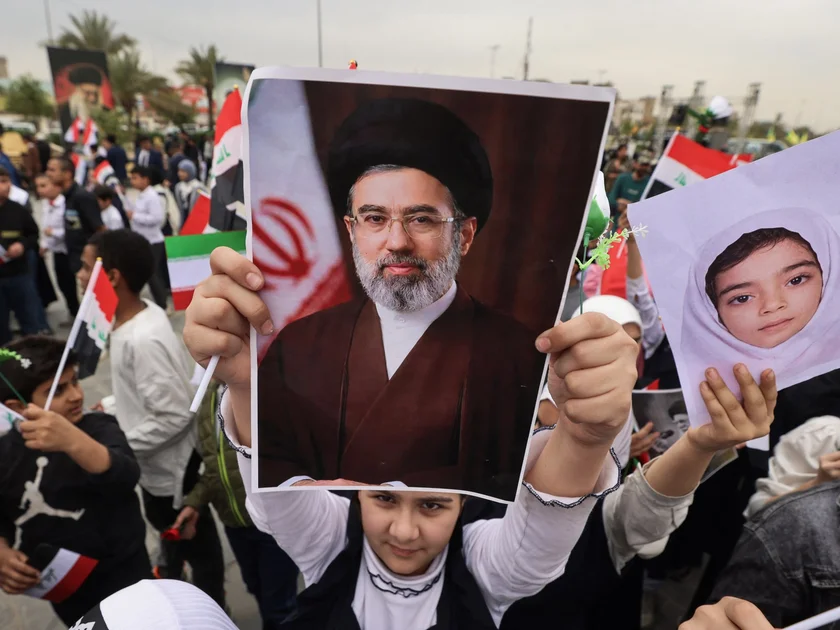
Iran's Supreme Leadership in Question: Who Is Mojtaba Khamenei?
As Iran navigates one of the most turbulent chapters in its post-revolutionary history, a single question looms larger than ever in diplomatic circles and among Iranian opposition groups: who will succeed Ali Khamenei as the Islamic Republic's Supreme Leader? Increasingly, the name that surfaces is Mojtaba Khamenei, the 55-year-old second son of the current Supreme Leader, who has long operated in the shadows of Iran's clerical establishment but whose influence is said to have grown dramatically in recent years.
Mojtaba Khamenei is not a publicly prominent figure in the conventional sense. He holds no official government title and rarely appears in state media. Yet analysts who track Iran's power structures consistently describe him as one of the most influential behind-the-scenes operators within the Islamic Revolutionary Guard Corps (IRGC) and the broader intelligence apparatus. His ascent has become a subject of intense scrutiny as his 85-year-old father's health remains a source of persistent speculation.
The Architecture of Power: How Mojtaba Built His Influence
Ties to the Revolutionary Guard and Intelligence Networks
Mojtaba Khamenei's power does not derive from religious scholarship — a traditional prerequisite for the role of Supreme Leader under Iran's constitution — but from his deep ties to the IRGC and the Basij paramilitary force. Reports from human rights organizations and Iranian dissident networks have long alleged that he played a coordinating role during the violent crackdowns on protesters, including those that followed the disputed 2009 presidential election and, more recently, the nationwide uprising triggered by the death of Mahsa Amini in 2022.
His network reportedly extends into financial institutions, media outlets, and religious foundations, known as bonyads, which control vast portions of Iran's economy. This financial footprint gives him leverage that transcends any single institution and mirrors the kind of structural power his father has exercised for over three decades.
The Constitutional Problem
One significant obstacle to Mojtaba's succession is Iran's own constitution, which requires the Supreme Leader to be a recognized marja — a senior Shia cleric of the highest religious rank — or at minimum a figure of substantial clerical standing. Mojtaba is believed to hold the mid-level rank of hojatoleslam, which falls short of the ayatollah designation considered necessary for the role. Critics argue that elevating him would expose the Islamic Republic to charges of dynastic rule, directly contradicting the revolutionary ideology that distinguishes the system from the monarchy it replaced in 1979.
Nevertheless, precedent exists for bending institutional rules in the name of political expediency. Ali Khamenei himself was considered insufficiently senior as a cleric when he assumed the role in 1989 following the death of Ayatollah Ruhollah Khomeini. The Assembly of Experts, the body constitutionally empowered to select the next Supreme Leader, ultimately amended its interpretation to accommodate him.
Why It Matters: Iran at a Regional and Global Inflection Point
The question of succession in Iran is not merely an internal political matter. Iran sits at the center of multiple geopolitical fault lines — its nuclear program remains a subject of fraught international diplomacy, its proxy networks extend from Lebanon to Yemen, and its relationship with both Russia and China has taken on new dimensions amid shifting global alignments. The identity and ideological orientation of the next Supreme Leader will shape all of these dynamics.
A Mojtaba-led Iran would likely signal continuity with the hardline security-state model that has defined recent years, potentially foreclosing prospects for diplomatic openings with Western nations. Observers have noted that the U.S.-Iran relationship, already severely strained — as evidenced by ongoing tensions in the Persian Gulf region, including disputes over navigation and energy security in the Strait of Hormuz — could become even more volatile under a successor drawn entirely from the IRGC's orbit rather than the clerical establishment's more diplomatically flexible wing.
For ordinary Iranians, particularly the younger generation that has driven successive waves of protest, the prospect of a dynastic handover represents a profound symbolic defeat — the transformation of a theocratic republic into something closer to a hereditary autocracy.
Broader Implications: Succession, Legitimacy, and the Future of the Islamic Republic
The Mojtaba Khamenei question encapsulates a deeper crisis of legitimacy facing the Islamic Republic. The system established in 1979 was premised on the concept of velayat-e faqih — the guardianship of the Islamic jurist — which rests on religious authority, not bloodlines. A son succeeding a father would undermine that foundational premise in ways that even loyal insiders might find difficult to rationalize.
This succession debate also reflects a global trend in which authoritarian systems struggle with institutionalized transitions of power. Without transparent mechanisms and genuine political competition, the process becomes vulnerable to factional infighting, potential instability, and international unpredictability.
Whether Mojtaba Khamenei ultimately ascends to the role of Supreme Leader or whether the Assembly of Experts charts a different course, the mere seriousness with which his candidacy is being discussed signals that Iran's political system is entering a period of profound uncertainty — one with consequences that will extend far beyond its borders.
Comments