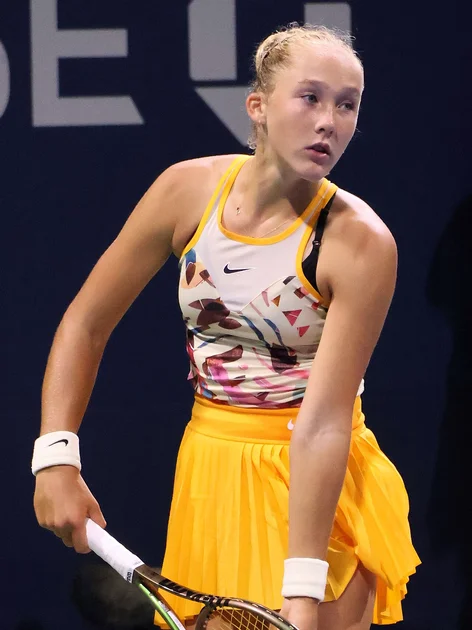
Russia's Teenage Sensation Delivers Another Statement Performance
Mirra Andreeva is once again the name on everyone's lips in the tennis world. The 17-year-old Russian prodigy has been delivering performances well beyond her years, advancing deep into a major tournament and defeating opponents ranked significantly higher in the WTA standings. Her combination of mental fortitude, baseline aggression, and a rapidly developing serve has left coaches, analysts, and fans alike struggling to find adequate comparisons.
In her most recent match, Andreeva dispatched a top-20 opponent in straight sets, displaying the kind of clinical precision that typically takes players years longer to develop. Her first-serve percentage hovered above 70 percent throughout the contest, and her ability to construct points methodically — rather than relying purely on raw power — drew widespread admiration from courtside observers.
Key Numbers Behind the Rise
Andreeva's WTA ranking has climbed sharply over the past 12 months, a trajectory that mirrors the early careers of the sport's all-time greats. She has now won more than 60 percent of her matches on the main tour this season, a figure that places her among the most consistent performers in women's tennis regardless of age. Tournament directors and broadcasters have begun scheduling her matches in marquee slots, a recognition of the audience she draws — both online and in stadium attendance.
Why This Moment Matters for Women's Tennis
The timing of Andreeva's emergence is significant. Women's tennis is currently navigating a generational transition, with several longtime stars either retiring or stepping back from the most demanding schedules. Into that vacuum, a handful of teenagers have stepped forward — but none with quite the same combination of technical skill, competitive temperament, and media presence as Andreeva.
Her success also arrives at a moment when the sport is under heightened scrutiny regarding how it manages young talent. The WTA has implemented age eligibility rules designed to protect developing players from burnout and overexposure, yet Andreeva's performances raise genuine questions about whether those guardrails are appropriately calibrated. She is, by almost any measure, already operating as a fully formed professional.
The Coco Gauff Parallel
Inevitably, comparisons have been drawn to Coco Gauff, who similarly burst onto the scene as a teenager before consolidating her position at the very top of the game. As detailed in coverage of Coco Gauff's recent dominant form and Grand Slam ambitions, the American's trajectory offers both a roadmap and a cautionary tale for young players managing expectations alongside competitive pressures. Andreeva's team appears acutely aware of this dynamic, carefully managing her tournament schedule to balance development with performance.
Sponsorship interest in Andreeva has also surged. Multiple sources within the sports marketing industry have confirmed that several major apparel and equipment brands are actively pursuing partnership discussions, with valuations reportedly exceeding what would be typical for a player at her current ranking. Her social media following has grown exponentially, crossing several million across platforms — an indicator of commercial appeal that extends well beyond traditional tennis demographics.
What Andreeva's Ascent Changes for the Sport
The broader implication of Mirra Andreeva's rise is not simply that another talented teenager has arrived on the tour. It is that the pipeline of elite female tennis talent appears to be broadening in ways that could reshape competitive dynamics at Grand Slam level for the next decade. Where the sport once relied heavily on a small cluster of dominant figures to carry viewership and revenue, a more distributed landscape of compelling young players is emerging.
For tournament organizers, broadcasters, and sponsors, this represents an opportunity to cultivate new narratives and rivalries at a time when sports media consumption is fragmenting. Andreeva, with her distinctive on-court personality and willingness to engage with audiences authentically, fits precisely the profile that the modern sports ecosystem rewards.
For her opponents, however, the message is more immediate and less abstract: Mirra Andreeva is not a future problem to solve. She is a present one. And based on current evidence, she is only getting better.
Comments