
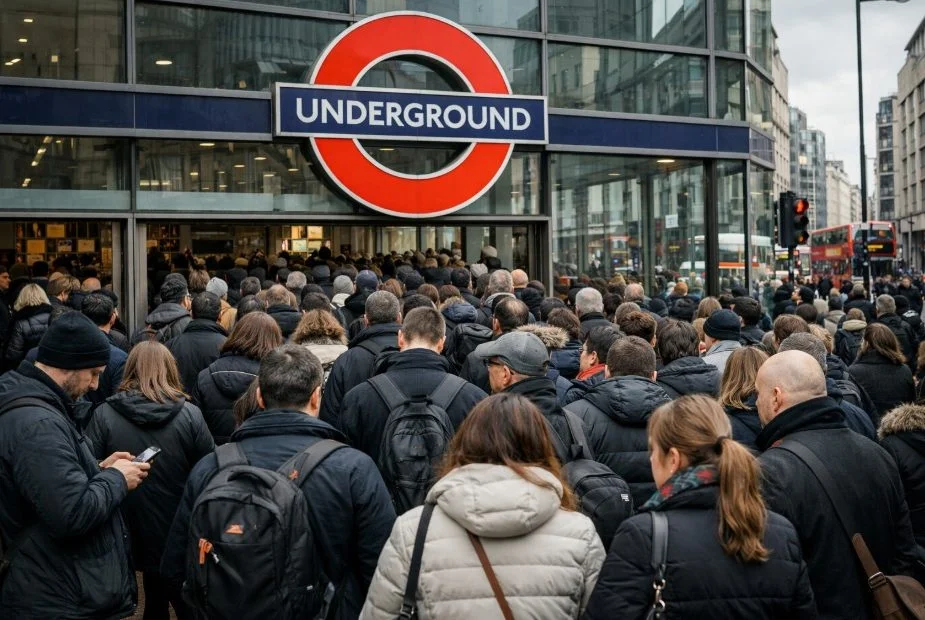
London's Underground Faces Its Biggest Disruption Since September — Starting Tuesday
Londoners are bracing for a significant week of transport chaos as the city's underground rail network prepares to be hit by a series of RMT-led strikes beginning on Tuesday, April 21. Tube drivers belonging to the Rail, Maritime and Transport (RMT) union are set to walk out on two separate 24-hour occasions next week, effectively shutting large parts of the London Underground for four consecutive days between Tuesday and Friday.
The strikes — the first to hit the capital since a period of relative calm that followed September 2025's disruptions — are part of a broader schedule of six walkouts spread across 12 days in April, May and June 2026. Transport for London (TfL) has confirmed that "significant disruption" is expected, and has urged passengers to check its journey planner before setting off.
Strike Dates, Times and the Lines Most Affected
The walkouts follow a precise 24-hour rolling format, beginning and ending at midday. The April schedule is as follows:
- April 21–22: 12:00 Tuesday to 11:59 Wednesday BST
- April 23–24: 12:00 Thursday to 11:59 Friday BST
Further strike action is also confirmed for May and June:
- May 19–20 and May 21–22
- June 16–17 and June 18–19
Which Tube Lines Will Be Closed?
TfL has confirmed that the Piccadilly line and Circle line will have no service at all during the strike days. The Metropolitan line will not run between Baker Street and Aldgate, and the Central line will be suspended between White City and Liverpool Street.
Most other lines are expected to run with significantly reduced frequency. Passengers on any operational line should expect overcrowding and may not be able to board the first service to arrive at their station. TfL has stressed that the overall level of disruption is anticipated to be less severe than the September 2025 walkouts, when Aslef — the other major train drivers' union — also participated in industrial action.
East London Commuters Face a Double Hit on Friday
A separate bus strike on Friday, April 24 will compound the misery for passengers in East London. Bus routes 8, N8, 25, N25, 205, N205 and 425, which operate out of Bow bus garage, will be affected. For commuters in that part of the city, Friday could represent the single most disruptive day of the entire week.
What Is the Dispute About?
The industrial action centres on proposals by TfL to introduce a condensed four-day working week for London Underground drivers. Under the plans, most drivers would see their weekly hours reduced from 36 hours over five days to 35 hours over four days — effectively removing one paid lunch break from their weekly schedule.
The Aslef union, which represents a large proportion of Tube drivers, has accepted the deal, calling it "exactly the sort of deal every trade union should be trying to achieve." RMT, however, has rejected the voluntary arrangement outright. The union's General Secretary, Eddie Dempsey, argues that condensing working hours into longer daily shifts poses a significant safety risk through driver fatigue, and that the change constitutes an unacceptable alteration to working time arrangements.
TfL's Position and the State of Negotiations
TfL has described the strikes as "completely unnecessary," pointing out that it is currently running a voluntary pilot of the four-day week for drivers on the Bakerloo line and that RMT members would not be compelled to change their schedules. The transport authority's Chief Operating Officer, Claire Mann, has indicated that dialogue remains ongoing, though neither TfL nor the RMT would provide detailed updates on negotiation progress this week — citing pre-local election restrictions on public communications.
This political constraint has added an unusual layer of opacity to the dispute at a critical moment. Talks between the two sides had shown enough promise in March that the RMT suspended its first round of planned strikes — originally scheduled for March 24–27 — just six days before they were due to start. The resumption of action now signals those talks have stalled, with additional June strike dates added to the calendar.
How to Get Around London During the Strikes
For the vast majority of Londoners, the four days of strike action will require a significant rethink of their commuting habits. The good news is that several key transport networks will continue to operate normally.
Alternatives That Will Keep Running
- London Overground: Full service expected throughout the strike period, though trains will be considerably busier than usual.
- Elizabeth line: No disruption planned. This cross-city rail link will be especially valuable for those travelling between central and outer London.
- DLR (Docklands Light Railway): Operating normally, making it a critical lifeline for workers in Canary Wharf and the East End — though note the bus strike on Friday will affect nearby routes.
- Buses: The vast majority of London's bus network is unaffected by the Tube strike, though the Bow bus garage routes are suspended on Friday, April 24.
- London Trams: Services in south London will run as normal.
Beyond Public Transport
TfL and various London transport commentators have encouraged Londoners to consider cycling or using e-bike hire schemes during the disruption. Several dockless e-bike and e-scooter hire operators, including those operating in inner London, are expected to see a surge in demand. Walking shorter distances to reach Elizabeth line or Overground stations not served by the closed Tube lines may also be a practical option for many commuters.
Passengers are strongly advised to use TfL's Journey Planner tool before setting off on all four affected days, as conditions may evolve quickly — particularly if last-minute negotiations between TfL and the RMT produce any movement.
The Broader Stakes: Workers, Safety, and the Four-Day Week Debate
The London Tube strikes arrive at a moment when the four-day working week has moved from fringe policy discussion to mainstream industrial relations terrain. Major trials across the UK and Europe have repeatedly shown that shorter working weeks can maintain or even increase productivity — but the RMT's concerns add an important public safety dimension that sets this dispute apart from standard wage negotiations.
The core of the RMT's argument is not that drivers should work fewer hours per week — TfL's proposal already reduces the weekly total from 36 to 35 — but that compressing those hours into four long daily shifts creates dangerous fatigue conditions in an environment where driver alertness is directly linked to passenger safety. The union is pushing for a 32-hour, four-day week, which it says would be necessary to make the condensed model genuinely safe and equitable.
TfL's counter-position — that the scheme is voluntary, and that the Bakerloo pilot will generate real-world safety data — has so far failed to bring the RMT to the table. The split between Aslef's endorsement and RMT's rejection underscores how differently two unions representing workers in near-identical roles can read the same contractual offer.
With the IMF already sounding alarms about the economic pressures facing major economies, the knock-on effect of repeated transport shutdowns in one of Europe's largest financial capitals is also worth noting. London's commuter economy — particularly retail, hospitality, and office-dependent businesses in the city centre — has struggled to fully recover from previous rounds of industrial action, and further disruption through June could accelerate the shift toward hybrid working patterns that permanently reduce footfall in central London.
What Happens Next
As of April 17, 2026, TfL says dialogue is ongoing but no breakthrough has been announced. The March precedent — where strikes were suspended at the eleventh hour — means a last-minute resolution cannot be ruled out. However, given that the union has now added June dates to the schedule and described the current talks as having made insufficient progress, the mood is considerably more entrenched than it was in March.
If the April 21 strike proceeds as planned, attention will quickly turn to whether TfL escalates its offer ahead of the May dates, or whether the RMT's position softens following pressure from its members. In the meantime, London commuters would do well to make their alternative travel plans today rather than Monday morning.
Comments