
LIV Golf Announces Lead Investor, Ensuring Survival Beyond 2026
LIV Golf CEO Scott O'Neil made a hastily scheduled appearance at Trump National Golf Club Bedminster on Wednesday, announcing that the league has signed an agreement with a lead investor to fund operations beyond the 2026 season. While O'Neil declined to identify the investor or disclose the financial terms, the announcement provides a temporary lifeline for the Saudi-backed circuit, which was dealt a major blow earlier this year when the Saudi Public Investment Fund (PIF) said it would withdraw funding at the end of the season.
According to reports from Bloomberg and the Financial Times, the mystery investor is British investment firm BC Partners, a lender to GSE Worldwide, the agency that represents LIV star Bryson DeChambeau. The league has reportedly been seeking capital in the range of $300 million — a far cry from the billions it once had at its disposal. O'Neil indicated that the new structure will shift from lucrative player salaries to an equity model, with players becoming the majority equity holders. "This second bite at the apple is equity instead of cash," he said.
The 2027 schedule is expected to shrink significantly, with just 10 events — five in the U.S. and five overseas — compared to the 14 originally planned for 2026. The league has already canceled its New Orleans event this season, and the status of its season-ending team championship in Michigan remains uncertain.
DeChambeau's Dual-Tour Dream Hits a Wall
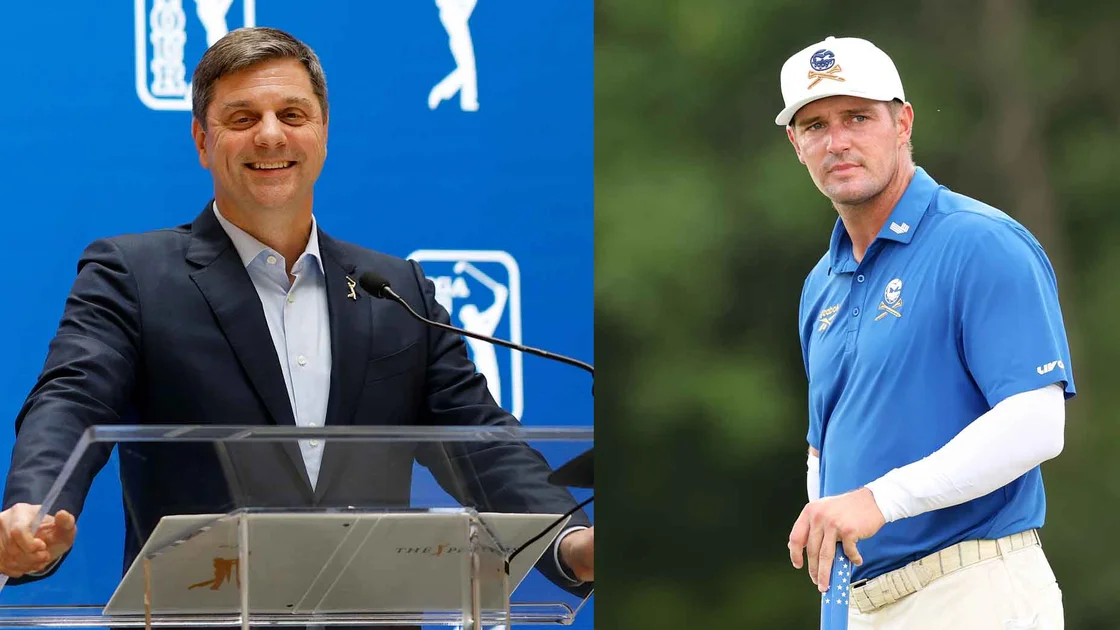
Bryson DeChambeau, who is competing at LIV Golf New York this week, expressed confidence in the league's future after O'Neil's announcement. "One hundred percent, no question. As long as the good of the game stays in view going forward, I totally think we can get there," DeChambeau told The New York Post. He reiterated his desire to play on both LIV and the PGA Tour simultaneously: "Personally, I'd love to be able to play events on the PGA Tour, too. I think that's best for golf. I'd love that. It's not an either/or mentality. It's 'can we do both?'"
However, PGA Tour CEO Brian Rolapp poured cold water on those hopes during a Bloomberg TV interview on Thursday. "There's no merger, no conversations, we've been really concentrated on the PGA Tour," Rolapp said, explicitly ruling out any renewed negotiations with LIV. The 2023 framework agreement that promised a unified professional golf world has long since lost momentum, and the PGA Tour has moved on.
Rolapp, who spent two decades at the NFL before joining the Tour last year, acknowledged that LIV's disruption had exposed flaws in the Tour's product, noting, "Huge innovation usually doesn't happen without a crisis." But he made it clear that the Tour's focus is on its own operations, not on accommodating the rebel league.
Meanwhile, DeChambeau had a rough start at the Bedminster event, shooting a five-over 76 in Thursday's first round, leaving him tied for 47th. His frustration was captured on video when he slammed his water bottle into a recycling bin, missed, and then walked away without picking it up. The clip quickly went viral, drawing criticism for what many viewed as a classless moment. While athletes are allowed to show frustration, failing to retrieve his own trash on a golf course — a game often associated with etiquette — struck many as a bad look, especially for a player who claims to want to grow the game.
The Stakes: A Diminished LIV, an Unyielding PGA Tour
The news of a lead investor offers some hope for LIV's survival, but the league will look drastically different in 2027. With a reduced schedule and lower prize money, the equity model is a gamble. Players who once commanded nine-figure contracts will now have to bet on the league's long-term value. O'Neil said some players "love that responsibility" of having more control over their financial destiny, but it's hard to see how equity in a diminished league could match the guaranteed millions of the past.
The PGA Tour, meanwhile, remains resolute in its independence. Rolapp's comments underscore a broader trend: professional golf is no longer on the path to unification. The two tours are retreating into their own corners, with LIV operating on a shoestring budget and the PGA Tour focusing on strengthening its own product. The disruption caused by LIV may have spurred innovation on the Tour, but it has not led to reconciliation.
What This Means for the Future of Professional Golf
The divided landscape appears entrenched. LIV Golf will likely survive in some form, but its influence is waning. The days of poaching superstars with enormous contracts are over. The league must now prove that its team format and equity incentives can attract and retain talent without the financial firepower of the Saudi state.
For Bryson DeChambeau, the dream of playing both Tours may remain just that. The PGA Tour shows no willingness to welcome back LIV defectors without consequences. The sport's civil war, which began in 2022, has settled into a cold peace with no end in sight. As LIV prepares for its 2.0 edition, the golf world watches to see if the rebel league can truly stand on its own — or if it will become a footnote in the game's history.
For more on the ongoing saga, check out our previous coverage: LIV Golf Secures Lead Investor to 2030, but DeChambeau's Future Still Unclear.
Comments