
Jury Finds Brothers Guilty in Massive Cattle Investment Fraud
A federal jury in Fort Worth, Texas, has convicted two brothers for their roles in a $240 million cattle investment scheme that defrauded more than 2,200 victims across the United States. Joshua Link, formerly of Strafford, Missouri, and Jason Link, of Herington, Kansas, were found guilty on Tuesday of wire fraud conspiracy, wire fraud, and money laundering following a six-day trial before U.S. District Judge Mark Pittman.
The convictions stem from their operation of Agridime LLC, a Fort Worth-based company that promised investors they could purchase individual cattle for $2,000 each. According to prosecutors, the brothers instead used new investor funds to pay earlier investors and cover operating expenses—a classic Ponzi structure—while also diverting millions for personal use.
Details of the Convictions
Joshua Link, Agridime’s co-owner and executive director, was convicted of two counts of wire fraud conspiracy, two counts of wire fraud, and two counts of money laundering. Jason Link, who owned Shady Brook Ranch LLC and served as Agridime’s livestock broker and Meat Chain Director, was found guilty of one count of wire fraud conspiracy, two counts of wire fraud, and two counts of money laundering.
The scheme operated from January 2021 through December 2023, during which Agridime collected more than $240 million based on fraudulent representations. Prosecutors said the company sold approximately 60,000 more cattle than it actually controlled in its inventory and overstated its cattle holdings to obtain loans from financial institutions, private lenders, and feedlots.
How the Scheme Worked
Agridime marketed cattle purchase contracts to the public, promising to care for the animals, process them into meat, and sell the meat on behalf of investors. However, instead of building a legitimate cattle business, the conspirators used money from new cattle purchasers to cover the company’s operating expenses, loan payments, and debts owed to earlier purchasers under their contracts.
Lavish Salaries and Fake Invoices
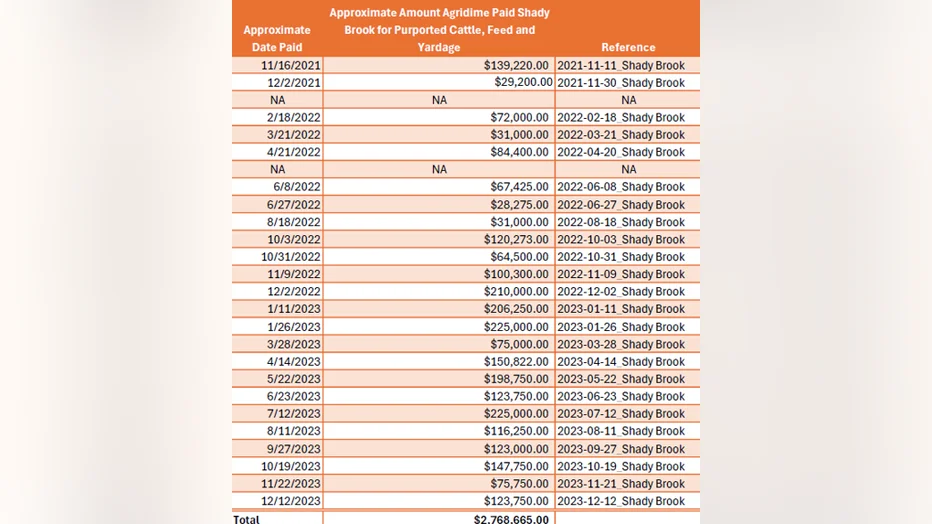
Between 2022 and 2023, Joshua Link and his wife, Tia Link, received more than $2.7 million in salaries and commissions, while another individual, Jed Wood, received over $2.4 million. In a separate scheme to defraud Agridime itself, the brothers submitted fraudulent payment requests described as feed and yardage expenses between November 2021 and January 2024. These requests caused Agridime to pay more than $2.7 million to Shady Brook Farms, a company controlled by Jason Link, even though the services were never provided and another company had already supplied and been paid for the cattle feed.
Context: A Growing Problem of Agricultural Investment Fraud
The Link brothers’ convictions come amid heightened scrutiny of alternative investment schemes, particularly those tied to agriculture. Cattle investment programs often attract retail investors seeking stable returns outside traditional markets, but they can be ripe for abuse when oversight is lax. The Agridime case echoes previous agricultural Ponzi schemes, such as those involving cattle feedlots or farmland, where promoters promise tangible assets but fail to deliver.
According to the U.S. Attorney’s Office for the Northern District of Texas, the scheme specifically targeted “Main Street Americans” who believed they were investing in cattle contracts. U.S. Attorney Ryan Raybould stated, “These defendants preyed directly on Main Street Americans who believed they were investing in cattle contracts. Instead of building a legitimate cattle business, the Link brothers ran a high-tech Ponzi scheme, siphoning away hard-earned life savings to build luxury retreats and line their own pockets.”
Regulatory Gaps and Investor Vulnerability
The case highlights the challenges regulators face in policing investment offerings that straddle commodities and securities. While the Commodity Futures Trading Commission (CFTC) and the Securities and Exchange Commission (SEC) have jurisdiction over many such schemes, fraudulent operators often exploit ambiguities to evade detection. The FBI and federal prosecutors in Texas ultimately led the investigation, underscoring the multi-agency effort required to dismantle complex frauds.
For victims, the convictions bring a measure of justice but not necessarily restitution. With more than 2,200 individuals defrauded, many of whom may have lost significant portions of their savings, the road to recovery remains uncertain. The government’s case focused on proving fraud and money laundering, but asset forfeiture and restitution will be addressed at sentencing.
Perspective: Deterrence and the Fight Against Financial Fraud
The convictions send a strong deterrent message to would-be fraudsters, particularly those who dress up schemes in the language of tangible assets like cattle. Federal prosecutors have increasingly prioritized cases involving retail investors, especially where elderly or unsophisticated individuals are targeted. The Link case also illustrates the importance of whistleblowers and internal controls—the separate fraud against Agridime itself suggests that even within a fraudulent enterprise, greed can lead to additional crimes.
As sentencing approaches, attention will turn to whether the brothers cooperate with authorities to recover assets. The case also serves as a reminder to investors to conduct thorough due diligence on any investment promising fixed returns from physical commodities. With digital marketing and social media enabling broader reach for such schemes, the need for investor education and regulatory vigilance is greater than ever.
What’s Next
Sentencing is scheduled for March 4, 2027. Each count carries potential decades in federal prison, though actual sentences will depend on guidelines and judicial discretion. The U.S. Attorney’s Office has not announced whether additional charges are pending against other individuals involved in Agridime, including Tia Link and Jed Wood, who are named in court documents but not among those convicted this week.
For now, the verdict closes a chapter in one of the largest cattle fraud cases in recent Texas history, but the broader fight against financial fraud continues. Investors and regulators alike will be watching closely to see what lessons emerge from the Agridime collapse.
Comments