
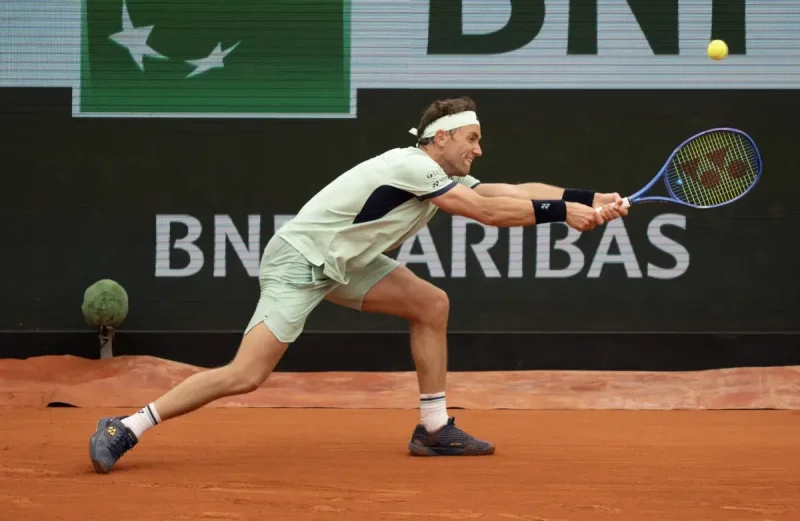
Underdog Turned Favorite: Faria Carries Momentum into Estoril Second Round
Portuguese tennis fans have their eyes fixed on Clube de Ténis do Estoril as home hope Jaime Faria takes on Botic van de Zandschulp in Tuesday’s Round of 32 at the Millennium Estoril Open. The 88th-ranked Faria enters the match as a slight favorite, with bookmakers pricing him at -145 odds, implying a 59.2% chance of victory. The match, scheduled for July 21, marks another chance for the 24-year-old to prove his recent clay‑court surge is no flash in the pan.
Faria’s 2026 record stands at 20‑8, a stark contrast to Van de Zandschulp’s 15‑15. On the season, Faria has won 63% of his matches, while his opponent has hovered around .500. The Portuguese player has also been dominant in sets: 50‑29 versus the Dutchman’s 43‑37. Even the micro‑stats favor Faria in several key areas, particularly on second‑serve points, where he has won 47.58% compared to Van de Zandschulp’s 44.53% over the past six months. He has also converted break points at a slightly higher rate (30.23% vs. 28.66%) and saved break points more frequently (56.76% vs. 55.74%).
But odds and form can be deceiving. Van de Zandschulp, ranked 55th, has played the vast majority of his matches on the main ATP Tour, while many of Faria’s wins have come at Challenger and ITF events. The Dutchman’s average opponent ranking this year is around 110, compared to roughly 210 for Faria — a gap that suggests Van de Zandschulp has faced significantly tougher competition week to week.
Recent Momentum: From Gstaad Semifinal to Home Court Advantage
Just five days before the Estoril match, Faria reached the semifinals of the ATP Swiss Open in Gstaad, where he ultimately fell to world No. 13 Casper Ruud in straight sets. That run included a gutsy three‑set win over Swiss legend Stan Wawrinka in the quarterfinals — a victory that signaled Faria’s growing comfort on clay against experienced opponents. Before Gstaad, Faria also posted a 3‑1 record at Wimbledon qualifying and the main draw, taking a set off Zizou Bergs before bowing out in the first round.
Estoril’s clay surface suits Faria’s game. The Portuguese has a 60.49% win rate over the past year (49‑32), with his strongest results on outdoor hard and clay. On indoor hard, his weakest surface, his win rate drops to 33%. Van de Zandschulp, by contrast, has historically performed best on indoor hard courts (61% win rate) but is less comfortable on clay. That surface divergence could tilt the match in Faria’s favor, especially if the home crowd provides an additional boost.
The two players have never met before in an official ATP match, making this a genuine first‑time encounter. Van de Zandschulp’s experience in high‑pressure moments on the main tour cannot be discounted, but Faria’s form and surface alignment give him the edge.
What’s at Stake: A Career‑Defining Run for Faria
For Jaime Faria, this is more than just a second‑round match. A win over Van de Zandschulp could propel him into the last 16 of his home ATP 250 event, where a potential meeting with a seed looms. After years grinding on the Challenger circuit, Faria has broken into the top 100 for the first time this season, climbing to a career‑high ranking of 88. A deep run in Estoril would solidify his place among Portugal’s leading tennis exports and likely push him closer to the top 50.
Faria’s rise is also a bright spot for Portuguese tennis, which has long relied on veterans like João Sousa. Sousa, now 37, has slipped outside the top 200, leaving a vacuum that Faria is eager to fill. His aggressive baseline game, combined with a willingness to step into the court on second serves, has made him a legitimate threat on the surface that suits his timing best.
Van de Zandschulp, despite his ranking advantage, is in a precarious position. The 28-year-old has lost five of his last nine matches on clay this year and looked shaky in recent Masters 1000 events. His first‑serve percentage has dipped below 60% in two of his last three losses, a vulnerability Faria’s return game — which wins 48.25% of points against opponents’ second serves — can exploit.
The Pressure of Probability
Data from match prediction models, including those from Data Skrive and MatchStat, give Faria a probability of winning between 52% and 59%, depending on the metric. “Jaime has had a small but meaningful edge on second‑serve points won,” notes one analyst, pointing out that Faria’s resilience in rallies behind weaker deliveries could decide tight games. Deciding‑set win rates also favor the Portuguese: he has won 60% of his final sets over the last year, while Van de Zandschulp has won just 37%.
But those numbers are sensitive to competition quality. The Dutchman’s recent wins include a three‑set battle against world No. 38 Alexandre Müller in Rome, a level of opposition Faria has not regularly faced. If Van de Zandschulp can impose his first‑serve advantage — he wins 27.13% of first‑serve return points, better than Faria’s 24.00% — the odds could flip quickly.
Broader Implications: A Changing of the Guard on Clay?
Faria’s rise mirrors a broader trend in men’s tennis, where younger players from smaller tennis nations are breaking through on clay. Estoril, alongside tournaments in Gstaad, Kitzbühel, and Bastad, often serves as a proving ground for players on the cusp of the top 50. Faria fits that profile: aggressive, athletic, and increasingly comfortable under pressure.
His Gstaad semifinal performance, where he hung with Ruud for a set before losing 6‑3, 6‑4, showed that he can compete with top‑20 talent. The key now is consistency. A loss to van de Zandschulp would be a setback, but not a disaster. A win, however, would set up a possible meeting with No. 3 seed Pedro Martínez or Luciano Darderi, either of whom would provide another demanding test.
For Van de Zandschulp, the stakes are different. He is fighting to stay inside the top 60 and avoid a rankings slide. At 28, he has time to rebuild, but losses to players ranked outside the top 80 on a favorable surface raise questions about his ceiling.
What Comes Next
Tuesday’s winner will face either Martínez or Darderi in the Round of 16, likely on Thursday. The tournament, held at the Clube de Ténis do Estoril in the coastal resort town of Estoril, has a history of producing surprises. In 2023, qualifier Marco Cecchinato reached the final; in 2024, wildcard João Sousa made a quarterfinal run before falling to eventual champion Stéfanos Tsitsipás.
Faria may be the favorite on paper, but clay matches are rarely decided by numbers alone. The crowd, the wind off the Atlantic, and the weight of home expectation can tip a close contest. One thing is certain: this is the biggest match of Faria’s young career — and he seems ready to play it.
For more tennis analysis, read our preview of Krejčíková Captures Athens Open Title, Ending Sakkari’s Home Dream and check out Liverpool FC Women Sign Mao Itamura: Eredivisie Player of the Year Joins from Feyenoord for another rising star’s story.
Comments