
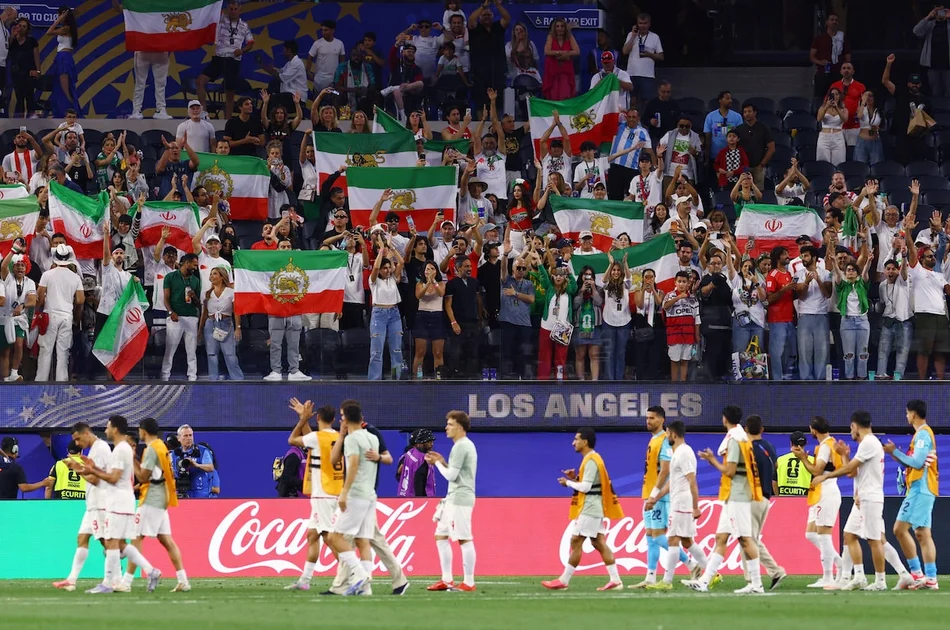
Flags and Defiance at SoFi Stadium as Iran Kicks Off World Cup Campaign
Iran’s World Cup campaign began Monday night at SoFi Stadium in Inglewood, California, against New Zealand — but the match was overshadowed by acts of political defiance and a historic diplomatic breakthrough. Dozens of fans brought pre-revolutionary Iranian flags, featuring the lion-and-sun emblem, into the stadium despite a court‑upheld FIFA ban, while outside the venue protesters called for regime change.
Inside the stadium, the tension was palpable. As matchday protocols called for the unfurling of the current Iranian flag on the pitch, a group of supporters on the far side held up their own pre-revolution flags in a pointed counter‑display. Security staff, who had been instructed to confiscate such items, largely left them unchallenged. Earlier, six fans wearing white T‑shirts with the lion‑and‑sun emblem were stopped at the gate and told to cover or reverse their shirts before being allowed entry. One of them, Mehdi, told reporters: “This is the true flag of my country,” while a younger boy added, “It means freedom.”
The flag dispute came to a head hours before kick‑off, when a federal judge in Los Angeles rejected an emergency petition by an Iranian fan who argued that FIFA’s prohibition violated free speech. FIFA had won a legal hearing enabling it to lawfully prohibit the flags on the grounds that they carry a political message and could cause disturbances. Despite that ruling, many fans successfully brought the banners inside.
A World Cup Against the Backdrop of War and Peace
The match was played under extraordinary geopolitical circumstances. On the same day the Iranian team landed in Los Angeles from their base camp in Tijuana, Mexico, U.S. President Donald Trump and Pakistani Prime Minister Shehbaz Sharif announced that a peace deal to end the U.S.-Iran war would be signed Friday in Switzerland. The conflict, which began in late February with joint U.S.‑Israeli strikes on Iran, upended Iran’s World Cup preparations: the team moved its training camp from Arizona to Mexico last month, and several members of its soccer federation were denied U.S. visas, forcing last‑minute travel adjustments.
Iran coach Amir Ghalenoei acknowledged the strain at a pre‑match press conference, saying the travel and visa issues “negatively affected the squad.” Still, he expressed hope that “football will bring about joy and enjoyment, and bring closer the cultures and countries.” The team arrived in the U.S. to a warm send‑off from fans in Tijuana, but the atmosphere in Los Angeles was more charged. Outside the stadium, a group of Iranian‑American protesters rallied, holding placards reading “No Shah – No Mullah in Iran – Regime Change by Iranians” and displaying photos of athletes allegedly killed after being arrested by the Iranian government during the 2025 protests.
Mojgan Ramezani, 56, an Iranian‑American protester, told Reuters: “They’re holding hostage their own people.” The demonstrations underscored the deep divisions within the Iranian diaspora over the government in Tehran, even as the U.S. and Iran move toward a formal peace.
Broader Implications: Football as a Stage for Protest and Diplomacy
The events at SoFi Stadium reflect a broader trend of football tournaments becoming arenas for political expression — especially for Iranian fans, who have used the World Cup to voice dissent since at least the 2022 edition in Qatar. The pre‑revolutionary flag, a symbol of the era before the 1979 Islamic Revolution, has been banned by FIFA in previous tournaments for its political connotations. That organisers largely failed to enforce the ban on Monday suggests that grassroots defiance may be outpacing institutional controls.
At the same time, the coincidence of a peace deal with Iran’s opening match highlights the unique power of sport to intersect with high‑stakes diplomacy. The U.S.‑Iran agreement, once signed, could reshape not only geopolitical relations but also the travel and security environment for future international tournaments. Iran still has group‑stage matches to play in the U.S. — a prospect that seemed impossible during the peak of the conflict.
For now, Iran’s World Cup journey remains a story of resilience under political and logistical pressure. The team, which has never met New Zealand at a World Cup before, faces a challenging road ahead. Elsewhere in the tournament, Cape Verde's 40-Year-Old Goalkeeper Vozinha Becomes World Cup Hero After Shocking Spain reminded fans that football can still produce stunning surprises.
But Monday night in Inglewood, the real drama was off the pitch. The sight of the lion‑and‑sun flags waving in defiance of a court order, the roar of protesters outside, and the announcement of peace from across the Atlantic together made this more than a football match — it was a snapshot of a nation in transition, played out in the stands as much as on the field.
As the tournament progresses, all eyes will be on whether the peace deal holds and whether Iranian fans will continue to use the World Cup stage to make their voices heard. For now, the image of fans holding up that banned flag is likely to remain one of the enduring symbols of the 2026 World Cup.
Comments