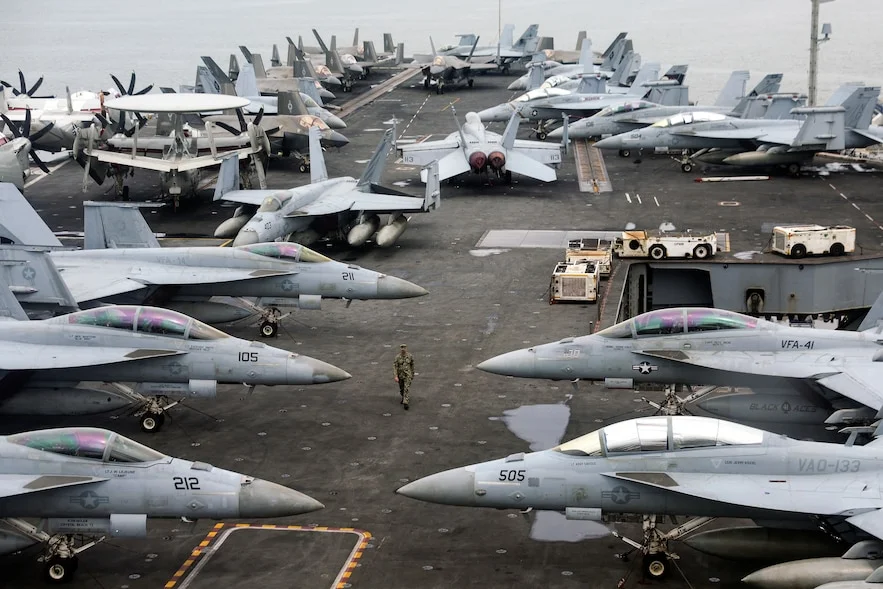
A History Rooted in Conflict
The relationship between Iran and the United States Navy is one of the most persistently tense maritime rivalries in modern geopolitics. Spanning more than four decades, this confrontation has unfolded primarily in the Persian Gulf, the Strait of Hormuz, and the Gulf of Oman — some of the world's most strategically vital waterways. What began as a ideological and political rupture following the 1979 Islamic Revolution has evolved into a complex pattern of military posturing, naval incidents, and proxy confrontations that continue to shape regional security today.
From the Tanker War to Operation Praying Mantis
The first direct military clash between the two navies occurred during the 1980s, when the United States became increasingly involved in the Iran-Iraq War. As Iran began targeting oil tankers in the Persian Gulf, the US launched Operation Earnest Will in 1987 to escort Kuwaiti tankers flying the American flag. Tensions escalated dramatically in April 1988 with Operation Praying Mantis, a large-scale US naval assault triggered by the mining of the USS Samuel B. Roberts. American forces destroyed two Iranian oil platforms and sank or damaged several Iranian vessels, making it the largest US naval surface engagement since World War II.
The Strait of Hormuz: A Perpetual Flashpoint
The Strait of Hormuz, through which roughly 20% of the world's oil supply passes, has become the defining arena for US-Iran naval tensions. Iran has repeatedly threatened to close the strait in response to international sanctions and military pressure, a move that would send global oil markets into turmoil.
Gunboat Diplomacy and Harassment Tactics
The Islamic Revolutionary Guard Corps Navy (IRGCN), a separate branch from the regular Iranian Navy, has been at the center of most modern confrontations. IRGCN speedboats have repeatedly approached US naval vessels in provocative maneuvers, coming dangerously close, shadowing destroyers, and in some cases pointing weapons at American sailors. In January 2016, Iranian forces briefly detained ten US Navy sailors whose patrol boats had drifted into Iranian territorial waters, sparking a diplomatic incident that was resolved within 24 hours but nonetheless highlighted the fragility of restraint in the region.
Seizures and Tanker Incidents
In 2019, following the Trump administration's withdrawal from the Iran nuclear deal and the reimposition of sweeping sanctions, the Persian Gulf witnessed a dramatic escalation. Iran seized several oil tankers and was accused of attacking others with limpet mines. The US responded by forming a maritime coalition and increasing naval patrols in the region. Iran also shot down a US RQ-4 Global Hawk surveillance drone it claimed had violated its airspace — a claim the US disputed — bringing the two nations to the brink of direct military confrontation.
Drones, Technology, and the Evolving Threat
The nature of the confrontation has evolved significantly with the rise of unmanned systems. Iran has invested heavily in drone technology, deploying maritime drones and unmanned surface vessels capable of threatening naval assets. The US Navy has responded by deploying its own unmanned surface vessels and establishing Task Force 59, specifically designed to integrate artificial intelligence and drone technology into Gulf operations.
Drone Warfare in Practice
In 2023 and into 2024, Iran-backed Houthi forces in Yemen — equipped with Iranian-supplied drones and missiles — began targeting commercial shipping in the Red Sea and Gulf of Aden. The US Navy, operating through Operation Prosperity Guardian, found itself intercepting dozens of drone and missile attacks, marking a significant expansion of the Iran-US naval confrontation beyond the Persian Gulf itself. American destroyers expended millions of dollars worth of advanced missiles to shoot down low-cost Iranian-designed drones — a cost-exchange dilemma that strategists in Washington found deeply concerning.
Diplomatic Dimensions and Nuclear Shadows
Every naval incident between Iran and the United States carries diplomatic weight that extends far beyond the immediate tactical situation. The status of the Joint Comprehensive Plan of Action (JCPOA) — the 2015 nuclear agreement — has repeatedly influenced the temperature of naval confrontations. When diplomacy advances, incidents tend to de-escalate. When talks collapse or sanctions tighten, provocations increase.
The Role of Regional Alliances
The US Navy does not operate in the Gulf alone. Its presence is anchored by the Fifth Fleet headquarters in Bahrain, strong partnerships with Saudi Arabia, the United Arab Emirates, and Israel, and bilateral defense agreements across the Gulf Cooperation Council. Iran views this military architecture as an existential encirclement, fueling its determination to maintain asymmetric naval capabilities as a deterrent and a bargaining chip.
Looking Ahead: Managing an Enduring Rivalry
Despite decades of hostility, the United States and Iran have never fought an all-out war — a testament to the restraint exercised on both sides even amid intense provocation. Both nations appear to understand the catastrophic consequences of miscalculation in such a narrow, oil-rich waterway. Military hotlines, back-channel diplomacy, and international maritime law have all served as guardrails.
Yet the structural conditions driving the conflict — Iranian regional ambitions, American alliance commitments, energy security imperatives, and ideological antagonism — show no signs of disappearing. As drone technology proliferates and proxy networks expand, the US Navy and Iran will likely remain locked in a dangerous maritime competition that demands constant diplomatic attention alongside military readiness.
Comments