
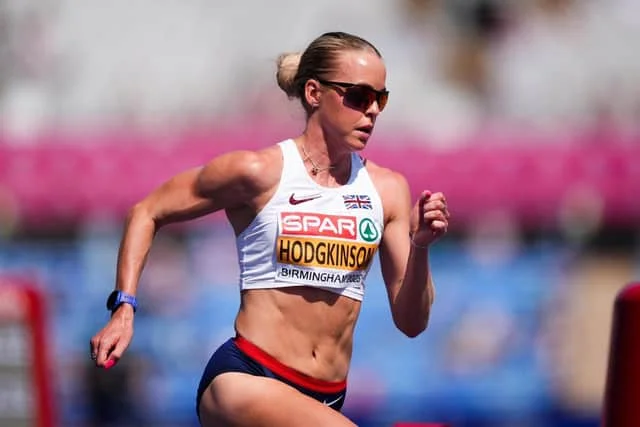
Hodgkinson's Absence Looms Over Diamond League Final and Next Week's Ultimates
The women’s 800m at the Diamond League final in Brussels on Saturday was always going to be a blockbuster, but it lacked the one name that has defined the event for the past three seasons. British Olympic champion Keely Hodgkinson was absent, withdrawing with a minor niggle, and her presence was felt as much in the empty lane as in the crowd’s buzz. In her place, Switzerland’s Audrey Werro won a thrilling final in a meeting record of 1 minute 54.75 seconds, holding off Dutch star Femke Broeders-Bol by just 0.06 seconds. It was a result that underlined both the depth of the current 800m generation and the vacuum left by the world’s best.
Werro, 22, has been the revelation of the 2026 season, running the third, fourth, and fifth fastest times in history this year. Her victory in Brussels was her latest statement, and she acknowledged that Hodgkinson’s absence changed the dynamic. “I felt her coming,” Werro said of Broeders-Bol’s late surge, “and I really enjoyed this battle because it pushes me to always work and not to get in my comfort zone. I just keep in mind that one day I will get beaten. But now I just enjoy the first place.” Broeders-Bol, who has finished second to Werro repeatedly this season, echoed the sentiment: “I thought I had it. I’ve never been so close.”
The two will have one final showdown at the inaugural Ultimate Championships in Budapest next week, where the winner takes home $150,000. And then, according to Hodgkinson’s coach, Trevor Painter, the Olympic champion will be back. “She has recovered from a minor niggle and will be lining up too,” Painter confirmed. That news sets up the tantalizing prospect of the season’s definitive 800m: Hodgkinson vs. Werro vs. Broeders-Bol on a stage designed to crown the ultimate champion.
Why Hodgkinson’s Absence Matters
The 800m has been the most compelling women’s event in athletics this season, and Hodgkinson has been at its center since her Olympic gold in Paris. Her rivalry with Werro has been the sport’s most anticipated matchup, with the two trading wins across the Diamond League circuit and at the World Championships. Hodgkinson’s withdrawal from Brussels was a precaution, but it denied fans a preview of what Budapest might offer.
The timing is delicate. With the Ultimate Championships—a new, winner-take-all format with a $150,000 first prize—just days away, every athlete is managing fatigue and injuries accumulated over a long season. Georgia Hunter Bell, Britain’s other middle-distance star, spoke candidly after finishing fourth in the 1500m in Brussels: “I was hoping for a higher finish but it’s been a long, hard season. That was my 19th race of the year and I have done three championships so I am starting to feel it in my body.” Her words echoed the strain felt across the sport, where the calendar has been extended by new events like the Ultimates, and the margin between triumph and collapse is ever thinner.
Hunter Bell, who won three major golds this year (World Indoor 1500m, Commonwealth 800m, European 1500m), admitted she struggled to find adrenaline in Brussels. “I am struggling a little bit, even mentally to get my adrenaline up again week in, week out,” she said. Her fourth-place finish in the 1500m, won by Poland’s Klaudia Kazimierska in a personal best of 3:54.05, was a reminder that even the most consistent champions are not immune to the toll of a relentless schedule.
The New Order in Women’s 800m
Hodgkinson’s dominance has shaped the women’s 800m narrative, but 2026 has signaled a shift. Werro’s rise has been meteoric, and her ability to hold off a charging Broeders-Bol in the final straight has become a trademark. Broeders-Bol, a former 400m hurdler who has transitioned impressively to the two-lap event, has pushed Werro closer each time they meet. In Brussels, she came within a fraction of a second, suggesting that a breakthrough might be imminent.
“You should ask her because I would like to know,” Broeders-Bol joked when asked what makes Werro so good. “But I think first of all she’s very strong in her mind. I think she’s a real fighter. She really goes for it with no fear and just all in. But I think just her last 200m is phenomenal. I think I could learn something from it but I think it’s her mind combined with her physical.”
That combination will be tested in Budapest, where the Ultimates will feature a winner-take-all format that rewards aggression over caution. For Hodgkinson, returning from injury, the challenge will be to reclaim her place atop a podium that now includes two women who have beaten her in her absence. The rivalry is now a three-way battle, and the stakes are higher than ever.
What It Means for the Ultimate Championships
The Ultimate Championships, scheduled for September 11-13 in Budapest, is a new competition designed to showcase athletics in a more dramatic, fan-friendly format. With a $150,000 first prize in each event, the incentive is clear. For track and field, it represents a bold experiment in a season that has already seen the Diamond League final break meeting records.
The women’s 800m is set to be the marquee event of the championships, and the presence of Hodgkinson, Werro, and Broeders-Bol ensures a head-to-head that could define the season. Hodgkinson’s coach, Trevor Painter, has confirmed her intention to compete, though her fitness remains a question after the minor injury. Her return to form is not guaranteed, but the British champion has shown throughout her career that she thrives on the biggest stages.
For fans, the Ultimates offer a rare opportunity to see the world’s best in a high-stakes, winner-take-all environment. The Diamond League final in Brussels demonstrated the appeal: record-breaking performances, tight finishes, and a sense of drama that traditional meetings sometimes lack. The 800m in Budapest promises even more, with a trio of athletes who have pushed each other to historic times all season.
A Season of Change and Fatigue
The 2026 athletics season has been one of transition. The emergence of new stars like Amy Hunt, who has become the face of British sprinting after winning four European golds, has been matched by the challenges of a congested calendar. Hunt’s second-place finish in the 100m in Brussels (11.06 seconds) was another step in her development, and she declared, “I am 24 and on the up and up and up. I am not afraid of the other girls.” Her confidence reflects a sport that is refreshing itself, but also straining under the weight of its own ambitions.
Georgia Hunter Bell’s fatigue is emblematic of the broader issue. As she said, “It’s been an amazing season... three major championship golds, a bunch of Diamond League wins, British champs, like all this stuff. So you hit this point in the season, and it is hard to find that adrenaline.” The Ultimates, as the season’s finale, will test not just talent but endurance—physical and mental.
For Hodgkinson, the road to Budapest will be a race against time. For Werro and Broeders-Bol, it is an opportunity to prove that their success is not merely a product of Hodgkinson’s absence. The narrative of the women’s 800m has never been richer, and the season’s final chapter is set to be its most dramatic.
Comments