
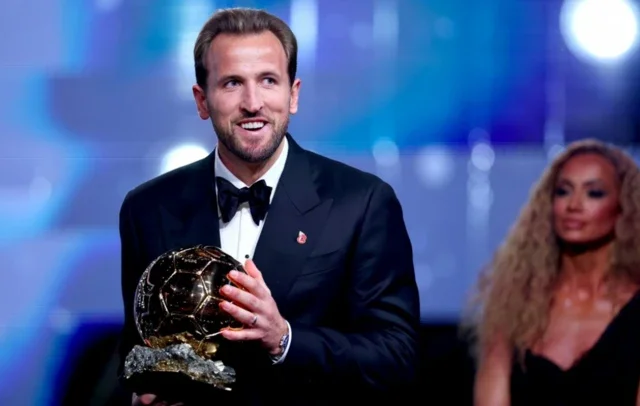
Harry Kane Ends 25-Year Wait for English Ballon d'Or Glory
Harry Kane has been crowned the 2026 Ballon d'Or winner at a ceremony in London, becoming the first English player to lift football's most prestigious individual award since Michael Owen in 2001. The England captain, who was among the favourites heading into Monday night's event at the first Ballon d'Or ceremony hosted in the English capital, finally broke a 25-year drought for English football.
Kane saw off competition from a star-studded nominee list that included Real Madrid's Jude Bellingham, Arsenal's Declan Rice, Kylian Mbappe, and Lamine Yamal. The 33-year-old's triumph marks the fifth time an Englishman has won the award and ends a wait that had stretched across a generation.
A Night of History in London
The ceremony, held on Monday, October 26, brought football's elite to London for the first time in the award's history. Kane's victory was the headline moment of an evening that also saw three English players among the 30 nominees—Kane, Bellingham, and Rice—reflecting the current strength of English football on the global stage.
Kane's win adds the sport's ultimate individual honour to a career that has long been defined by prolific goalscoring but had, until now, lacked the Ballon d'Or recognition. His triumph comes at the age of 33, making him one of the older first-time winners in recent memory.
The Long Road Since Michael Owen
Owen's 2001 Triumph
The last Englishman to win the Ballon d'Or was Michael Owen, who claimed the prize in 2001 at just 22 years and four days old—still the second-youngest winner in the award's history. Owen received 176 points to beat Real Madrid legend Raul (140 points) after helping Liverpool win a treble of the FA Cup, UEFA Cup, and League Cup. He scored 24 goals that season, including two in the FA Cup final, and his electric pace made him one of the most exciting players in world football.
Near Misses Along the Way
Since Owen's win, English football has come close on several occasions without breaking through. Frank Lampard finished second in 2005, with Steven Gerrard third, as Ronaldinho took the prize. David Beckham was runner-up in 1999, and Gary Lineker finished second in 1986. More recently, Jude Bellingham placed third in 2024, hinting at the new generation's potential.
The Full List of English Winners
Kane joins an exclusive club of English Ballon d'Or recipients:
- Stanley Matthews (1956) – The inaugural winner, aged 41, while at Blackpool.
- Bobby Charlton (1966) – Crowned after England's World Cup triumph on home soil.
- Kevin Keegan (1978, 1979) – The only Englishman to win the award twice, during his time at Hamburg.
- Michael Owen (2001) – The last before Kane, following Liverpool's cup treble.
- Harry Kane (2026) – The latest winner, ending a 25-year wait.
What Kane's Win Means for English Football
Kane's victory is more than a personal milestone; it signals a broader resurgence of English football on the individual stage. With Bellingham and Rice also among the nominees, England now boasts a depth of world-class talent that has been rare in the post-Owen era. The fact that three English players were shortlisted for the 2026 award underscores the country's growing influence at the highest level of the game.
The win also puts to rest a long-standing narrative about English players being overlooked for major individual honours despite strong club and international careers. Lampard, Gerrard, and Beckham all came close but fell short; Kane has now broken the barrier.
For Kane personally, the award caps a career that has seen him become one of the most consistent strikers of his generation. At 33, he becomes one of the older first-time winners, proving that persistence and longevity can be rewarded in an era increasingly dominated by younger stars like Yamal, who at 19 is still without a Ballon d'Or.
As English football basks in the glow of Kane's achievement, attention will quickly turn to whether this is the start of a new era of English dominance—or simply a rare moment of individual brilliance. With Bellingham and Rice already knocking on the door, the next English winner may not be 25 years away.
Comments