A Caribbean Nation Sitting on an Oil Goldmine
Guyana, a small South American nation of fewer than 800,000 people, has quietly become one of the most consequential oil producers in the Western Hemisphere. In just under a decade, offshore discoveries in the Stabroek Block — operated by ExxonMobil in partnership with Hess Corporation and China's CNOOC — have catapulted the country into energy headlines worldwide. With recoverable reserves now estimated at more than 11 billion barrels of oil equivalent, Guyana holds one of the largest offshore oil discoveries made in the past two decades.
Production has been scaling rapidly. Guyana currently pumps over 600,000 barrels per day and is on track to surpass one million barrels per day within the coming years — a staggering output for a country of its size. The government of President Irfaan Ali has positioned this windfall as a once-in-a-generation opportunity to transform one of South America's historically poorest nations into a prosperous, diversified economy.
The Chevron-Hess Deal Adds International Intrigue
The geopolitical and corporate stakes surrounding Guyana's oil have been amplified by Chevron's landmark acquisition of Hess Corporation. The $53 billion deal, finalized in 2024, was partly driven by Hess's prized 30% stake in the Stabroek Block. However, ExxonMobil and CNOOC have asserted preemption rights, potentially allowing them to block Chevron from acquiring Hess's Guyana assets. This corporate dispute has drawn international arbitration proceedings and placed Guyana's oil sector at the heart of a major Wall Street and energy industry battle. The outcome could reshape ownership structures in one of the world's most valuable offshore oil plays.
Why Guyana Matters Beyond Oil
A GDP Transformation Without Precedent
The numbers are extraordinary. Guyana's GDP growth rate has been among the highest in the world for several consecutive years, consistently posting double-digit expansion — a rate that most economists associate with post-war reconstruction booms, not peacetime development. The International Monetary Fund and World Bank have repeatedly flagged Guyana as a case study, both in terms of its extraordinary growth potential and the inherent risks of what economists call the "resource curse" — the tendency for resource-rich nations to suffer institutional decay, inequality, and economic volatility.
The Guyanese government has established a Natural Resource Fund to manage oil revenues responsibly, but critics and civil society organizations have raised concerns about transparency, equitable distribution, and whether the country's infrastructure and institutions are developing quickly enough to absorb the influx of capital. Health, education, and housing remain persistent challenges for large portions of the population, particularly Indigenous communities and those living in rural regions.
The Venezuela Border Dispute Escalates Tensions
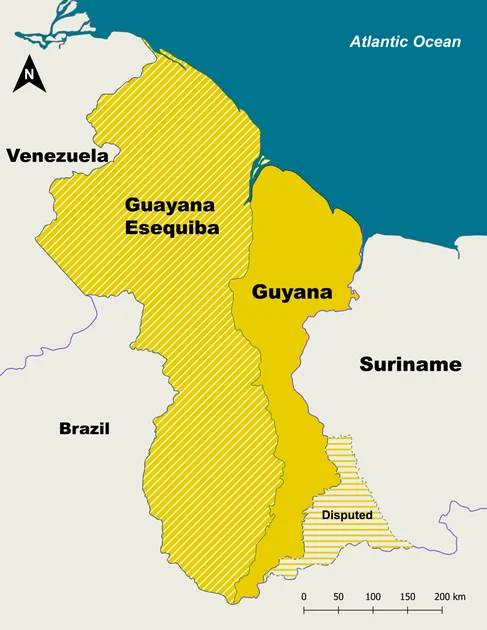
Guyana's rise has not gone unnoticed by its neighbors — particularly Venezuela. The long-standing territorial dispute over the Essequibo region, which covers roughly two-thirds of Guyana's land area and includes significant oil and mineral resources, has intensified in recent years. In late 2023, Venezuela held a controversial referendum in which voters were asked to support annexing the territory, a move condemned internationally as provocative and illegal under international law. The International Court of Justice has asserted jurisdiction over the matter, and the case is ongoing.
The dispute has prompted Guyana to strengthen its defense relationships with the United States, which has conducted joint military exercises in the country and reaffirmed its support for Guyanese sovereignty. The situation adds a layer of geopolitical complexity that extends far beyond the bilateral relationship, touching on regional stability, U.S.-Venezuela relations, and international norms around territorial integrity.
The Bigger Picture: Guyana as a Barometer for the Energy Transition
Guyana's oil story unfolds against the backdrop of a global energy transition that is accelerating but remains uneven. For wealthy nations debating the pace of decarbonization, Guyana presents an uncomfortable question: should developing countries be denied the economic benefits of fossil fuel revenues that industrialized nations used for their own development over the past century?
President Ali has made this argument forcefully on international platforms, including at climate summits, insisting that Guyana's oil revenues are essential for lifting its population out of poverty and funding investments in renewable energy and climate resilience. The country has pledged to keep a significant portion of its forests — among the most biodiverse in the world — intact, and has entered into international agreements to monetize these carbon sinks.
For investors and energy markets, Guyana represents a rare combination of low-cost production, stable institutional frameworks, and significant growth runway. As global energy security concerns grow — particularly in the context of supply disruptions, Middle Eastern tensions, and the ongoing volatility in commodity markets — Guyana's role as a reliable Western Hemisphere supplier has gained strategic importance. With global financial markets already on edge, as reflected in 10-Year Treasury Yield movements and broader economic signals, the stability of new oil-producing nations like Guyana becomes an increasingly watched variable.
What happens in Georgetown's government ministries, in international courtrooms debating Stabroek preemption rights, and along the Venezuelan border will have consequences that ripple far beyond this small nation's shores. Guyana is no longer just a footnote in South American affairs — it is a central chapter in the story of 21st-century energy, geopolitics, and development.
Comments