
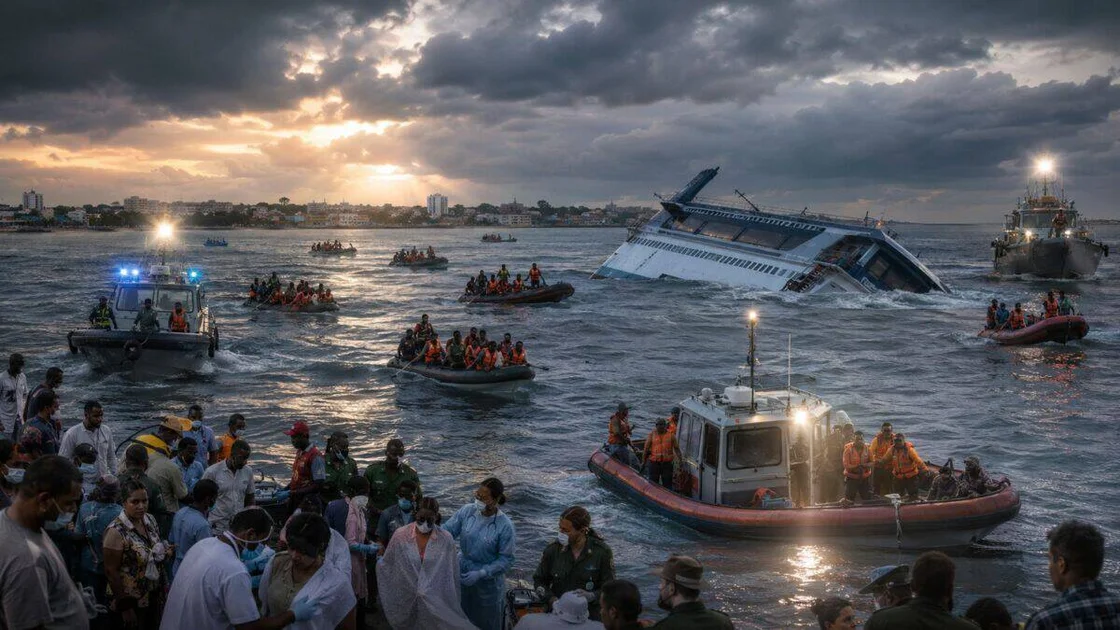
MV Barima Capsizes: Guyana Faces Its Worst Maritime Disaster in Decades
A catastrophic maritime tragedy has unfolded off the coast of Guyana, where the passenger ferry MV Barima capsized late Saturday night near Iron Punt, leaving at least 27 people confirmed dead and 83 others missing. The disaster, described by officials as one of the country’s worst maritime incidents, has triggered a massive search-and-rescue operation involving the Guyana Defence Force Coast Guard, Air Corps, private aircraft, fishing vessels, and civilian volunteers.
According to Prime Minister Mark Phillips, 69 people have been rescued so far. Speaking at a press conference on Monday, Phillips said authorities are now “confident” that 179 people were on board the vessel—far more than the 133 listed on the official manifest. “Our focus again is on finding people,” Phillips told reporters. “We still have hope.”
Divers continue to search the wreck site, and authorities have urged anyone who believes their loved ones may have been on the ferry to contact emergency hotlines. The MV Barima had departed Georgetown, the capital of this English-speaking South American nation, at approximately 3:15 p.m. on Saturday, bound for Port Kaituma in the oil-rich Essequibo region near the Venezuelan border. A distress call was received shortly after 11 p.m., prompting an urgent multi-agency response.
The incident has sent shockwaves through the country, drawing national attention to passenger ferry safety and emergency preparedness along Guyana’s coastal and river transport network. For many remote communities, these ferries are not a luxury but a lifeline—the only affordable link to markets, healthcare, and family.
Criminal Investigation Launched After Captain Tests Positive for Cannabis
Authorities have launched a criminal investigation after Public Works Minister Juan Edghill revealed that the ferry’s captain and the first engineer allegedly tested positive for cannabis. Both men are now in police custody. “I am outraged. We are talking about operational breaches; people will be dealt with,” Edghill said at a Sunday night press conference in Georgetown.
Edghill also expressed fury over the discrepancy between the ship’s manifest and the actual number of passengers. The official registry had listed 116 passengers and 17 crew members—133 people in total. But after cross-referencing survivors, officials discovered that only 35 of the 67 rescued individuals were on the passenger list. “We are talking about operational breaches; people will be dealt with,” Edghill repeated.
The MV Barima, Edghill had previously stated, was certified to carry 397 passengers and 284 tonnes of cargo, and was equipped with 250 lifejackets, two lifeboats, and six inflatable rafts. There was no mechanical problem reported, and the vessel had been operating within its legal limits—at least on paper. The discovery that the manifest was inaccurate has compounded the tragedy, hampering rescue coordination and causing anguish for families uncertain whether their loved ones were even on board.
Prime Minister Phillips described the news as “deeply concerning and shocking.” He added: “The government has ordered an urgent and comprehensive investigation involving the Guyana Police Force, the Guyana Defence Force, the Maritime Administration Department, and other technical maritime experts.”
Why the Disaster Matters: A Lifeline Severed
For the people of Guyana’s interior and coastal regions, ferries like the MV Barima are not merely a mode of transport—they are a critical piece of infrastructure. The route from Georgetown to Port Kaituma connects the capital with remote mining and agricultural communities in the Essequibo region. Without reliable air service, many residents depend entirely on these vessels for travel, commerce, and access to medical care.
The capsizing has exposed deep vulnerabilities in the nation’s maritime safety framework. While the MV Barima was certified to carry nearly 400 passengers, the fact that the manifest was so inaccurate raises serious questions about boarding procedures, oversight, and accountability. The positive drug tests for the captain and a crew member further erode public trust.
Edghill made clear the government’s stance on substance abuse among crew. “We have zero tolerance for members of the crew drinking or smoking while at work,” he said. “And for us to have positive tests from the captain… this is serious.”
The Human Toll: Survivors’ Accounts and Rescue Efforts
Survivors rescued in the immediate aftermath described scenes of chaos and desperation. Some reported clinging to floating debris or life rafts for hours before being spotted by fishing vessels or coast guard boats. Emergency responders transported survivors to medical facilities for evaluation, while additional teams expanded search efforts across nearby waters.
Among the rescued were children, women, and men, though officials have not released a detailed breakdown of survivors. The rescue operation has been hampered by murky waters, strong currents, and the sheer number of people unaccounted for. The Coast Guard, private aircraft, and civilian volunteers have all played a role in scouring the ocean for signs of life.
“We still have hope,” Phillips said, though the recovery of only 27 bodies—with 83 still missing—suggests the death toll may rise significantly in the coming days. The fact that the vessel capsized late at night, when many passengers would have been asleep or resting, may have contributed to the high number of casualties.
Broader Implications: Maritime Safety Under the Spotlight
The MV Barima disaster has renewed scrutiny of maritime safety not only in Guyana but across the Caribbean and South America. In many developing nations, aging vessels, lax enforcement of safety regulations, and corruption in licensing have long been cited as contributing factors to maritime accidents.
Guyana’s government has moved swiftly to distance itself from any negligence, promising a full and transparent investigation. But the incident comes at a particularly sensitive time for the country. Guyana has experienced an oil-driven economic boom in recent years, with massive offshore discoveries transforming its economy. However, the rapid growth has also strained infrastructure, including transport networks that serve remote communities.
Questions Over Emergency Preparedness and Confidence in Regional Travel
The disaster has also raised questions about emergency preparedness along Guyana’s coastline. While the initial response involved multiple agencies, the inaccurate manifest delayed a clear understanding of how many people were actually in danger. The incident highlights the need for improved passenger tracking systems, better crew vetting, and stricter enforcement of maritime regulations.
For the travel and tourism industry, the tragedy could have ripple effects. Guyana has been positioning itself as an ecotourism destination, attracting visitors to its rainforests, waterfalls, and wildlife. The perceived safety of coastal and river transport is a key factor in traveler confidence. As one travel industry analysis noted, the incident “has renewed broader discussions about vessel preparedness, emergency response capabilities, and the importance of maintaining confidence in maritime transportation.”
This is not the first time Guyana has faced a maritime disaster, but the scale of the MV Barima sinking—and the circumstances surrounding it—make it a defining moment. The government has vowed to hold those responsible accountable, but for the families of the missing and the dead, accountability will not bring back their loved ones.
What Happens Next: Investigation, Recovery, and Reform
In the coming days, the focus will remain on search and rescue, though hopes are fading for finding more survivors. Officials have said that dive teams will continue to search the vessel itself, which rests in relatively shallow waters near Iron Punt. The recovery of bodies is also a priority, both for forensic investigation and to provide closure to grieving families.
Parallel to the rescue operation, the criminal investigation is moving forward. The captain and first engineer remain in custody, and authorities are examining whether other crew members may have been aware of the manifest irregularities or the captain’s alleged drug use. The results of toxicology tests on additional crew members are pending.
The government has announced a comprehensive review of maritime safety protocols, including passenger counting procedures, crew drug testing policies, and vessel inspection schedules. Prime Minister Phillips has promised that “where negligence, misconduct or criminal wrongdoing is established, those responsible will face the full force of the law.”
Regional and International Reactions
The disaster has drawn condolences from neighboring countries and international organizations. Venezuela, despite its ongoing territorial dispute with Guyana over the Essequibo region, has offered assistance. The United States and United Kingdom have also expressed readiness to help, though the Guyanese government has so far managed the response with its own resources.
For the diaspora—many of whom rely on these ferries when visiting family—the tragedy has struck a deep chord. Social media has been flooded with messages of grief and anger, as well as demands for reform. Some have drawn comparisons to other recent ferry disasters in the developing world, where lax regulation and corruption have led to needless loss of life.
A Call for Systemic Change
The sinking of the MV Barima is not an isolated incident but a symptom of systemic failures that have long plagued maritime transport in many parts of the world. Overcrowding, falsified manifests, crew negligence, and inadequate safety equipment are recurring themes in similar tragedies from Bangladesh to the Philippines to West Africa.
In Guyana, the disaster may finally force the kind of regulatory overhaul that safety advocates have been calling for years. The country’s newfound oil wealth provides both the resources and the incentive to modernize its maritime sector. But progress will require political will, public pressure, and an end to the culture of impunity that allowed a captain to operate under the influence of drugs while carrying more than 100 passengers.
As the search continues and the full scope of the tragedy becomes clear, one question hangs over the nation: How many more lives must be lost before the system is fixed?
For now, Guyana mourns. Families hold vigils. And rescue workers push on, hoping against hope that someone, somewhere, is still alive.
This article was updated on July 21, 2026, with the latest official figures and statements from the Guyanese government.
Comments