
Fatal Crash at Tanagra Air Base
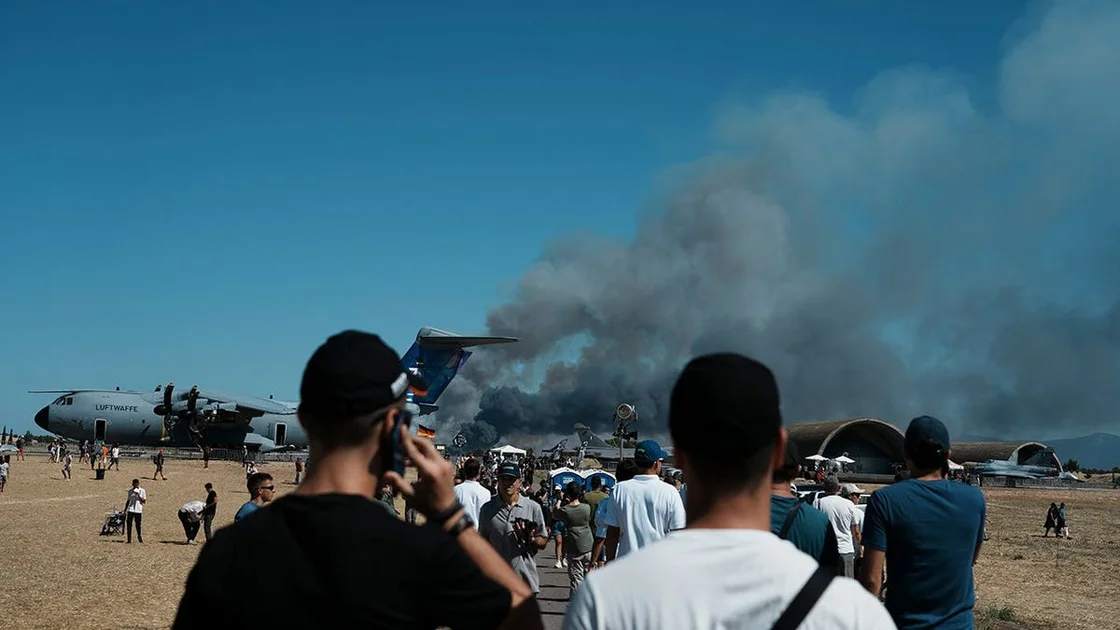
The Hellenic Air Force is in mourning after an F-4 Phantom fighter jet crashed during the Athens Flying Week air show at Tanagra Air Base on Saturday, September 5, 2026, killing both pilots on board. The aircraft went down around 15:00 local time in front of thousands of spectators, bursting into flames upon impact and igniting a fire that spread to a nearby wooded area.
Greek authorities confirmed that the bodies of the two pilots were recovered from the wreckage, though their names have not been released pending notification of next of kin. The crash occurred during a demonstration flight at the annual air show, a highlight of Greece‘s military aviation calendar that draws aviation enthusiasts from across the country.
Firefighting efforts were extensive, with 95 firefighters deployed to contain the blaze, supported by 29 fire engines, nine aircraft, and four helicopters. An emergency alert via the 112 system was issued at 15:34, urging residents in surrounding areas to take precautions due to smoke and the proximity of the fire. The blaze was brought under partial control later that evening, but the stark images of the burning wreckage and the pall of smoke over the base have shaken the nation.
Greek Defence Minister Nikos Dendias, who was attending the 90th Thessaloniki International Fair, immediately cut short his programme and returned to Athens to oversee the investigation. The air show was suspended following the incident, and the remaining scheduled performances were cancelled.
The Phantom’s Legacy and Risks
The F-4 Phantom, a twin-engine, all-weather fighter bomber that first entered service in the 1960s, has been a workhorse of the Hellenic Air Force for decades. Though long superseded by newer aircraft like the F-16 and Mirage 2000, Greece maintains a fleet of approximately 30 upgraded F-4E Phantoms, primarily used for ground attack and reconnaissance missions. The type is known for its ruggedness and versatility, but its age and the complexity of maintaining older platforms raise perennial questions about safety and readiness.
This is not the first fatal accident involving a Greek Phantom. In 2017, one pilot was killed when an F-4 crashed into the Ionian Sea during a training mission. In 2010, another Phantom went down in southern Greece, claiming the lives of both crew members. Each incident prompts internal reviews, but the underlying challenges of operating ageing aircraft persist.
Air shows, by their nature, carry inherent risks. Low-altitude manoeuvres, high-speed passes, and rapid attitude changes place immense stress on both airframes and pilots. While rigorous safety protocols are in place, the margin for error is minimal. The Athens Flying Week event, which celebrates Hellenic Air Force history and capabilities, has been held since 2012, and until Saturday had been free of major incidents.
The crash comes at a time of heightened regional tension. Greece has been actively modernising its armed forces with new acquisitions, including Rafale fighters from France and plans to purchase F-35 stealth jets from the United States. The F-4, however, remains a symbol of a generation of aircraft that many allies have already retired. Last year, Japan flew its final F-4 sortie, and the US Air Force removed the Phantom from active service decades ago. Greece’s continued operation of the type is a financial necessity, as the country balances defence spending with economic recovery.
Eyewitness Accounts and Aftermath
Videos circulating on social media show the Phantom performing a climbing roll before plunging toward the ground; some spectators are heard screaming as the fireball erupts. The footage, though harrowing, provides crucial data for investigators.
The Air Accident Investigation and Aviation Safety Board has launched a full inquiry, with a focus on mechanical failure, pilot error, and possible bird strikes. The flight data recorder and cockpit voice recorder—both recovered from the wreckage—are expected to play a central role in determining the cause. An initial assessment is likely within weeks, though definitive conclusions may take months.
Psychologists and military chaplains have been deployed to support the pilots‘ families and the airbase community, including many young recruits who witnessed the tragedy. The air show’s organisers, meanwhile, are reviewing future events to enhance safety, but experts stress that no measures can fully eliminate the inherent dangers of high-performance aviation.
This fatal accident also echoes a broader global conversation about the risks and rewards of military air displays. In 2022, a vintage fighter crashed at an airshow in Texas, killing two. In 2019, a Swiss F-18 crashed during a display, and the pilot tragically lost his life. Each incident prompts public scrutiny and soul-searching about whether such displays are worth the risk, even as proponents argue that they foster public support for the armed forces and inspire future pilots.
Implications for Air Show Culture and Public Perception
The Tanagra crash reignites a debate that has simmered for years: should military air shows continue? Proponents argue that these events are essential for community outreach, recruitment, and maintaining a connection between the public and the armed forces, particularly in countries like Greece where mandatory military service is still in effect. Opponents, however, question the necessity of performing hazardous manoeuvres over crowded areas, no matter how experienced the pilots may be.
Modern air shows in many countries enforce strict minimum altitude limits and require detailed safety plans, but such regulations are based on national and international guidelines, not hard and fast international law. The European Aviation Safety Agency (EASA) harmonises some rules, but military aviation is exempt from civilian oversight. That leaves individual air forces to decide and enforce their own safety standards, creating an uneven patchwork of risk management.
The immediate reaction in Greece is one of profound grief. Flags at military installations are flying at half-staff, and tributes have flooded social media, with many posts honouring the two pilots as heroes who died doing what they loved.
At the same time, the crash highlights the broader challenge facing all air forces: the conundrum of budget constraints versus modernisation needs. Greece has pledged to increase defence spending to 2% of GDP, and the Phantoms have already been slated for replacement in the coming years. But with geopolitical uncertainties in the Aegean and Eastern Mediterranean, the current fleet must keep flying until replacements are delivered.
A Nation’s Tribute and Lessons Forward
As the investigation unfolds, the Hellenic Air Force has declared a period of mourning. The air show season in Greece is now effectively over, with most remaining events cancelled. The public will look for answers in the months ahead: technical findings, human factors, and operational decisions will all be scrutinised.
But there is also a deeper, more human question: what can the aviation community learn from this tragedy? Every crash is a potential teaching tool, not just for investigators but for pilots, engineers, and show organisers worldwide.
The F-4 Phantom has served Greece faithfully for decades, and its ultimate legacy will be one of service, even as it now also carries the weight of loss. In memory of the two pilots, the Greek people have shown an outpouring of national unity. Their sacrifice will not be forgotten.
For now, the skies above Tanagra are silent, but the memory of that Sunday afternoon will linger. The air show will likely return next year—such events usually endure—but it will be with increased scrutiny and, perhaps, greater caution.
In the broader context, this crash is a stark reminder that military aviation remains a high-risk endeavour, even in peacetime, and that every flight is a calculated gamble. As officials continue their work, the international community watches and takes notes, hoping to prevent the next tragedy.
The wheels of investigation turn slowly, but for the families left behind, the pain is immediate. They, and the nation, await a shared truth, hoping that answers will pave the way to safer skies.
Comments