Early Life and Playing Career
Gordon Strachan was born on 9 February 1957 in Edinburgh, Scotland. Growing up in the Scottish capital, he developed a passion for football from an early age, eventually rising through the ranks to become one of the most technically gifted midfielders of his generation. His career spanned more than two decades, during which he earned a reputation for his energy, creativity, and competitive spirit on the pitch.
Aberdeen and the Emergence of a Star
Strachan's professional career began at Dundee before he made a defining move to Aberdeen in 1977. It was at Pittodrie Stadium that he truly flourished under the legendary management of Sir Alex Ferguson. During his time at Aberdeen, Strachan was a key figure in one of the most successful periods in the club's history. The Dons famously won the UEFA Cup Winners' Cup in 1983, defeating Real Madrid in the final — a result that sent shockwaves across European football. Strachan's intelligent play and leadership qualities were central to Aberdeen's domestic and European success during this era.
Manchester United and Leeds United
In 1984, Gordon Strachan made a high-profile move to Manchester United, reuniting with Sir Alex Ferguson when the latter took charge at Old Trafford. He won the FA Cup with United in 1985, further cementing his status as an elite midfielder. After five years at the club, he joined Leeds United in 1989, where he experienced a remarkable renaissance. Under manager Howard Wilkinson, Strachan helped Leeds win the First Division title in the 1991–92 season, the last top-flight English league championship before the formation of the Premier League. His performances earned him the Football Writers' Association Footballer of the Year award in 1991, a testament to his enduring quality.
International Career with Scotland
Gordon Strachan represented Scotland on 50 occasions between 1980 and 1992, contributing five international goals. He was a key member of the Scottish squads that participated in three FIFA World Cups — in 1982, 1986, and 1990. His performances on the international stage demonstrated his ability to compete at the highest level of the global game. Though Scotland did not advance beyond the group stages during his tenure as a player, Strachan consistently performed with distinction and was widely regarded as one of the finest Scottish players of his era.
Management Career
Following his retirement from playing in the mid-1990s, Gordon Strachan transitioned into football management, where he achieved considerable success across several clubs and the Scottish national team.
Success at Celtic
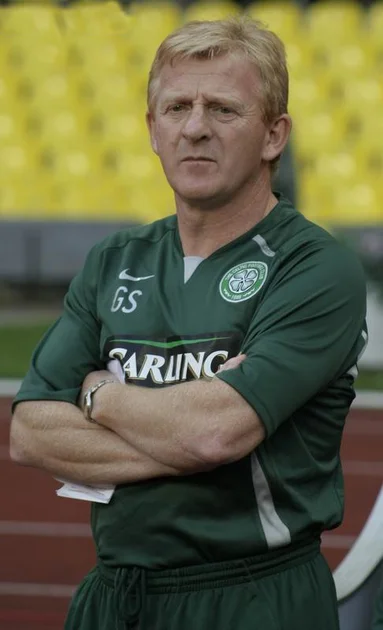
Strachan's most celebrated chapter as a manager came at Celtic, where he was appointed in 2005. During his four years at Parkhead, he guided the club to three consecutive Scottish Premier League titles and two League Cups. In the 2006–07 UEFA Champions League campaign, he led Celtic to the knockout stages, a notable achievement for a Scottish club in European competition. His tactical acumen and man-management skills were widely praised throughout his tenure, and he left Celtic in 2009 having established himself as one of the most successful managers in the club's recent history.
Stints at Coventry City, Middlesbrough, and Southampton
Prior to his time at Celtic, Strachan managed Coventry City from 1996 to 2001, where he maintained the club's Premier League status for several seasons. He later took charge of Southampton in 2001, stabilising the club and guiding them to an FA Cup final in 2003, where they lost to Arsenal. He also managed Middlesbrough from 2010, though his time at the Riverside Stadium proved more challenging given the club's financial constraints.
Scotland National Team Manager
In 2013, Gordon Strachan was appointed manager of the Scottish national team, succeeding Craig Levein. His tenure was marked by moments of real promise, most notably a memorable 1–0 victory over England at Hampden Park in 2017 during a World Cup qualifying campaign. However, Scotland ultimately failed to qualify for both the 2016 UEFA European Championship and the 2018 FIFA World Cup, and Strachan stepped down from the role in October 2017.
Legacy and Influence in Football
Gordon Strachan's impact on British football spans both sides of the touchline. As a player, he demonstrated that technical skill, intelligence, and dedication could sustain a career at the highest level well into his late thirties. As a manager, he showed a consistent ability to build competitive teams and nurture talent. His no-nonsense communication style and dry wit also made him a sought-after pundit and media personality in retirement. Strachan remains a respected figure in Scottish football culture, recognised for his contributions as both a player and a manager across more than four decades in the sport.
Comments