
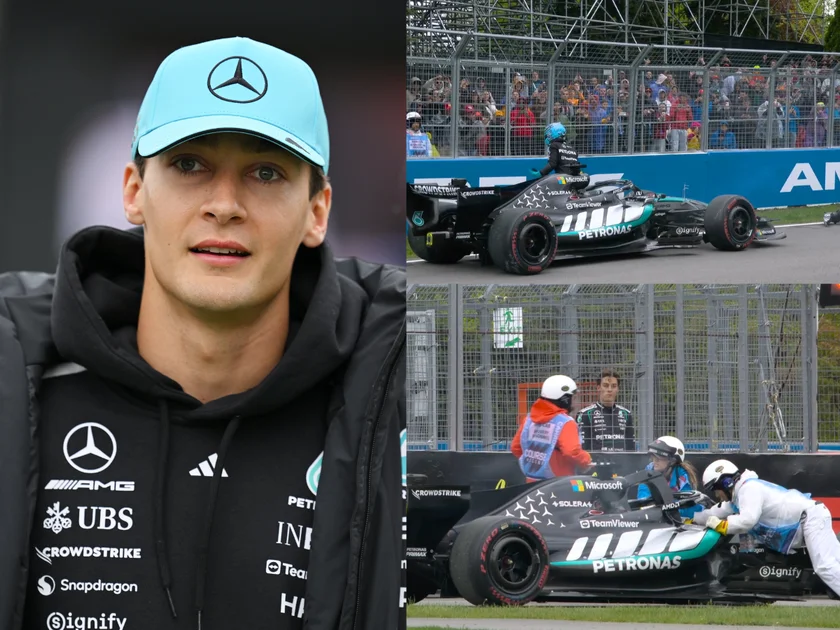
George Russell Fined After Battery Failure Ends Canadian GP Title Fight
George Russell‘s hopes of closing the Formula 1 championship gap to Mercedes teammate Kimi Antonelli were shattered on Sunday when a sudden battery failure forced him out of the Canadian Grand Prix while leading. The retirement, which occurred on lap 30 at the Circuit Gilles Villeneuve, not only ended a spectacular wheel-to-wheel battle but also triggered an FIA investigation into the British driver‘s actions in the immediate aftermath. Russell was subsequently fined €5,000 — suspended for 12 months — after he threw his headrest from the car in frustration, an act the stewards deemed an unsafe release of debris onto the circuit.
Russell, who had controlled the weekend from the front — winning the Sprint race and taking pole for the main event — was locked in a tense duel with Antonelli when his Mercedes W17 suddenly shut down. “Everything just turned off all of a sudden,” Russell told Sky Sports F1. “Just went into the corner, engine stopped, no electronics, no proper braking. I’m a bit lost for words to be honest right now.” The failure was later confirmed by Mercedes team principal Toto Wolff as a battery-related issue that caused a complete electrical shutdown.
The immediate fallout: FIA hearing and fine
Russell’s frustration boiled over moments after climbing from the car. He removed his headrest and flung it onto the track, a decision that immediately drew the attention of race officials. According to the FIA decision document, the stewards heard from Russell and a team representative and reviewed video evidence. The driver “expressed his embarrassment at what subsequently followed” and “apologised to the stewards for his action and acknowledged that it did not set a good example and offered to apologise publicly.”
The resulting fine, suspended for 12 months contingent on no similar recurrence, reflects the FIA’s stance that such emotional outbursts, while understandable in the heat of a championship-defining moment, cannot be allowed to compromise track safety. The incident comes at a time when the sport is placing increased emphasis on driver conduct, particularly after a series of high-profile on-track flare-ups earlier this season.
Why This Retirement Stings More Than Most
Russell’s DNF carries consequences far beyond one lost victory. With Antonelli taking his fourth consecutive win of the season — and his third in a row in Canada after a dominant 2025 weekend — the Italian teenager has extended his championship lead from 18 points to 43. In a season where Mercedes has emerged as the class of the field following its 2026 upgrade package, the team’s internal dynamic has shifted decisively in Antonelli’s favour.
“When you take a step back and judge George Russell’s race weekend on its merits, it was almost faultless and exactly what he needed,” wrote former Renault F1 driver Jolyon Palmer in his analysis for Formula1.com. Palmer noted that Russell’s performance across qualifying and the Sprint was “almost faultless,” and that he should “take heart from the Montreal weekend” despite the devastating outcome. Still, in a championship where consistency matters, a 43-point gap with 12 races remaining is a steep mountain to climb, even for a Mercedes driver in a dominantly fast car.
The Wolff dilemma
For Toto Wolff, the weekend encapsulated the bittersweet reality of managing two drivers both capable of winning. “As a team we have had so many situations where it is bittersweet. You are extremely happy for one driver but feel gutted for the other one. It’s difficult,” Wolff told Sky Sports F1. “Kimi has done a splendid job today and deserved the win. It was a shame for George as he was leading.”
The team principal revealed on Monday that he had warned his drivers to “tidy up their racing” after several near-misses during their lead battle, going as far as to consider ordering them to settle positions — before deciding against it. “We half enjoyed watching how they fought it out and we wished we would have had a one and a two,” Wolff said, adding that the team “never changed the engine strategies” and treated both drivers equally throughout the race.
Mercedes‘ reluctance to impose team orders — a departure from the clear number-one hierarchy enforced at Red Bull and, at times, Ferrari — reflects its desire to let its drivers race. But as the championship gap widens, that policy could come under pressure. Wolff has already hinted at possible intervention, telling reporters after the race that Mercedes may need to turn the Antonelli-Russell battles “down a notch” to prevent further costly incidents. The question is whether that intervention will come in time for Russell or whether it will solidify Antonelli’s status as the de facto team leader.
The Technical Failure: A Rare Mercedes Weakness Exposed
On a weekend where Mercedes‘ upgrade package delivered “a small but undeniable advantage” over the chasing pack, according to Sky Sports expert analyst Martin Brundle, the sudden battery failure was a stark reminder of the fragility inherent in the sport‘s next-generation power units. The 2026 regulations introduced heavily electrified powertrains that rely on complex battery management systems, and the Canadian Grand Prix — with its long straights and heavy braking zones — posed a particular challenge.
“We were a little nervous that the 2026 power units might struggle more here than most track layouts this season given so many long straights and less chances to fill the battery,” Brundle wrote in his race verdict. He noted that teams and drivers are still “quickly adapting and learning how to best use the engine and battery for qualifying, starting the race, restarting after safety cars, and in both attacking and defensive modes.” For Mercedes, the failure of a critical component during a lead battle could point to a durability issue that the engineering team must address urgently.
Russell’s retirement came without any prior warning. “The car was literally going dark, there was no electricity in the car anymore,” Wolff explained. The driver reported no steering wheel warnings, no loss of power before the complete shutdown — a sudden and complete failure that, in the high-speed environment of Montreal’s walls and chicanes, could have had far more serious consequences. Russell managed to coast to a safe stopping point at the Turn 8/9 chicane, but he acknowledged that the lack of “proper braking” made the moment “pretty damn scary.”
Recovery mode or damage limitation?
Mercedes now faces a delicate balance: it must identify and rectify the root cause of the battery failure without sacrificing the performance edge that has made it the benchmark in 2026. The team’s upgrade package — widely credited with delivering three-tenths of a second per lap over its rivals — has put both drivers in championship contention, but reliability will be the deciding factor in who ultimately prevails.
Max Verstappen, watching from Red Bull’s garage as his team struggles with its own 2026 package, was quick to note the unpredictability of the new car generation. “We’ve seen so many weird failures this year,” Verstappen said after the race. “At the end of the day, it’s still early days for these power units. The teams that can keep them running every weekend are the ones who will win.”
Perspective: What This Changes for the 2026 Title Race
Before Montreal, the 2026 season was shaping up as a three-way fight between Antonelli, Russell, and a resurgent Lewis Hamilton — whose fourth-place finish for Ferrari in Canada — described by Brundle as his “best race result at Ferrari” — briefly lit up the midfield. Now, with a 43-point lead and four consecutive wins under his belt, Antonelli has opened a gap that may prove unbridgeable for Russell, particularly if the Mercedes team management shifts its stance on intra-team rivalry.
Brundle cautioned that while the title race is not over, the momentum has clearly shifted. “I really didn‘t expect Mercedes, McLaren, Ferrari and Red Bull to be so close so quickly,” he wrote. “And the biggest spoiler of the weekend was George Russell’s battery — or lack of it.” For Russell, the next few rounds — starting with Monaco on June 5–7 — will be critical not only for his championship hopes but also for his standing within the team.
The broader trend: Emotional regulation vs. racing instinct
Russell’s headrest incident taps into a broader conversation about driver conduct under pressure. In an era where drivers are increasingly scrutinised for their behaviour both on and off the track — from social media controversies to on-track collisions — the FIA‘s willingness to punish even a momentary lapse in control signals a zero-tolerance approach. With the sport attracting a younger, more global audience, governing bodies are under pressure to present clean, professional role models.
Russell, to his credit, immediately accepted responsibility. The FIA document noted his offer to apologise publicly and his expression of embarrassment — a far cry from the defiance that often follows such incidents. Whether that contrition translates into a more disciplined approach on track remains to be seen. He will need to channel the same composure that delivered his near-flawless weekend into the coming races if he hopes to reel in Antonelli.
For fans of the sport, the Canadian GP delivered everything that modern F1 promises: close battles, technical drama, and high stakes. The Hurricanes’ playoff run — unrelated but equally gripping — reminds us that sport’s unpredictability is its greatest asset. But for Russell, the sting of this failure will linger well beyond the flight back to Brackley.
What’s Next for Mercedes and Russell?
The next race, the Monaco Grand Prix (June 5–7), offers a unique opportunity and challenge. Monaco’s tight, twisty streets punish unreliability severely, but they also level the playing field — raw power matters less, and driver skill matters more. Russell, who has historically excelled on street circuits, will be desperate to prove that his Montreal heartbreak was a one-off, not a pattern.
Wolff, meanwhile, will face mounting pressure to clarify Mercedes’ driver strategy. If Antonelli continues to win, the team may have little choice but to protect his championship position — even if it means curbing Russell‘s freedom to race. For now, the message from Brackley remains one of support. “From my side I don’t feel like there was anything more I could have done this weekend,” Russell said. “So, I’ll leave satisfied. Of course, I’m pretty damn frustrated with what’s happened. But yeah, what more can I do?”
The answer, starting in Monaco, will define the rest of his season.
Comments