
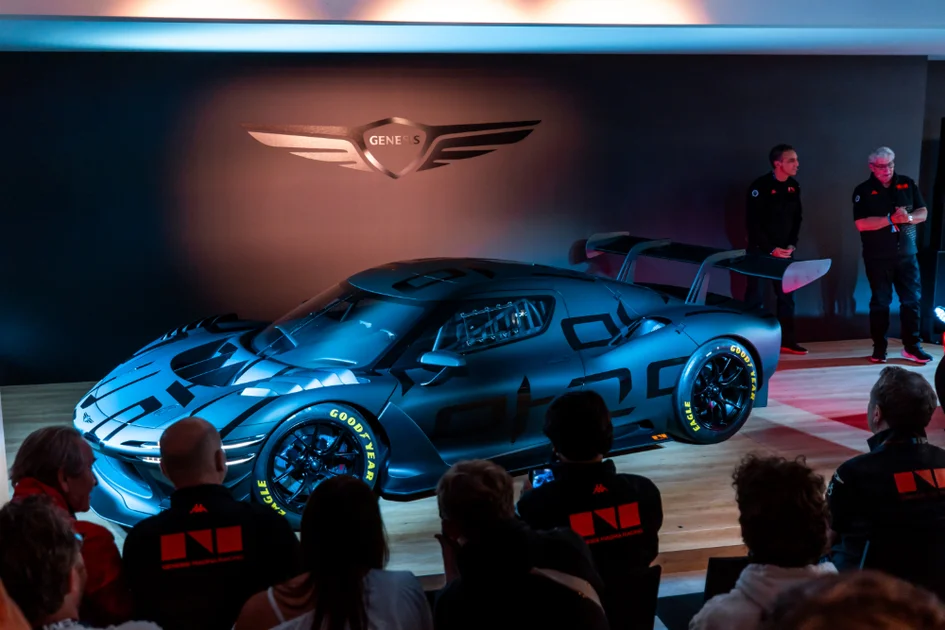
Genesis GT3 Concept Steals Headlines Ahead of the 24 Hours of Le Mans
As the 94th edition of the 24 Hours of Le Mans gets underway this weekend, Genesis has injected fresh energy into the paddock with the unveiling of a new GT3 Concept. The Korean luxury brand’s racing division, Genesis Magma Racing, showcased the concept at Circuit de la Sarthe just two days before its GMR-001 Hypercar makes its Le Mans debut.
The concept is designed from the ground up to comply with GT3 technical regulations, featuring a wider track, aggressive race-ready bodywork, and advanced thermal management systems aimed at improving durability. While Genesis has emphasized that this remains an exploratory exercise, the company confirmed that components, development pathways, and the underlying architecture are still under evaluation. The GT3 Concept is derived from the Genesis Magma GT road car, which also made its first full interior debut in France this week.
A Growing Motorsports Footprint
Genesis entered the FIA World Endurance Championship’s Hypercar class this year with the GMR-001, marking a significant step into top-tier endurance racing. The brand’s first Le Mans appearance represents a milestone for a manufacturer that has rapidly expanded from luxury road cars into motorsport. According to Genesis, lessons from the GT3 Concept and its Hypercar program could influence the performance DNA of future road models under its Magma performance subbrand.
The 94th Running: What to Expect
Le Mans remains one of motorsport’s crown jewels, alongside the Indianapolis 500 and the Monaco Grand Prix—together forming the unofficial Triple Crown. This year, 62 cars across three classes will tackle the 8.5-mile circuit, which combines permanent track sections with public roads that serve as local thoroughfares for the rest of the year.
The top-tier Hypercar class features factory teams from Ferrari, Toyota, Porsche, Peugeot, BMW, Cadillac, and now Genesis. Ferrari has won every Le Mans since the Hypercar regulations were introduced in 2023, but has not won a WEC race since last year’s French classic. The Italian marque will look to extend its streak, while challengers like Toyota and BMW—who have won races earlier this season—aim to dethrone the reigning champion.
The Human and Technical Challenge
Endurance racing at Le Mans is unlike any other motorsport. Preparation begins a week before the race, with practice and qualifying sessions scheduled throughout afternoons, evenings, and nights. Cadillac LMDh Chief Engineer Jeromy Moore told The Athletic that engineers and drivers can be awake for around 40 hours during the event. “The sessions and timings are purposely designed to challenge everyone, to put them through this grueling event, to really test if they’re strong enough to last the 24 hours,” Moore said.
Drivers work in three-man crews, with stints rotating through day and night. The field includes professional factory drivers alongside wealthy amateurs—often tech entrepreneurs—funding their seats. This year, the co-founders of GitHub and Crowdstrike, as well as the creator of Ruby on Rails, are competing in LMP2. Valve’s Gabe Newell owns the Aston Martin team fielding entries in both Hypercar and LMGT3, the latter driven in part by his son Gray Newell.
A Tradition of Automotive Innovation
Le Mans has historically served as a proving ground for technologies that later appear on road cars. Disc brakes, direct-injection engines, hybrid powertrains, brake-by-wire systems, and advanced headlights all saw early development or validation at the French endurance race. The event was founded in 1923 as a rigorous test for automotive machinery, and that mission continues today with the latest hybrid prototypes and GT machinery.
The race also highlights a broader trend in motorsport: manufacturers increasingly use endurance racing to develop electrified performance technologies. With Genesis entering Hypercar and exploring GT3, and with established players like Ferrari and Toyota refining their hybrid systems, Le Mans remains a critical laboratory for the automotive industry’s transition toward electrification.
As the 2026 race unfolds, all eyes will be on whether Ferrari can maintain its dominance, whether Genesis can make a strong debut, and what the future holds for the new GT3 Concept—potentially paving the way for Genesis to compete in customer GT racing worldwide. For now, the brand is clear: this is an exercise, but one that signals serious intent.
Le Mans this weekend is not just about winning; it is about survival, innovation, and the relentless pursuit of performance. As drivers prepare for 24 hours of racing, the sport continues to evolve—with Genesis’s GT3 Concept hinting at where it might head next.
Comments