
Opening
Nationwide Unrest Erupts in France
France is grappling with its worst bout of civil unrest in years after a national day of demonstrations against the cost of living and deteriorating public services descended into widespread violence and looting. At least 2,400 people have been arrested across the country, according to the Guardian, while the BBC reports that an estimated 550,000 people took to the streets on Saturday, the majority peacefully.
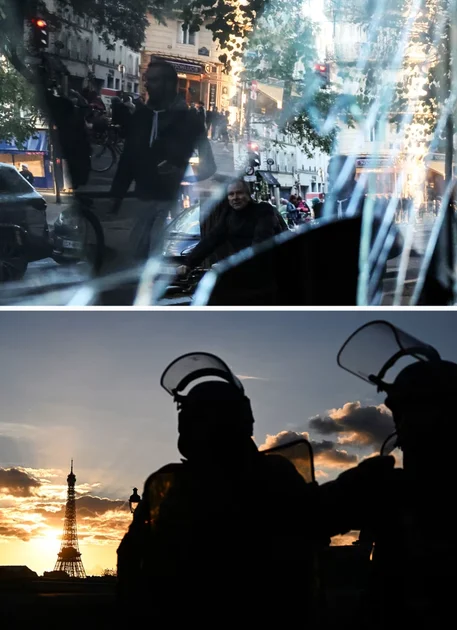
The protests, which began in late September over conditions in high schools, spiraled into broader anger over rising prices, fuel costs, and stagnant wages. In Paris and other cities, riot police fired tear gas and water cannon as masked groups torched vehicles, barricaded roads, and smashed shop windows. In Limoges, central France, protesters stormed and set fire to the 19th-century town hall, causing its roof to partially collapse. In Lyon, the city's tourist office was burned, a tragedy Mayor Grégory Doucet called heartbreaking.
Government Under Fire as Macron Addresses Nation
President Emmanuel Macron, in a televised address, condemned what he called “unbridled violence” and said “nothing justifies” the destruction. He drew a distinction between peaceful demonstrators airing grievances over the cost of living and education system, and “factious groups from the ultra-left, joined by numerous delinquents” who he said were responsible for the chaos. Interior Minister Laurent Nuñez offered his resignation on Monday, but Macron refused it, instead tasking him with ensuring transparency over intelligence and planning failures and implementing new operational methods for security forces. Prime Minister Sébastien Lecornu convened a crisis cabinet meeting on Monday as political opponents and unions accused the government of being ill-prepared. Yaël Braun-Pivet, president of the lower house of parliament, has called for an inquiry.
Context
Roots of Discontent: Schools, Costs, and a Housing Crisis
The protests originated in late September, a week after the school year began, when high school pupils demonstrated against long hours, missing teachers, dilapidated classrooms, and an opaque university admissions system. Pupils routinely miss months of teaching due to unfilled staff absences. The General Confederation of Labour (CGT), one of France's largest unions, backed the movement and called for lower prices, higher pensions, and boosted wages. Fuel prices have risen sharply after US bombing effectively closed the Strait of Hormuz, adding to household financial strain.
Similar grievances have sparked protests across Europe. In Spain, activists demonstrated over housing prices after an 87-year-old woman was evicted following a 230% rent hike; she died two weeks later. In Portugal, hundreds gathered in Lisbon over housing costs that have more than doubled since 2015. In Italy, marches in Milan, Turin, and Bologna over squeezed household budgets turned violent, with rioters throwing stones and setting fire to barricades. The Guardian describes a broader European trend of young people protesting unaffordable housing, poor school conditions, and the cost-of-living crisis.
A Government Already on Edge
The unrest comes as Macron nears the end of his second term, leaving him with diminished political capital. The scale of Saturday's violence—an estimated 1,500 shops and businesses looted or destroyed, and about 1,000 police officers injured, seven seriously—has exposed intelligence and policing failures. Interior Minister Nuñez has been accused by political opponents, unions, and on social media of being under-prepared. The crisis also echoes the Yellow Vest protests of 2018-2019, which similarly began over fuel taxes and morphed into a broader anti-government movement. Unlike then, however, the current protests have a strong youth-led education component, and the involvement of radical ultra-left groups has complicated the government's response.
Perspective
What This Means for France and Europe
The violence in France is the most dramatic manifestation of a continent-wide wave of discontent. With inflation eroding purchasing power and housing costs soaring in many EU countries, governments face mounting pressure to address inequality and public service decay. In France, the unrest threatens to destabilize Lecornu's government and could force concessions on wages, pensions, and education funding. Macron's refusal to accept Nuñez's resignation suggests a desire to project stability, but calls for accountability are growing.
The protests also raise questions about policing tactics and civil liberties. Macron has allowed local officials to ban certain street gatherings, a move critics say could inflame tensions further. As France struggles to recover from the weekend's destruction, the underlying grievances—unaffordable living costs, underfunded schools, and a perceived disconnect between elites and ordinary citizens—remain unresolved. With Macron a lame duck and no clear successor, the political vacuum could embolden both protesters and opposition parties. European leaders will be watching closely, as similar pressures build across the continent.
Comments