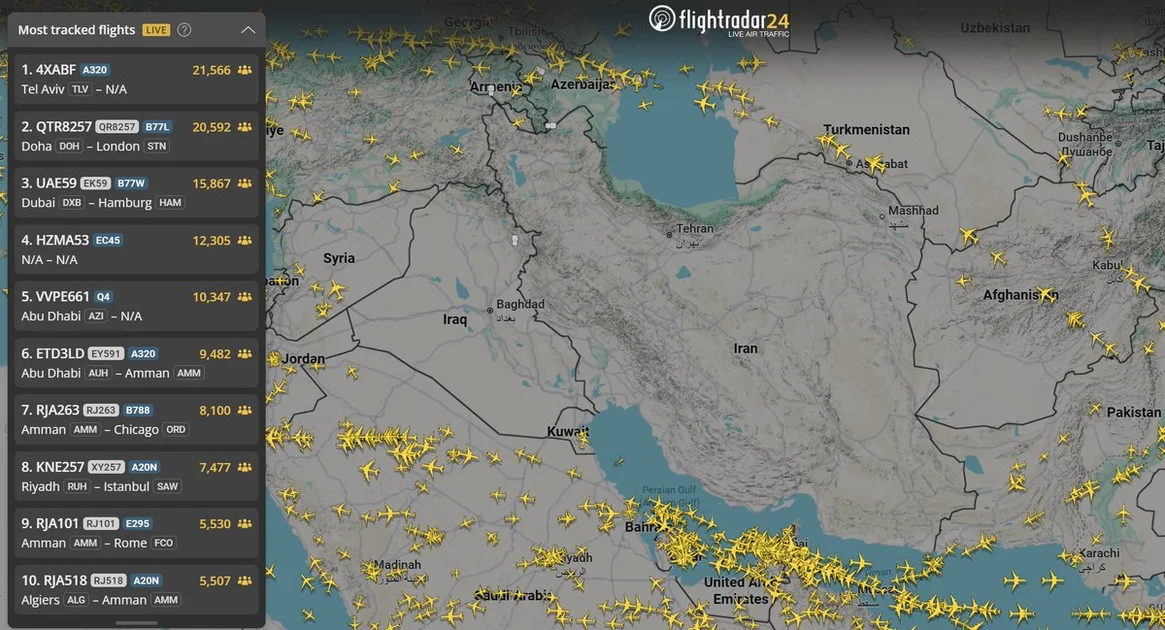
Understanding Flight Radar and Airspace Monitoring
Flight radar platforms like Flightradar24 and RadarBox have become indispensable tools for tracking civil aviation in real time. By aggregating ADS-B (Automatic Dependent Surveillance–Broadcast) signals transmitted by commercial aircraft, these services paint a near-complete picture of global air traffic at any given moment. When a normally busy corridor suddenly appears empty, it is rarely a technical glitch — it is almost always a signal that something significant is happening on the ground, in diplomatic circles, or in the skies themselves.
How ADS-B Data Works — and Its Limits
ADS-B transponders broadcast an aircraft's GPS position, altitude, speed, and flight number to ground receivers and satellites. Coverage depends on the density of receiver networks. In remote areas or regions with limited infrastructure, gaps in coverage can occur naturally. However, Iran sits at a strategic crossroads between Europe, Asia, and the Gulf, making it a heavily monitored zone. When Iranian airspace appears empty on flight radar, it is overwhelmingly due to deliberate decisions rather than data blind spots.
Why Iranian Airspace Goes Empty: Key Triggers
Several distinct scenarios have caused Iranian airspace to appear largely void of traffic on flight radar screens, each reflecting a different dimension of the country's geopolitical situation.
Military Escalations and Regional Conflicts
The most dramatic episodes of empty Iranian airspace have coincided with military escalations. In April 2024, when Iran launched an unprecedented drone and missile attack against Israel — and again when Israel responded — flight radar users around the world watched in real time as commercial airlines rerouted away from Iranian airspace at speed. Major carriers including Lufthansa, Air France, and Emirates suspended or diverted flights, leaving the corridors that normally channel hundreds of daily transits eerily bare.
Similarly, following the U.S. drone strike that killed General Qasem Soleimani in January 2020, Iranian airspace was briefly closed and global airlines avoided the region for days. The tragic downing of Ukraine International Airlines Flight PS752 by an Iranian missile just hours after that strike — killing all 176 people aboard — underscored the lethal stakes of flying through an active conflict zone, even for civilian aircraft.
Sanctions, NOTAMs, and Regulatory Pressure
Beyond acute military crises, Iranian airspace is shaped by a complex web of international sanctions and regulatory advisories. The United States Federal Aviation Administration (FAA) has long maintained flight prohibitions for U.S.-registered aircraft over Iranian territory. Other national aviation authorities issue periodic NOTAMs (Notices to Air Missions) warning carriers about elevated risk levels, particularly during periods of heightened geopolitical tension.
When multiple major airlines simultaneously heed such warnings, the cumulative effect on flight radar is striking: a country that serves as a transit corridor for intercontinental routes between Europe and South and Southeast Asia can appear almost completely void of traffic within hours.
The Strategic Importance of Iranian Airspace
To fully appreciate the impact of an empty Iranian airspace, it is worth understanding what is normally there. Iran's airspace is one of the busiest overflight zones in the world. Routes connecting Frankfurt, Amsterdam, and London to cities like Delhi, Bangkok, and Kuala Lumpur frequently pass over Iranian territory because the straight-line geography makes it the most fuel-efficient corridor.
Economic Consequences of Avoidance
When airlines reroute to avoid Iran, the financial impact is immediate and measurable. A flight from Europe to India that bypasses Iranian airspace may add 60 to 90 minutes of flight time, consuming thousands of additional kilograms of fuel and generating significant extra costs per flight. During extended periods of closure or avoidance — as seen during the 2022 Russia-Ukraine war, which simultaneously eliminated Russian airspace as an option — carriers face a compounding challenge of finding viable, cost-effective routes across Eurasia.
Iran itself also loses substantial overflight fees, which represent a meaningful source of revenue for its civil aviation authority. Prolonged avoidance therefore carries economic consequences on both sides of the equation.
Reading the Radar: What Empty Skies Tell Us
For aviation analysts, journalists, and even everyday citizens, flight radar has become a form of open-source intelligence. A sudden emptying of Iranian airspace visible on platforms like Flightradar24 often precedes or accompanies major news events by minutes or hours, as airline operations centers respond to security alerts faster than news cycles.
The Rise of Aviation OSINT
Open-source intelligence (OSINT) researchers have built entire analytical frameworks around flight radar data. Tracking military aircraft, monitoring the movement of government jets, and observing the sudden absence of commercial traffic are all techniques used to assess real-world situations when official information is scarce or delayed. During the April 2024 Iranian missile attack, aviation OSINT accounts on social media were among the first to report the scale of the airspace emergency, doing so purely by observing what was disappearing from the radar map.
Conclusion: Airspace as a Geopolitical Barometer
An empty Iranian airspace on flight radar is never just an aviation curiosity. It is a barometer of geopolitical tension, a reflection of calculated risk assessments made by airlines, regulators, and governments simultaneously. As long as Iran remains at the center of regional security dynamics — nuclear negotiations, proxy conflicts, and diplomatic standoffs — its airspace will continue to serve as one of the world's most visible indicators of instability. For those who know how to read the radar, the sky above Iran tells a story that no press release can obscure.
Comments