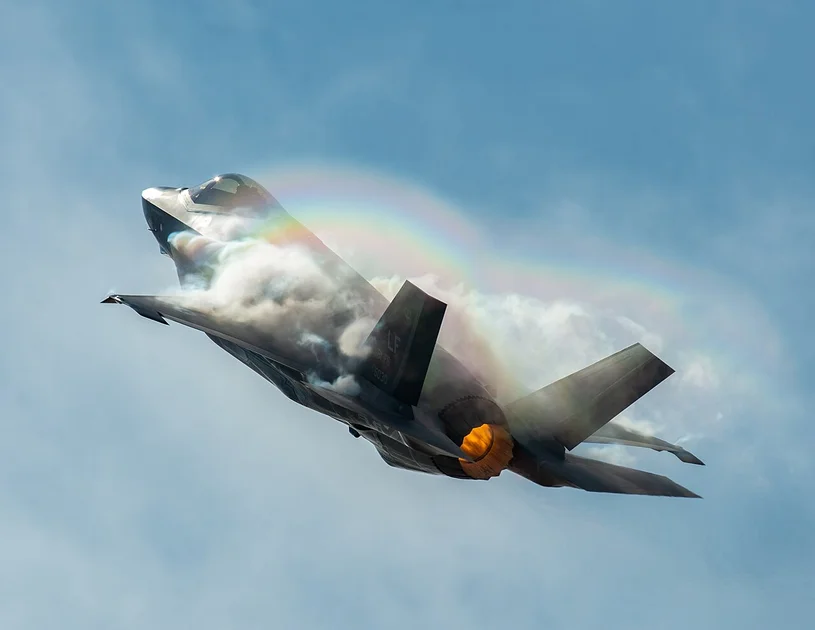
What Is the F-35 Lightning II?
The F-35 Lightning II is a family of single-engine, supersonic stealth multirole combat aircraft developed by Lockheed Martin. Designed primarily for the United States military, the program was created to replace several aging platforms across the Air Force, Navy, and Marine Corps. The jet first flew in 2006 and has since become one of the most widely discussed and deployed aircraft in modern military history.
The aircraft is the product of the Joint Strike Fighter (JSF) program, one of the most expensive defense acquisition programs in history, with a projected lifetime cost exceeding $1.7 trillion. Despite its controversies around cost and development delays, the F-35 is now operational across multiple allied nations.
Key Design Features
The F-35 incorporates advanced stealth technology that reduces its radar cross-section, making it significantly harder to detect than conventional aircraft. Its airframe is built using composite materials to minimize weight while maintaining structural integrity. The aircraft is equipped with a Pratt & Whitney F135 engine, one of the most powerful fighter jet engines ever produced.
A defining feature is the pilot's helmet-mounted display system, which projects critical flight and targeting data directly onto the visor, giving pilots a 360-degree situational awareness capability without looking down at cockpit instruments.
The Three Main Variants
The F-35 program was designed to meet the distinct operational needs of different military branches, resulting in three primary variants that share approximately 80% of their components.
F-35A – Conventional Takeoff and Landing (CTOL)
The F-35A is the most widely produced variant and is intended for the United States Air Force and many international partners. It is designed for conventional runways and is the smallest and lightest of the three versions. The F-35A is also the only variant equipped with an internal 25mm cannon.
F-35B – Short Takeoff and Vertical Landing (STOVL)
The F-35B is operated by the U.S. Marine Corps and several allied nations, including the United Kingdom. This variant can take off from short distances and land vertically, similar to the AV-8B Harrier it partially replaces. The STOVL capability makes it well-suited for operations from amphibious assault ships and austere airstrips.
F-35C – Carrier-Based Variant (CV)
The F-35C is tailored for the U.S. Navy and features a larger wing area and reinforced landing gear to handle the stress of carrier-based operations. It is equipped with a tailhook for arrested landings on aircraft carriers and has a longer range than its counterparts.
Combat Capabilities and Avionics
The F-35 is classified as a fifth-generation fighter, combining stealth, advanced sensor fusion, and network-centric warfare capabilities. Its AN/APG-81 Active Electronically Scanned Array (AESA) radar provides exceptional target detection and tracking across long distances.
The Electro-Optical Targeting System (EOTS) allows the pilot to identify and engage targets using infrared and laser guidance without the need for an external targeting pod. The Distributed Aperture System (DAS) uses six infrared cameras mounted around the aircraft to give the pilot an unobstructed view of the surrounding environment.
Weapons and Payload
The F-35 can carry a wide range of air-to-air and air-to-ground munitions. In stealth mode, weapons are stored in internal bays to preserve the aircraft's low radar signature. These include the AIM-120 AMRAAM, AIM-9X Sidewinder missiles, and Joint Direct Attack Munitions (JDAMs). External hardpoints allow for additional payloads when stealth is not a priority.
International Adoption and Strategic Role
The F-35 has been adopted by numerous allied nations as their primary or supplemental fighter platform. Countries including the United Kingdom, Australia, Japan, South Korea, Israel, Italy, Norway, and the Netherlands have either received or ordered the aircraft. This widespread adoption is central to NATO interoperability strategies.
Israel became the first country to use the F-35 in combat operations, conducting strikes in the Middle East starting in 2018. The aircraft's combination of stealth and sensor capabilities has proven valuable in contested airspace environments.
Ongoing Developments
Lockheed Martin and the U.S. Department of Defense continue to invest in Block 4 upgrades, which expand the aircraft's software capabilities, weapons compatibility, and electronic warfare systems. These improvements ensure the F-35 remains relevant against evolving threats from near-peer competitors well into the 2040s and beyond.
Comments