
F-15EX Eagle II Expansion Brings New Risks, Pentagon Report Warns
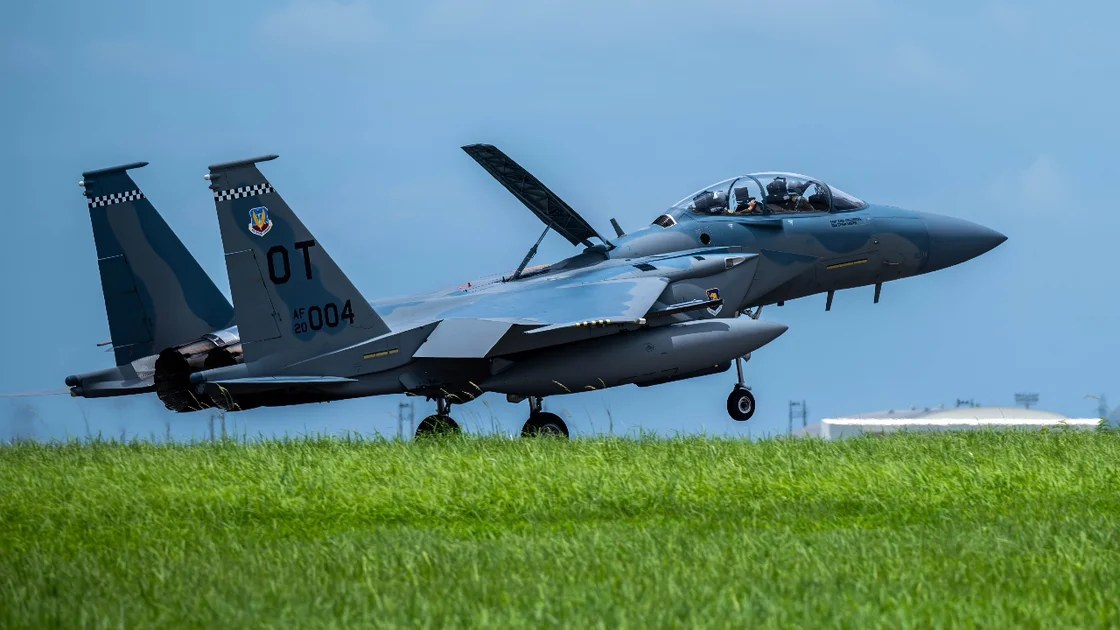
The US Air Force is moving forward with its ambitious plan to more than double its fleet of Boeing F-15EX Eagle II fighters, but a new Pentagon report cautions that the expanded program introduces significant cost and technical challenges. The warning comes as the first Eagle II destined for permanent assignment at Kadena Air Base in Japan departed Boeing's St. Louis facility on August 28, marking a key milestone in the service's Indo-Pacific modernization.
The Air Force announced earlier this year that it would increase its planned F-15EX procurement from 129 to 267 aircraft, a decision driven by the need to recapitalize the aging F-15E Strike Eagle fleet and complement the fifth-generation F-35 and F-22. However, the F-15EX selected acquisition report released in August outlines new uncertainties, including extended production timelines, potential subsystem obsolescence, and a required major technical refresh.
First Kadena-Bound F-15EX Delivered
The first F-15EX for the 18th Wing at Kadena Air Base, serial 22-0022, departed Boeing's St. Louis plant on August 28, 2026. The aircraft is now at Portland Air National Guard Base in Oregon for final staging before its planned deployment to Okinawa, with permanent arrival expected in fiscal year 2027 beginning October 1. Boeing confirmed delivery of the 22nd F-15EX to the US Air Force on September 3 via social media.
Brig. Gen. John Gallemore, 18th Wing commander, called the delivery an "important next step" toward bringing the F-15EX to Kadena, where it will replace the retired F-15C/D fleet. The Eagle II brings modernized avionics, an expanded electronic warfare suite, and increased weapons carriage—capabilities designed for the vast Western Pacific theater. The 18th Wing plans to integrate the EX with regional allies, including the Japan Air Self-Defense Force.
The Expansion and Its Stakes
The decision to scale the F-15EX program from 129 to 267 aircraft—more than the 187 F-22s ever built—reflects a strategic shift. The Air Force originally planned to replace its F-15C/D air-superiority fighters and eventually the F-15E Strike Eagles with stealth aircraft like the F-35. But the high cost and limited payload of fifth-generation fighters, combined with delays in the sixth-generation F-47 program, have forced a re-evaluation.
The F-15EX, though not stealthy, offers speed, massive payload capacity, and lower operating costs. It can carry more weapons than stealth fighters, which must keep ordnance internal to maintain a low observable profile. The Air Force sees the EX as a complement to the F-35 and future drones, serving in homeland defense, standoff strike, and 'missile truck' roles.
Consequently, the Air Force is also restructuring its fighter basing. Seymour Johnson Air Force Base in North Carolina, the largest active-duty F-15E base, is set to become a major F-15EX hub and training center. Meanwhile, some F-15E Strike Eagles may be relocated to Whiteman Air Force Base, home of the B-2 Spirit, as part of a broader force redistribution.
Pentagon Caution: Production and Obsolescence Risks
The Pentagon's selected acquisition report, released in late August, highlights several concerns. The expansion extends production from eight to twelve lots, requiring Boeing to conduct what the report calls "a major technical refresh" to counter diminishing manufacturing sources and material shortages.
Over time, key systems such as the F-15EX's radar, mission computer, electronic warfare suite, and engines may become obsolete, forcing a "significant redesign effort." The program plans to mitigate this by integrating upgraded subsystems through operational flight program releases scheduled between 2031 and 2035. This structured approach aims to field new capabilities without halting the production line.
However, the report notes that the full cost of extending production has not yet been estimated. A rapid cost estimation process is underway to inform the fiscal 2028 budget request. Until then, the program is relying on government estimates, leaving budget planners in a state of uncertainty.
Implications for the Future Fighter Fleet
The F-15EX's expansion comes at a time of intense debate over the future mix of the US fighter force. The Air Force is committed to its fifth-generation fleet and the upcoming sixth-generation F-47, but budget realities and operational needs have forced a pragmatic approach. The F-15EX is now seen as an essential bridge—capable of executing missions that would otherwise overburden stealth aircraft.
Critics argue that pouring resources into a fourth-generation-plus platform could become a liability as peer adversaries deploy more advanced fighters and air defenses. The Pentagon report itself acknowledges that the EX may face obsolescence as the world moves deeper into the fifth- and sixth-generation era. Yet proponents point out that the F-15EX's large payload and advanced electronic warfare gear make it a cost-effective complement, especially in the Indo-Pacific where basing and logistics are constrained.
The deployment to Kadena is a signal of that strategy. The F-15EX will operate alongside allied forces and fifth-generation aircraft, providing additional capacity for long-range fires, sensors, and electronic warfare in contested environments. The Air Force's ability to manage the expansion's risks—production costs, technology refreshes, and budget demands—will shape whether this gamble pays off.
As Boeing navigates broader scrutiny over its defense programs, the F-15EX program stands as a crucial test. The company faces the challenge of delivering a modernized aircraft at scale while containing costs. With the first Kadena-bound jet already in motion, the coming years will reveal whether the Air Force's doubled bet on the Eagle II strengthens its tactical airpower or becomes a costly lesson in overreach.
Comments