
Eurovision 2026 Semi-Final 1: Finland, Israel Qualify as Boycott Waves Shake Contest
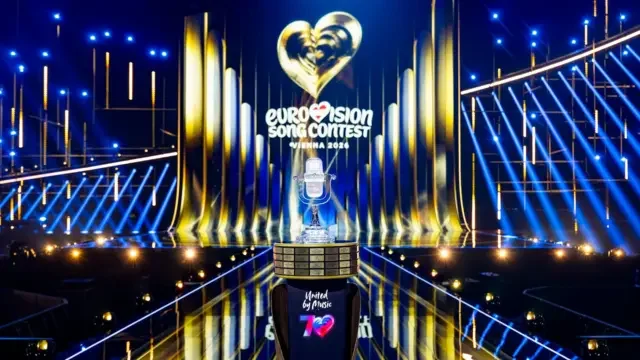
The 70th Eurovision Song Contest kicked off with its first semi-final on Tuesday, May 12, 2026, at the Wiener Stadthalle in Vienna, Austria, delivering a night of high-stakes performances, surprise qualifiers, and deepening political fault lines. Fifteen countries competed for ten spots in Saturday’s grand final, with bookmakers’ favorites Finland and Greece sailing through, alongside Israel, whose participation has triggered the largest boycott in the contest’s modern history.
Hosted by Austrian stars Victoria Swarovski and Michael Ostrowski, the show opened with a tribute to the contest’s seven-decade legacy—"By Your Side for 70 Years"—featuring a 70-member choir and 1967 entrant Vicky Leandros performing "L’amour est bleu." The nostalgic opener belied the charged atmosphere surrounding this year’s event, as at least five nations—Spain, Ireland, the Netherlands, Iceland, and Slovenia—have withdrawn their broadcast and participation over Israel’s inclusion, the largest such boycott since the 2022 edition.
The Qualifiers: Favorites Advance, Poland Snatches a Spot
As expected, Finland’s entry "Liekinheitin" by Linda Lampenius & Pete Parkkonen secured a place in the final, alongside Greece’s Akylas with "Ferto" and Sweden’s Felicia performing "My System." Israel’s Noam Bettan advanced with "Michelle," while strong vocal performances from Croatia (Lelek – "Andromeda"), Belgium (Essyla – "Dancing on the Ice"), Lithuania (Lion Ceccah – "Sólo quiero más"), Moldova (Satoshi – "Viva, Moldova!"), and Serbia (Lavina – "Kraj Mene") rounded out the qualifiers.
The night’s biggest upset came from Poland’s Alicja, whose song "Pray"—backed by a kinetic dance routine and a powerful vocal—propelled her past higher-ranked rivals. San Marino’s Senhit, featuring Boy George on backing vocals, was eliminated despite strong pre-show odds. Estonia’s Vanilla Ninja, returning after two decades, also failed to advance with "Too Epic To Be True."
Two of the pre-qualified "Big Four" countries—Italy (Sal Da Vinci – "Per sempre sì") and Germany (Sarah Engels – "Fire")—performed as interval acts but were not up for elimination. The UK, France, and host Austria also bypass the semi-finals and will join the 20 qualifiers for Saturday’s final.
Context: Boycotts, Security, and the Stakes for Europe’s Biggest Music Event
The 2026 contest marks the first time Spain’s public broadcaster RTVE has chosen not to air the event since its debut in 1961. Spain, historically one of the "Big Five" automatic qualifiers, joins Ireland, the Netherlands, Iceland, and Slovenia in an unprecedented wave of broadcast withdrawals. The boycotts stem from Israel’s participation amid ongoing military operations in Gaza, which have drawn widespread condemnation across European cultural sectors.
The political tension was evident even before the first note. In his live commentary for the BBC, music correspondent Mark Savage noted that several delegations had requested reduced flag displays during the semi-final, while security was visibly increased around the Wiener Stadthalle. The contest’s organizers, the European Broadcasting Union (EBU), have repeatedly defended Israel’s inclusion on the grounds that Eurovision is a non-political event, a stance that has drawn criticism from artists, broadcasters, and human rights groups.
Security concerns also dominated the lead-up to the event. Earlier this week, the FBI provided a cybersecurity boost to the contest’s digital infrastructure, as reported in Eurovision 2026 Rehearsals Heat Up in Vienna Amid FBI Cybersecurity Boost, amid fears of hacking and disinformation campaigns targeting the voting system. The EBU confirmed that no major incidents occurred during the first semi-final, but the agency remains on high alert for Thursday’s second semi-final and Saturday’s grand final.
The Big Picture: A Contest at a Crossroads
The 2026 Eurovision Song Contest has become a lightning rod for broader debates about the role of culture in geopolitical conflicts. The number of boycotting broadcasters—five in total, with Spain being the most significant because of its historical Big Five status—represents the largest protest action in the contest’s history. By comparison, the 2022 edition saw only a handful of broadcasters withdraw over Russia’s invasion of Ukraine, and the contest itself banned Russia from participation that year.
The EBU’s decision to allow Israel to compete while excluding Russia in 2022 has been called into question by critics, who argue the organization applies its political neutrality rule inconsistently. Supporters of Israel’s participation counter that the contest should not exclude any UN member state and that cultural exchange can foster understanding. The EBU has stated that the decision rests on whether a country’s public broadcaster complies with its membership obligations, which Israel’s Kan does.
At the same time, the contest’s musical quality has not suffered. Finland’s "Liekinheitin" has been hailed as one of the strongest entries in years, blending folk-metal with orchestral elements. Greece’s Akylas brings a modern pop sound, while Sweden’s Felicia continues the country’s tradition of polished pop productions. Belgium’s Essyla, a newcomer, has been praised for her atmospheric electronic ballad "Dancing on the Ice."
The emotional high point of the night came from Poland’s Alicja, whose survival against the odds resonated with many viewers. Savage commented that her performance “roused her higher-placed rival” and that her qualification “was the only real surprise of the night.”
Perspective: What This Year’s Boycotts Mean for Eurovision’s Future
The boycott wave of 2026 may redefine how the contest handles politically sensitive participants in the future. While the EBU has historically resisted calls to bar member broadcasters, the economic and reputational cost of losing major broadcasters like Spain’s RTVE could force a reevaluation. Spain’s absence not only removes its voting public from the semi-finals but also its domestic viewership, which has traditionally been among the highest in Europe.
In the UK, viewers were reminded that they could not vote during the first semi-final, a rule that applies to all non-participating countries. The BBC’s broadcast of the semi-final on BBC One and iPlayer attracted strong ratings, according to early data, despite the political controversy.
Industry analysts note that the contest’s resilience lies in its core audience: young viewers across Europe who engage with the event through social media, streaming, and live events. Even as broadcasters withdraw, fan voting remains robust, and the contest’s expanded online presence allows viewers in boycotting nations to still follow the results informally. For instance, many Spanish fans have taken to platforms like X and TikTok to discuss the show, bypassing RTVE’s blackout.
The second semi-final, scheduled for Thursday, May 14, will feature 15 more acts competing for the remaining 10 spots in the grand final. Among the highlights will be the UK’s entry Look Mum No Computer (a British musical boffin whose real name is Sam), and British Cypriot singer Antigoni representing Cyprus. Both are expected to benefit from the UK’s automatic qualification, but they will perform for exposure and to influence the televote.
Meanwhile, the political drama shows no signs of abating. Protests are expected outside the Wiener Stadthalle in the coming days, and security remains tight. The EBU has yet to comment on whether Spain or other boycotting nations will face sanctions or fines for non-broadcast, although such penalties are rare in the contest’s history.
As the first semi-final concluded, Savage summed up the prevailing mood: “For keen Eurovision-watchers, tonight’s qualifying acts were almost a foregone conclusion. Finland and Greece are the most-favoured contestants here in Vienna; with Israel and Sweden also in the Top 10. The only person who managed to beat the odds was Polish singer Alicja. That’s the magic of Eurovision—even in the middle of a political storm, the music can surprise you.”
The grand final on May 16 will bring together 25 acts—the 10 qualifiers from each semi-final, plus the five automatic qualifiers: the UK, France, Germany, Italy, and host Austria. The winner will be decided by a combination of jury and public votes. With tensions high and boycotts unprecedented, this year’s contest may well be remembered as a turning point in Eurovision’s long history.
Comments