
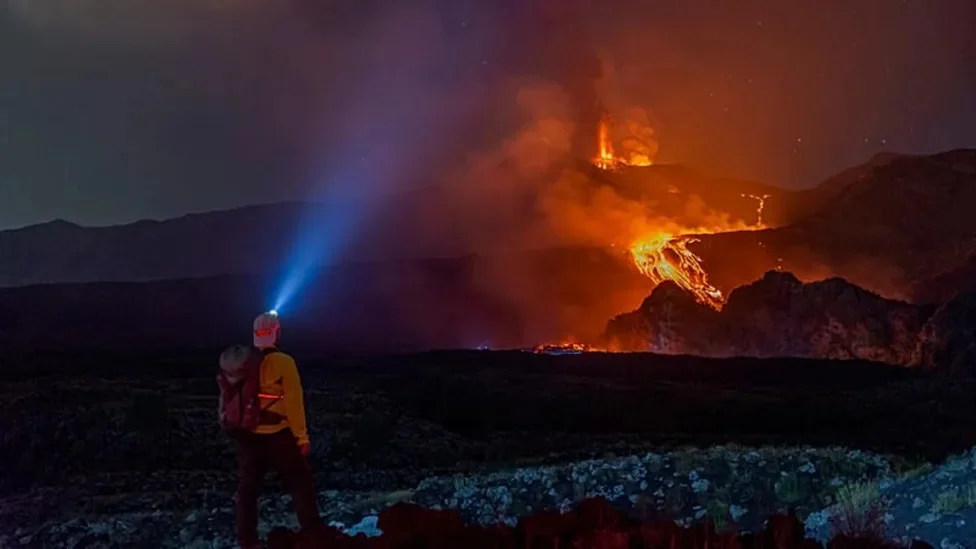
Mount Etna's relentless eruption grounds hundreds of flights at Sicily's busiest airport
Mount Etna, Europe's most active volcano, is in the midst of an exceptionally long eruption that has entered its seventh day, spewing ash and lava and forcing the closure of Catania Airport — Sicily's busiest — for the fifth consecutive day. The airport, located about 20 miles south of the volcano, has suspended all flights until early Saturday, August 15, stranding hundreds of summer holiday travelers during Ferragosto, the peak of Italy's summer vacation season.
Around 700 flights have been canceled since the eruption began, according to local authorities, as volcanic ash blankets the region and drifts with the wind as far as Malta and northern Africa. The airport closure has rerouted planes to other airports on the island, causing chaos for travelers and driving up taxi fares and car rental prices.
A phenomenon unseen since the 1970s
Volcanologists at the National Institute of Geophysics and Volcanology (INGV) say the current eruptive phase is unusual not for its intensity but for its persistence. Lava fountains and flows have occurred multiple times in recent decades, but they typically lasted from a few hours to half a day. This time, the eruption has continued for a full week, a characteristic last seen in the late 1970s.
Salvo Gambino, director of the INGV's Etnean Observatory in Catania, told Euronews that the unusual duration suggests "magma rising from greater depth and richer in gas." The eruption is affecting several sectors of the volcano simultaneously, with intense activity at the Voragine crater, continued lava fountains and ash emissions, and multiple vents feeding a lava field in the Valle del Bove. Gambino stressed that the lava flows do not currently pose a threat to inhabited areas.
The ash cloud, however, is causing the biggest disruption. The wind has been blowing south, pushing the plume directly toward Catania's airport, making it unsafe for aircraft. "Volcanic ash can be a great risk for aircraft," said Boris Behncke, a researcher at the INGV's Etna Observatory. "It can be sucked into the motors, and force them to stall. This is why everyone is so very cautious with aircraft when there is a volcanic ash emission."
Why this eruption is different
Etna is the largest active volcano in Europe, and its eruptions are a recurring feature of life in eastern Sicily. Over the past few decades, the volcano has produced many short but strong eruptions, some of which closed the airport for hours or even a day. But Behncke emphasized that this event is distinct because of the sustained ash emission from the summit. "There have been many shorter interruptions — and stronger eruptions — over the past few decades, but this event is different because the ash emission from Etna's summit has been much more persistent," he told the Associated Press.
The prolonged closure of Catania Airport is a major problem for the region's economy and for travelers. Catania is a gateway to popular Sicilian destinations such as Taormina, Syracuse, and the slopes of Etna itself. The timing could not be worse: Ferragosto, on August 15, is the height of the Italian summer, when millions of Italians and tourists alike head to the coast and mountains. Many flights have been rerouted to Palermo and other Sicilian airports, but the disruption has left many passengers stranded or scrambling for alternative transport.
The Italian government has tried to reassure the public. The minister for Civil Protection and Sea Policies, Nello Musumeci, said on Wednesday that "it is not the volcano that is out of place, but the airport," referring to the airport's proximity to Etna. However, the closure has raised questions about the resilience of the region's infrastructure in the face of natural hazards.
Tourists flock to watch, but safety remains a concern
Despite the disruption, the eruption has also attracted large numbers of curious visitors and hikers, eager to witness the glowing lava and ash plumes lighting up the night sky. Footage from August 14 shows crowds of tourists gathered near Catania, with police vehicles and roadblocks restricting access to dangerous areas around the volcano.
Local guides have been offering safe viewing points, but authorities have warned that the situation can change rapidly. "The volcano is not a tourist attraction, but a natural hazard," said a spokesperson for the Italian civil protection agency. "People should keep a safe distance and follow the instructions of local authorities."
The eruption has also had environmental impacts. Ash has fallen on towns and villages within a wide radius, and light ash has even reached Malta and northern Africa. In Catania, streets and cars are covered in a layer of dark ash, and residents have been advised to wear masks to avoid respiratory irritation.
What this means for the future
Scientists are closely monitoring the eruption to understand whether this prolonged activity indicates a shift in Etna's behavior. The last similarly long eruption in the 1970s was followed by a period of intense activity, and some researchers believe this eruption could be the start of a new cycle.
"This tells us that there is a lot of magma available at depth and that the volcano is in a very active phase," said Behncke. "We will have to see how long this continues and what it means for the coming months."
For now, the priority is to restore air travel and ensure public safety. The airport is expected to reopen on Saturday, but officials say that could change if the ash emission intensifies. In the meantime, travelers are advised to check with their airlines and consider alternative arrangements. The WWE SmackDown Results 8/14: Three Titles on the Line, CM Punk and Kevin Owens Collide and other news from the day continue to be covered, but for now, the main story in Italy is the volcano that will not calm down.
The eruption is a stark reminder of the fragility of modern travel and the power of nature. As the world watches, Etna — affectionately nicknamed "Her Majesty" by locals — continues to shape the lives of Sicilians, as it has for millennia. Whether this marks a new era of prolonged eruptions or a temporary anomaly, one thing is certain: the volcano remains as unpredictable and awe-inspiring as ever.
Comments