
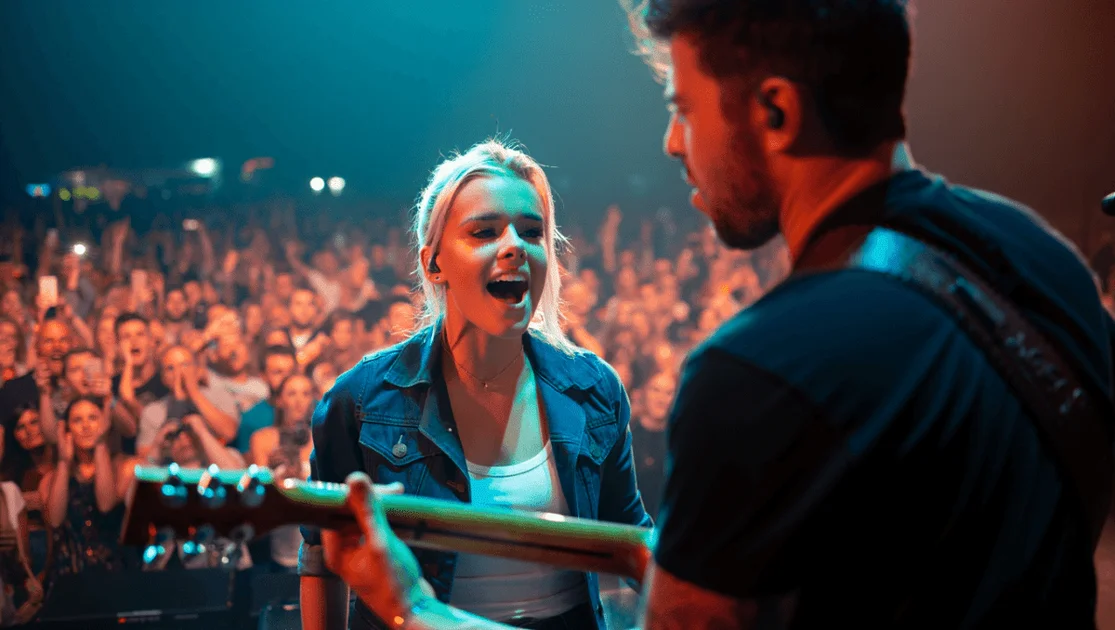
A Surprise Debut Turns Into a Social Media Storm
What was supposed to be a triumphant musical moment has quickly become a flashpoint in the ongoing culture wars surrounding country music. On Saturday, April 19, 2026, rising country star Ella Langley joined Morgan Wallen onstage during his Still The Problem 2026 Stadium tour stop in Tuscaloosa, Alabama, to perform their brand-new, unreleased duet, "I Can't Love You Anymore." The surprise performance was electric for country fans in attendance — but the fallout on social media told a very different story.
Wallen himself introduced the moment with characteristic warmth, telling the crowd that Langley had written and sent him the song roughly a month prior, and that he had immediately loved it. For many fans, the announcement was less of a surprise than it appeared: Langley had been dropping subtle hints, most notably through a close-up shot of a white van's license plate reading "ICLYA" at the end of her "Choosin' Texas" music video. The official release of the track is scheduled for Friday, April 24, 2026.
The Backlash Erupts Online
Within hours of the Tuscaloosa performance, a wave of criticism began rolling across X (formerly Twitter), largely from users outside the country music community. The criticism was less about the music itself and more about perceived political associations. Several viral posts suggested that collaborating with Morgan Wallen — a figure who has attracted political controversy in the past — was tantamount to a political endorsement. One widely shared tweet read: "Now that she's collabing with Morgan Wallen we can assume she's MAGA." Others were more overtly hostile, with some users going as far as posting what they described as "curses" aimed at Langley for the collaboration.
Some posts also invoked comparisons to other female country artists, implying that Langley had compromised her independence or credibility by aligning herself with Wallen's commercial juggernaut.
Why This Collaboration Matters — and Why It's Drawing Fire
Langley's Momentum at a Critical Juncture
The timing of the backlash is notable. Ella Langley is arguably at the highest point of her career so far. Her single "Choosin' Texas" was in its seventh consecutive week at number one on the Billboard charts heading into the weekend of the Tuscaloosa show, making her one of country music's most dominant forces of the moment. Her previous duets with Riley Green were both chart-toppers, and her role as Wallen's opening act on a stadium-level tour underscores just how rapidly she has ascended.
For an artist at this stage — building a fanbase, establishing a brand identity, and crossing over into mainstream visibility — a collaboration with the biggest name in country music is a logical and potentially career-defining move. Morgan Wallen is, by almost any commercial metric, the reigning king of the genre, having previously notched a number-one hit on the Billboard Hot 100 with his duet with pop star Tate McRae, "What I Want."
The Wallen Factor
Morgan Wallen's polarizing reputation precedes him. The Sneedville, Tennessee native has faced significant controversy in the past, including an incident involving a racial slur that temporarily derailed his career in 2021, though he subsequently staged one of the most commercially successful comebacks in recent music history. For some listeners — particularly those outside the country music world — his name alone carries political and cultural baggage that no collaboration can fully sidestep.
This is precisely why Langley's decision to release a duet with him is being read by some as a political statement, even in the absence of any explicit political activity on her part. The equation, reductive as it may be, seems straightforward to her critics: proximity to Wallen equals political alignment with his perceived fanbase.
Fans Rally to Langley's Defense
Langley's own supporters have pushed back firmly against the criticism. Many have argued that reducing an artist's musical choices to assumed political affiliations is both unfair and intellectually dishonest. Fox News reported that fans quickly rallied to her defense across platforms, emphasizing that collaboration in country music — a genre built on duets, co-writes, and touring partnerships — should not be treated as a political litmus test.
It is also worth noting that Langley and Wallen are not new collaborators. She has opened for him on previous tours and has joined him onstage for live duets on multiple occasions before "I Can't Love You Anymore" was ever announced. For those embedded in the country music world, this partnership is a natural continuation of an existing professional relationship, not a sudden or provocative alliance.
The Broader Trend: Art in the Age of Political Tribalism
The backlash against Ella Langley is the latest example of a growing and troubling pattern in popular culture: the assumption that an artist's collaborators, touring partners, or professional associations are direct reflections of their personal politics. This phenomenon is not unique to country music — artists across genres have faced similar scrutiny — but country music has become a particularly charged arena for these debates, partly because of the genre's historical associations with a specific demographic and political identity.
What makes the Langley situation somewhat paradoxical is that much of the criticism is coming from outside country music's core audience, from observers who may have little familiarity with the industry's norms and collaborative culture. Within country music circles, a Wallen-Langley duet is a commercial event, not a political manifesto.
As cultural polarization continues to intensify, the line between artistic collaboration and political statement grows increasingly blurry in the public eye. The episode echoes broader conversations about how entertainment figures are judged — a dynamic also visible in television, where hosts and personalities face intense scrutiny for who they platform and associate with. Whether "I Can't Love You Anymore" becomes a chart-topping hit — which industry observers widely expect — may ultimately matter far more than any Twitter controversy. But for now, Ella Langley is navigating the uncomfortable reality that in 2026, who you sing with can feel, to some, as consequential as what you sing.
Comments