
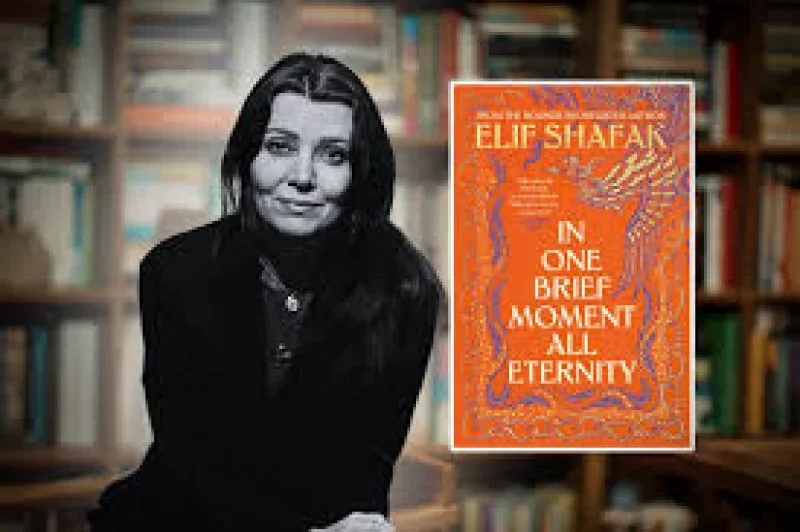
Elif Shafak's New Novel Turns Flaubert's Life into a Meditation on Depression and Creativity
Elif Shafak, the acclaimed Turkish-British novelist and president of the Royal Society of Literature, has released her 14th novel, In One Brief Moment All Eternity, a fictionalized account of Gustave Flaubert's life that she describes as her "love letter to literature" and a response to a period of depression and anxiety. The book, published this week, arrives as Shafak—one of the UK's bestselling literary authors—opens up about her creative crisis in a series of interviews with The Guardian, The Irish Times, and other outlets.
The novel reimagines Flaubert's life from his lonely childhood in Rouen to his death in 1880, interspersing his story with thirty voices of women—some historical, some fictional, some inanimate—who question his narrative. Among them are Emma Bovary, who speaks back to her creator and puts him on trial for how he portrayed her; Eleanor Marx, Flaubert's first English translator; George Sand; and even the city of Istanbul. The book's title derives from Attar's poem The Conference of the Birds, and its cover features the Simurgh, a mythical bird that also appears to Flaubert during his epileptic fits.
A Novel Born from 'Angst, Anger, and AI'
Speaking to The Guardian's Lisa Allardice over coffee in west London, where she has lived for 18 years with her husband and two children, the 54-year-old author said the book grew out of what she calls "the age of three As: Angst, Anger and AI." She described Flaubert as "a lonely boy who was misunderstood by almost everyone around him, including his own family members," who was "regarded as a failure, as a disappointment, treated as 'the other.'" The novel is dedicated to anyone who has felt similarly treated. "I wanted to be able to say, 'you're my brother, you're my sister.' That was the beginning," she said.
Shafak has been open about the personal toll of writing the book. In an interview with The Irish Times, she said the novel emerged from a period of depression and anxiety, which she described using the Turkish word hüzün. She framed the book as an act of recognition, placing herself inside a lineage of writers who turned private unease into art. "This book is really my love letter to literature," she told The Guardian.
A Career of Steady Ascent
The new novel comes as Shafak's reputation continues to grow. Her previous book, There Are Rivers in the Sky, was one of the UK's bestselling literary novels last year. The Island of Missing Trees was shortlisted for the Women's Prize in 2022, and 10 Minutes 38 Seconds in This Strange World was shortlisted for the Booker Prize in 2019. Her 2017 TED Talk has been viewed more than 6.4 million times. Last December, she was elected president of the Royal Society of Literature.
Despite this success, Shafak's latest work is notably more introspective. The novel's metafictional structure—with Emma Bovary challenging her creator's authority—raises questions about the novelist's godlike control over their characters. "What if multiple women were to tell the story of one man's life?" Emma asks in the book. Shafak uses this device to explore the porous boundary between creator and creation, and to give voice to those whom history has marginalized or overlooked.
Flaubert's 19th Century Echoes Today
In her interview with The Irish Times, Shafak drew parallels between Flaubert's France—a time of war, civil war, siege, and starvation—and the present day. "The 19th century is not over yet," she said, noting that while modern challenges like AI are new, "this feeling that the world is unravelling is not a new feeling." The novel asks what value storytelling has in a time of chaos, a question Shafak said she grappled with during her own creative crisis.
The book has already sparked discussion among reviewers. The Lonesome Reader blog cautioned that the novel spoils the ending of Madame Bovary in its opening pages, but noted that Shafak wanted readers unfamiliar with Flaubert to connect with the story. The blog praised the portrayal of Gustave as a lonely, bookish child, and highlighted Shafak's depiction of him as a synaesthete who can taste words—a trait that recalls Arthur in There Are Rivers in the Sky.
A Broader Conversation About Mental Health and Art
Shafak's willingness to discuss her depression and anxiety comes at a time when mental health is increasingly part of the public conversation in literary and creative industries. Her admission that even a highly successful author can struggle with such issues challenges the romantic notion of the tortured genius and offers a more nuanced view of the relationship between creativity and mental health.
The novel also intervenes in ongoing debates about AI and creativity. By invoking "the age of AI" alongside angst and anger, Shafak positions her work as a humanistic counterpoint to machine-generated content. Her focus on empathy, recognition, and the stories of marginalized voices suggests that literature's value lies not in efficiency or novelty, but in its capacity to connect and console.
As Shafak told The Guardian, the book is ultimately about loneliness and otherness—themes that resonate in an era of global uncertainty. With In One Brief Moment All Eternity, she has turned her own creative crisis into a work that speaks to anyone who has ever felt like an outsider, and in doing so, reaffirmed her place as one of the most beloved novelists writing today.
Comments