
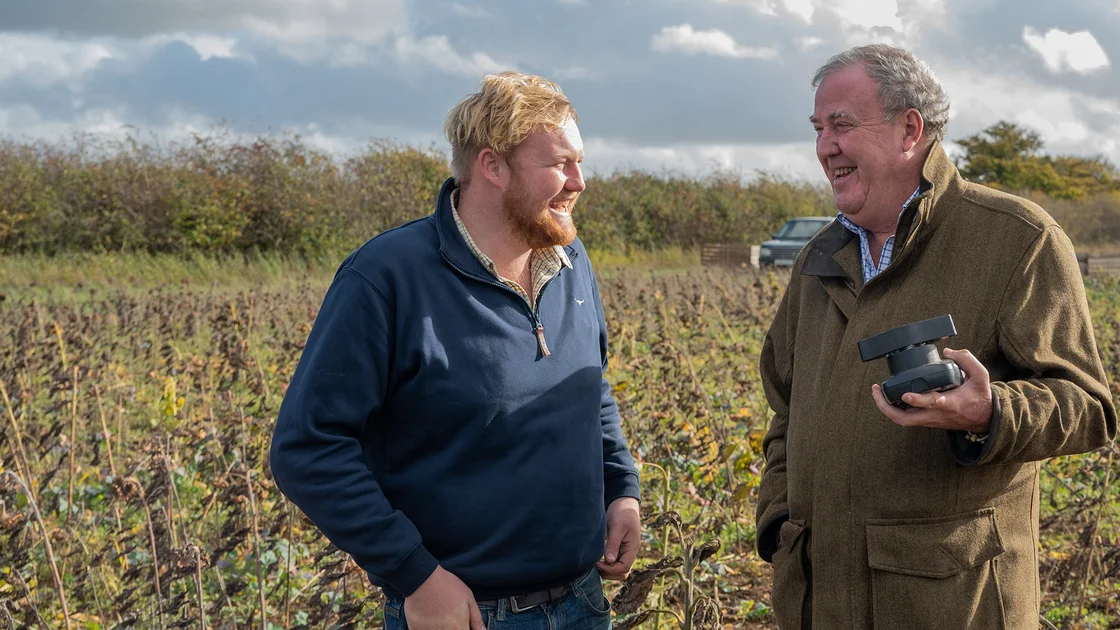
Jeremy Clarkson Reveals the Unpaid Reality of Farming: 15-Hour Days and No Profit
Jeremy Clarkson has once again thrust the financial struggles of British farmers into the spotlight, revealing that despite working 15 to 20 hours a day during the harvest season on his Cotswolds farm, Diddly Squat, he doesn't actually get paid for his produce. In his latest newspaper column, the Clarkson's Farm star detailed the grueling summer schedule, waking at 4am and working non-stop, only to conclude that it is "cheaper to go on an expensive holiday" than to rely on income from his wheat and barley.
Clarkson, who has become an unlikely agricultural advocate since taking over the farm in 2019, wrote that the current economic climate, compounded by what he calls the government's "strange hatred of farmers," has made it impossible to turn a profit from growing food. The comments echo his previous declarations, including his recent decision to leave 200 acres of his land bare because planting wheat or barley would "definitely make a loss."
The revelations come as the fifth series of Clarkson's Farm continues to draw massive audiences, yet the glamour of the show contrasts sharply with the bleak financial reality Clarkson describes. His columns and the Amazon Prime series have consistently highlighted the precarious nature of modern agriculture, from unpredictable weather to policy changes that squeeze already thin margins. The Department for Environment, Food and Rural Affairs (Defra) has been contacted for comment but has not yet responded to his claims.
Meanwhile, in a separate development, one of the innovative farming projects Clarkson championed on his show has announced it is closing. A groundbreaking floating dairy farm in the Netherlands, which Clarkson visited and praised as an elegant solution for sustainable food production, is being put up for sale after facing years of regulatory hurdles. The farm, home to 28 cows, was forced to shut after its port location was earmarked for redevelopment and new environmental certification issues arose. Clarkson had suggested Britain should adopt similar floating farms in cities like London, Liverpool, and Manchester, but the Dutch farm's closure casts doubt on the viability of such projects.
The Financial Squeeze on Modern Farmers
Clarkson's latest comments underline a growing crisis in British agriculture. Farmers across the country are struggling with rising input costs, fluctuating commodity prices, and post-Brexit policy changes that have removed subsidies and replaced them with a system that many argue is less supportive. In his column, Clarkson pointed out that the sheer cost of planting, tending, and harvesting a crop often exceeds the market price for that crop, a reality that drives many farmers out of business.
For Clarkson, the personal stakes are high. He bought Diddly Squat in 2008 but only began farming it in 2019 after his partner Lisa Hogan suggested he take over the land. The resultant Amazon Prime series, Clarkson's Farm, has turned him into a global celebrity-farmer and a vocal critic of government agricultural policy. His frustration has grown since the 2024 budget introduced inheritance tax changes on agricultural assets, which Clarkson has argued will force family farms to sell land to pay the tax bill. He has protested the changes publicly, and his show has documented his attempts to diversify and find new revenue streams, from opening a farm shop to brewing his own beer, all in the face of local council opposition.
But the economics remain stark. In his column, Clarkson noted that the satisfaction of harvesting is not matched by financial reward. "You turn off the engines and in the golden-hour silence that results, you crack open an ice cold bottle of beer and gulp at it as the sun goes down. I've drunk beers in many exotic and beautiful locations over the years, but none of them match the beer you treat yourself to after a hard day's harvesting," he wrote, adding: "The only slight fly in the ointment is that thanks to the hot summer and this Government's strange hatred of farmers, you don't actually get paid for the wheat and the barley you've harvested."
He even calculated that taking an expensive holiday would be cheaper than relying on the income from his harvest, a damning indictment of the current state of farm economics. For the average farmer, the situation is even more critical, as they cannot supplement their income with book deals or television royalties. The fact that Clarkson, with his immense wealth and media income, cannot make farming pay is a stark illustration of the broader crisis.
The Floating Farm: A Dream Sinking
The floating dairy farm in the port of Rotterdam was conceived as a climate-adaptive response to land scarcity and rising sea levels. Established in May 2019 by Peter and Minke van Wingerden, the farm operated independently of land, with cows housed on a three-level structure where feed, milking, and waste processing all occurred on site. It quickly became a tourist attraction, drawing hundreds of thousands of visitors and attention from around the world.
Clarkson visited the farm during filming for Clarkson's Farm and was visibly impressed. "I was there with Kaleb [Cooper], who thought he knew all about cow farming. But he was stunned by this," Clarkson wrote in the Sunday Times. He noted the elegant simplicity of the concept and suggested that British cities with docklands should adopt similar structures. "Peter and his wife, Minke, have also opened a farm shop. It's just like the one we have at Diddly Squat; he even has a neighbour who writes to the council every day urging them to close it down," he added, drawing a parallel to his own struggles with local authorities.
However, the farm has now hit a wall. The Port of Rotterdam and the city council are planning to redevelop the area for residential housing, which initially forced the closure. Regulatory complications then made any relocation impossible. Approximately two years ago, the farm's specially designed low-emissions floor began to bulge, causing problems for the cows and a robotic scraper. The owners replaced it with a German-built floor, which met all emission standards but was not certified in the Netherlands. Despite regular monitoring proving compliance, the environmental service, DCMR, issued sanctions, adding to the owners' frustration. "The certification was ridiculous outdated demands," owner Peter van Wingerden said.
The farm's closure is a blow to proponents of urban agriculture and sustainable farming innovation. Clarkson had praised the model as a way to protect the environment, but the regulatory and administrative challenges proved insurmountable. The sale of the farm highlights a broader tension between innovative farming methods and antiquated regulations, a theme that resonates with Clarkson's own battles with local councils over his farm shop and other diversification efforts.
The Wider Implications for Agricultural Innovation
The dual stories of Clarkson's unpaid labor and the floating farm's closure paint a troubling picture for the future of farming, both in the UK and globally. The increasing financial pressure on traditional farming is driving many to sell or diversify, while innovative projects face bureaucratic hurdles that can crush even the most sustainable of ventures.
Clarkson has used his platform to argue for reforms that would allow farmers to convert agricultural buildings into homes and shops, a move they believe is essential for financial survival. In May 2024, he challenged government planning reforms, demanding that farmers be allowed more flexibility to diversify their income sources. His own farm shop at Diddly Squat has been a success, but only after a lengthy and contentious planning battle with West Oxfordshire District Council. The shop has become a tourist destination, yet the constant threat of closure by planning enforcement officers is a source of ongoing stress.
The floating farm saga, meanwhile, is an example of how even a flagship project can be undone by regulatory constraints. The owners spent years developing a system that not only produced milk but also treated waste and reduced emissions, yet they were unable to secure the permits needed to continue. For Clarkson, who has often railed against what he sees as a “nanny state” and a “hatred of farmers,” the story is likely to reinforce his belief that regulators are out of touch with modern farming realities.
And while Clarkson may have to pinch pennies like any farmer, his position is unique. He has multiple income streams, including his television shows, newspaper columns, and books. His partner, Lisa Hogan, has also become a star in Clarkson's Farm, yet in a recent interview, she revealed that despite starring in one of Amazon's biggest shows, neither she nor Clarkson receives free Amazon Prime subscriptions. "I share my son's," she said. "We don't get any goodies." The comment, while lighthearted, underscores the financial disconnect between the glamour of television and the realities of the farm.
The Changing Landscape of Farming in 2026
As 2026 unfolds, the agricultural sector is at a crossroads. The challenges that Clarkson highlights are not isolated to his farm. Across Europe, farmers have protested against regulations and taxes, and the war in Ukraine has disrupted grain markets, creating instability. The weather, too, has become more unpredictable, with super El Niño events affecting harvests around the world.
In Britain, the transition away from the EU's Common Agricultural Policy has been rocky. Many farmers say the new Environmental Land Management schemes, which pay for public goods like biodiversity, are not enough to replace the income they lost. The budget changes to inheritance tax have added another layer of uncertainty, with many family farms facing the possibility of having to sell off land to pay the tax bill. Clarkson has become a vocal leader in these protests, using his celebrity to draw attention to what he describes as existential threats.
The closing of the floating dairy farm is a reminder that the path to sustainable farming is not linear. Innovation requires not only investment but also supportive regulatory frameworks. As it stands, many farmers feel that the government is an obstacle rather than a partner. Clarkson's repeated assertions that he would be better off taking a holiday than farming are stark, but they are a rallying cry for those who feel ignored by policymakers.
For the general public, the success of Clarkson's Farm has opened a window into the hidden struggles of food production. The show's popularity has led to a greater awareness of where food comes from and the challenges farmers face, from unpredictable markets to capricious weather. It has also humanized the issue, making it accessible to audiences beyond the farming community.
As the harvest season continues, Clarkson will no doubt be back on the combine harvester, working long hours and finding joy in the work despite the lack of financial reward. But his message is clear: the current system is broken, and without meaningful reform, the farmers who feed the nation may simply walk away. The debate is no longer just about subsidies or the weather; it's about the very viability of farming as a profession, and the future of food security in the UK.
The Independent requested comment from the Department for Environment, Food and Rural Affairs on Clarkson's claims but had not received a response at the time of publication. For those watching Clarkson's Farm, the next season will likely document the ongoing struggle to keep Diddly Squat afloat, with all its highs, lows, and the ever-present threat of planning inspectors. One thing is certain: farming, for Clarkson, has never been a path to riches, but it has become a passion that he refuses to abandon, even when the numbers say otherwise.
Comments