
Hocevar Stands Firm on Aggressive Style Despite Costly Martinsville Penalty
Carson Hocevar is not backing down. Nearly two weeks after a deliberate brake-checking incident at Martinsville Speedway triggered a $100,000 fine, a 25-point deduction, and a one-race suspension from his own team, the 23-year-old Spire Motorsports driver made clear that the aggression that led to the penalties is not going away.
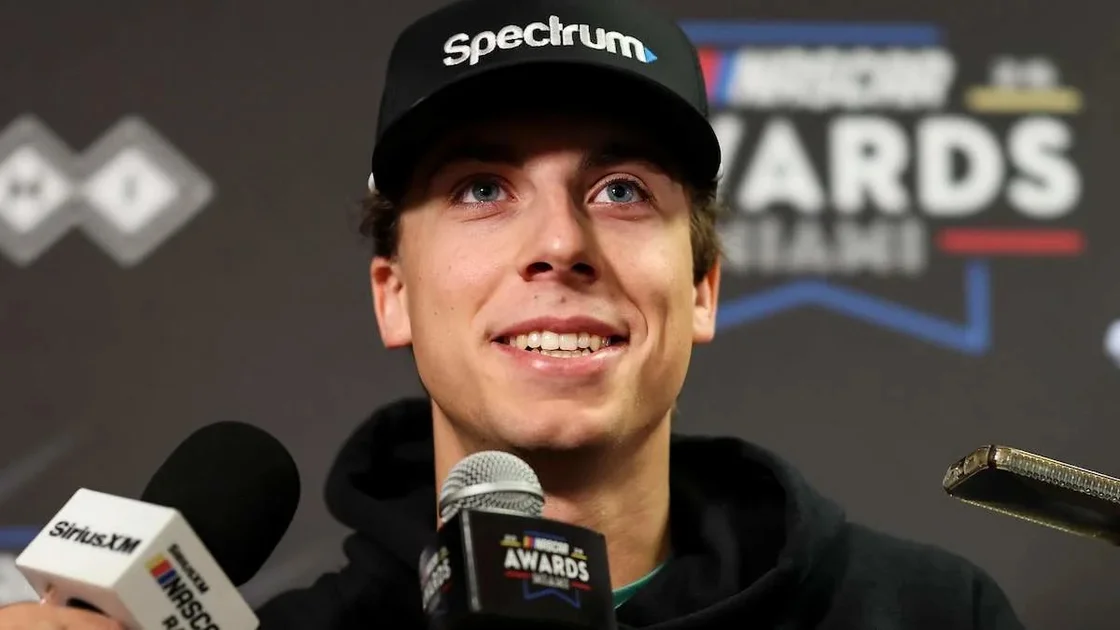
"It's the same thing in racing or in anything in life. You just go a little further, go a little further, go a little further, and then you've got to get the leash back or get it back under control," Hocevar said Tuesday at the NASCAR Awards in Miami, according to comments posted by Fox Sports reporter Bob Pockrass. "I think that's the balance of all that. I think you're seeing that after Martinsville. It's like, 'Okay, let's reel back in a little bit here on this type of stuff.' I think the aggression side of it, like you said, it's kind of what got me here, so why change?"
Those remarks came just over a week after Spire Motorsports co-owner Jeff Dickerson announced that the team had suspended Hocevar for the Cup Series season finale at Homestead-Miami Speedway. Justin Haley drove the No. 77 Chevrolet in his place. Hocevar watched from the sidelines — and, at times, from atop a golf cart as he greeted fans — while NASCAR separately penalized him under Section 4.4a of its rule book for actions detrimental to stock car racing.
The Incident That Sparked the Penalties
The trouble began on November 1 during the Xfinity 500 at Martinsville Speedway. During the second stage, Hocevar repeatedly hit his brakes in front of Austin Cindric's No. 2 Team Penske Ford. According to Racer, SMT data showed more than 1,000 pounds of brake pressure applied by Hocevar. The contact crushed the nose of Cindric's car and ended his race, leaving him 36th. Hocevar finished 21st.
NASCAR handed down its penalty days later: a $100,000 fine and a 25-point deduction. NASCAR Senior Vice President of Competition Elton Sawyer indicated that Hocevar's history played a role in the severity of the fine. Spire then took the extraordinary step of benching its own driver for the season finale, a decision Dickerson framed as a matter of principle rather than points or money.
"The way Carson conducted himself at Martinsville doesn't meet the standard we set for our drivers, team members, or employees, and there are consequences for that," Dickerson said. He stressed that the team had not stopped supporting Hocevar.
Hocevar, for his part, has acknowledged wrongdoing. He called it "an embarrassing day" and admitted he crossed the line in comments quoted by Yahoo Sports. He also released an 18-minute video apologizing for his actions. Yet his comments this week suggest a nuanced position: he accepts the need to pull back "on this type of stuff" while defending the underlying aggression that he says made him a Cup Series winner.
A Season of Flashpoints
The Martinsville incident did not occur in a vacuum. Hocevar's breakthrough 2026 season — highlighted by Spire Motorsports' first Cup Series victory at Talladega and a playoff berth — was punctuated by confrontations and controversial on-track moments.
At Darlington, Hocevar spun Brad Keselowski after contact and then joked that he did things for television and clicks. His rivalry with Zane Smith escalated at Chicagoland, where the two wrecked and were summoned to NASCAR's hauler. At Bristol, late contact with Ryan Blaney ended the Team Penske driver's race; the two traded punches afterward, and Hocevar finished third. At Phoenix, contact involving Ross Chastain sent Hocevar into Smith and Josh Berry.
The pattern drew scrutiny from veterans. Kevin Harvick, the 2014 Cup Series champion, issued a stern warning on his Happy Hour podcast following the Homestead sidelining.
"The fact that Hocevar got kicked out. And going back to the beginning of the season, when you talk about everything, there is a certain way that you have to go about all this," Harvick said. "And in the last race of the season, it caught up with Carson Hocevar and how you have to deal with things. You can't just do whatever you want in Cup racing."
Harvick's critique captures the tension at the heart of Hocevar's situation. The young driver has undeniable talent — enough to deliver Spire its first Cup win and earn a playoff spot — but his recurring flashpoints have invited consequences from both NASCAR and his own team, raising questions about whether his style is sustainable at the sport's top level.
Spire's Discipline Message Extends Beyond NASCAR
The consequences of Martinsville may reach beyond stock cars. Dickerson confirmed to Adam Stern of Sports Business Journal that Spire has discussed an Indianapolis 500 start for Hocevar but wants to see more discipline in his race craft first.
"What we're also wanting to see is a little more discipline" in Hocevar's race craft, Dickerson said, citing safety. "Because he could actually hurt himself in those cars." IndyCars run well over 200 mph at Indianapolis Motor Speedway — a different kind of risk than the Next Gen stock car.
Dickerson said an Indy 500 start is something Hocevar wants and something he has discussed with Dan Towriss, CEO of TWG Motorsports, which owns part of Spire and is the majority owner of Andretti Global. "But yeah, we've talked about it for sure, and I know it's something that Dan has said when the time is right that we can do," Dickerson said, "but I don't think we're there yet." Stern reported that the opportunity will not come in 2027.
Hocevar has already spent time around Andretti. In May, he watched practice for the 110th Indianapolis 500 from the team's pit box and afterward confirmed interest in attempting the Memorial Day weekend double — running the Indy 500 and the Coca-Cola 600 at Charlotte Motor Speedway on the same day. That ambition now appears contingent on demonstrating the discipline Spire is demanding.
Perspective: A Test of Talent and Temperament
Hocevar's situation reflects a broader tension in NASCAR between the aggression that produces exciting racing and the code of conduct that governs it. His refusal to abandon his style — even after a six-figure fine and a benching — sets up a compelling narrative for 2027: can a driver known for crossing lines learn to pull back without losing the edge that made him a winner?
His immediate future remains bright in some respects. Dale Earnhardt Jr. said on a live Dale Jr. Download that JR Motorsports plans to put Hocevar in one of its cars next year, suggesting that his talent remains in demand despite the controversy. Hocevar also characterized his punishment as fitting and described his Sunday at Homestead as relatively comfortable.
"I was pretty content with it. It wasn't like a surprise the second race started," he said. "There's a lot of people. I think they knew I had a little bit more time on my hands on Sunday."
But the stakes are clear. Harvick's warning, Dickerson's discipline-first stance on Indy, and NASCAR's willingness to levy a heavy fine all point to a sport that will not tolerate repeated violations. Hocevar says he will reel things in "on this type of stuff." The coming season will reveal whether that means meaningful change or merely a temporary adjustment. For a driver whose aggression is both his signature and his liability, the answer will shape not only his career but Spire's ambitions — on ovals and potentially at Indianapolis.
As Hocevar himself put it: "It's kind of what got me here, so why change?" The next chapter will test whether that question is confidence or defiance.
Comments