
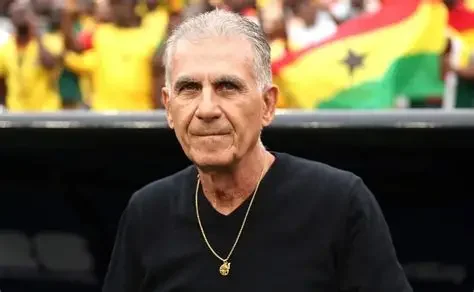
Queiroz confirms departure after Colombia defeat
Carlos Queiroz has confirmed he is stepping down as head coach of Ghana's Black Stars following the team's elimination from the 2026 World Cup. The 73-year-old Portuguese coach announced his exit after Ghana lost 1-0 to Colombia in the round-of-32 knockout stage on Friday.
Queiroz was appointed on a short-term deal in April to lead the West African side through the tournament. His departure marks the end of a brief tenure that lasted less than three months. The Ghana Football Association has yet to officially confirm the decision, but Queiroz made his exit public through a social media statement on Sunday.
Ghana finished third in Group L with four points — a 1-0 win over Panama, a goalless draw with England, and a 2-1 loss to Croatia. They advanced to the knockout phase as one of the best third-placed teams before falling to Colombia. Queiroz’s final match in charge was also his fifth consecutive World Cup as a manager, having previously led Iran, Portugal and Egypt at major tournaments.
A short but eventful stint
Queiroz took over from Otto Addo, who was sacked after Ghana's failure to qualify for the Africa Cup of Nations and a run of four straight defeats, including heavy friendly losses to Austria (5-1) and Germany (2-1). Despite the limited preparation time, Queiroz steadied the ship enough to guide Ghana through the group stage, but the round-of-32 exit proved to be the end of the road.
In his farewell message, Queiroz wrote: "Football, like life, teaches us one timeless lesson: you either win or you learn. I leave this journey with pride in what we achieved, but also with the healthy dissatisfaction of those who always wanted more."
Why Queiroz's exit matters for Ghana
Queiroz's departure plunges the Black Stars back into familiar turmoil. Ghana has cycled through coaches in recent years, struggling to build continuity. The team missed the 2025 Africa Cup of Nations, and the early World Cup exit — while a marginal improvement over previous campaigns — has not masked deeper structural issues.
Queiroz himself hinted at those problems in his statement, noting that success "must start off the field, by creating the best possible environment to prepare, protect and develop Ghana’s extraordinary football talent." The comment was widely interpreted as a critique of the Ghana Football Association's institutional backing.
Ghana is not alone in its coaching upheaval. Jordan also parted ways with head coach Jamal Sellami on Sunday after finishing fourth in Group J, highlighting a broader trend of World Cup management turnover. For Ghana, the immediate priority will be finding a permanent replacement to lead the team through the next World Cup cycle.
A decorated but nomadic career
Queiroz's resume includes two stints as Manchester United assistant under Sir Alex Ferguson, a brief and difficult spell as Real Madrid head coach, and nine different international teams. Before Ghana, he managed South Africa, the United Arab Emirates, Colombia, Egypt, Qatar and Oman, leaving the latter post in March just weeks before taking the Ghana job.
His influence on African football has been significant, but his quick exits have become a pattern. Just days before the World Cup, Queiroz had even suggested he might target a sixth World Cup in 2030 with Ghana, but that ambition has now evaporated.
Broader implications for African football
Queiroz's exit is the latest chapter in a turbulent World Cup for African teams. Ghana was one of several African nations to advance past the group stage, but the round-of-32 exit underscores the gap between promise and results on the continent. Systemic challenges — from federation governance to player development infrastructure — continue to hamper sustained success.
The round-of-32 stage itself has seen several high-profile exits, with England knocking out Mexico in a historic away win, Norway defeating Brazil, and Morocco preparing to face Canada in the next round. For Ghana, the search for stability begins again. Whether the next coach can break the cycle of short tenures and unfulfilled potential remains an open question.
Queiroz’s final World Cup campaign may be over, but the lessons he leaves behind — about preparation, environment and ambition — will likely echo in Ghanaian football for years to come.
Comments