
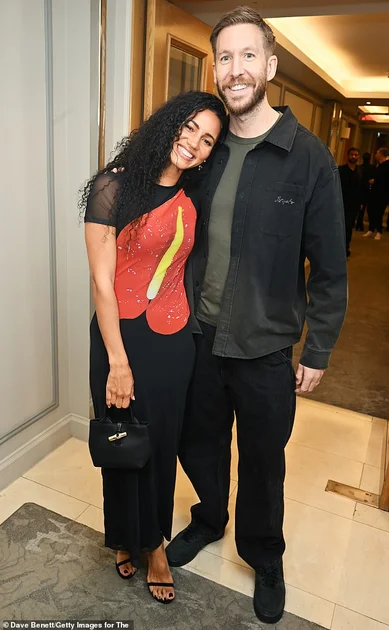
Calvin Harris Walks the Ivor Novello Awards Red Carpet in London
Superstar DJ and producer Calvin Harris made a rare public appearance at the 2026 Ivor Novello Awards in London on May 21, arriving alongside fellow luminaries for the prestigious songwriting ceremony. The evening’s red carpet saw Harris posing for photographers, his presence adding significant star wattage to an event already buzzing with surprise appearances and pointed political statements.
Harris was among a diverse lineup of nominees and presenters that included two-time nominee Self Esteem, rising star Chloe Qisha, and the night’s Special International Award winner, Linda Perry. Perry, best known for her work with 4 Non-Blondes and as a songwriter for artists like Pink, used her acceptance speech to reflect on the meaning of recognition. “It’s just nice when you get validation. To me, that’s what these kind of awards are. I’m doing something right. I’m on the right track,” she said, while also revealing that 4 Non-Blondes are reuniting for a new album and tour.
The event, officially known as the Ivors with Amazon Music, has long been a celebration of human songwriting craft. But this year’s ceremony carried a notably combative tone, as artists and industry figures used the stage to criticize artificial intelligence’s incursion into music and to lament the financial struggles facing modern songwriters.
A Night of Surprises and Sharp Critiques
The Ivor Novello Awards have historically been a genteel affair, quietly honoring the architects of beloved songs. This year, however, the room crackled with urgency. According to Variety, Ivors bosses Tom Gray and Roberto Neri issued stark warnings about how difficult it remains for songwriters to be heard and paid in the current streaming economy. Multiple artists used their airtime to slam AI companies and the music industry at large, framing the evening as a “deeply human, hot mess of a show” rather than the usual slick spectacle.
One of the biggest surprises of the night came when Harry Styles crossed the English Channel after opening his tour in Amsterdam to present Radiohead’s Thom Yorke with the Academy Fellowship, the Ivors’ highest honor. The moment was nearly spoiled when Sir Elton John inadvertently revealed the plan ahead of time, adding to the chaotic atmosphere. Styles’ appearance underscored the event’s ability to draw A-list talent, even as the mood turned defiant.
Rising star nominee Chloe Qisha spoke directly to the AI question during a red carpet interview. “I think I can only speak from what I know about writing,” she told reporters, emphasizing the irreplaceable value of human creativity in an era where algorithms are increasingly capable of generating music.
Why Songwriters Are Fighting Back Against AI and Low Streaming Royalties
The stakes for this year’s Ivors extend far beyond a single ceremony. The music industry is grappling with two existential threats: the rapid advancement of generative AI—which can now produce convincingly human-sounding vocals and compositions—and the persistent inadequacy of streaming payouts. For songwriters, who earn a fraction of a penny per stream, the combined pressure is pushing many out of the profession entirely.
Linda Perry’s Ivor Novello recognition came at a pivotal moment. Her career, spanning decades from the 1990s hit “What’s Up?” to writing for modern pop stars, represents the kind of longevity that today’s marketplace makes increasingly difficult. Her commentary about validation feels particularly resonant when set against the backdrop of an industry where even established writers struggle to make a living.
Self Esteem, a two-time nominee who won the Ivor Visionary Award in 2025, struck a more tempered note during her red carpet interview. “It’s not really about winning,” she said. “It’s just like a nice celebration of the people you work with as well. My team gets to put their frocks on and come. That’s nice.” Her perspective highlights the communal value of award ceremonies—a human connection that AI cannot replicate, but that the industry must still find ways to fund.
The Bigger Picture: Human Creativity Under Siege
The 2026 Ivor Novello Awards may well be remembered as a watershed moment in the music industry’s relationship with technology. For 71 years, the Ivors have quietly commended the geniuses behind the songs that shape popular culture. This year, the premise of human creativity itself felt under direct threat.
The anger on display was not unfounded. Major labels are racing to adopt AI tools for production and even songwriting, while streaming platforms continue to pay artists fractions of a cent per play. The disconnect between the value of music and the compensation it generates has never been wider. Songwriters, once the anonymous heroes of the industry, are now forced to become activists just to keep their profession viable.
Yet moments like Harris’s red carpet appearance and Styles’s tribute to Thom Yorke offer a counter-narrative. They remind audiences that live performance, collaborative creation, and shared recognition remain deeply valuable—even if the economic model supporting them is broken. As Linda Perry put it, external validation may not make you a better songwriter, but it does confirm you are on the right track.
The Ivors’ chaotic, passionate evening served as a microcosm of a larger struggle: how to preserve the soul of music-making in an era of unprecedented technological disruption. Whether the industry heeds that warning remains to be seen—but for one night in London, the songwriters made sure their voices were heard. For a look at how other forms of entertainment are navigating these shifts, see our coverage of Jake Gyllenhaal Box Office Flops and Streaming Wins: A Tale of Two Markets and Ron Howard and Natasha Lyonne Bring Avedon Doc to Life in Cannes Celebrations.
Comments