
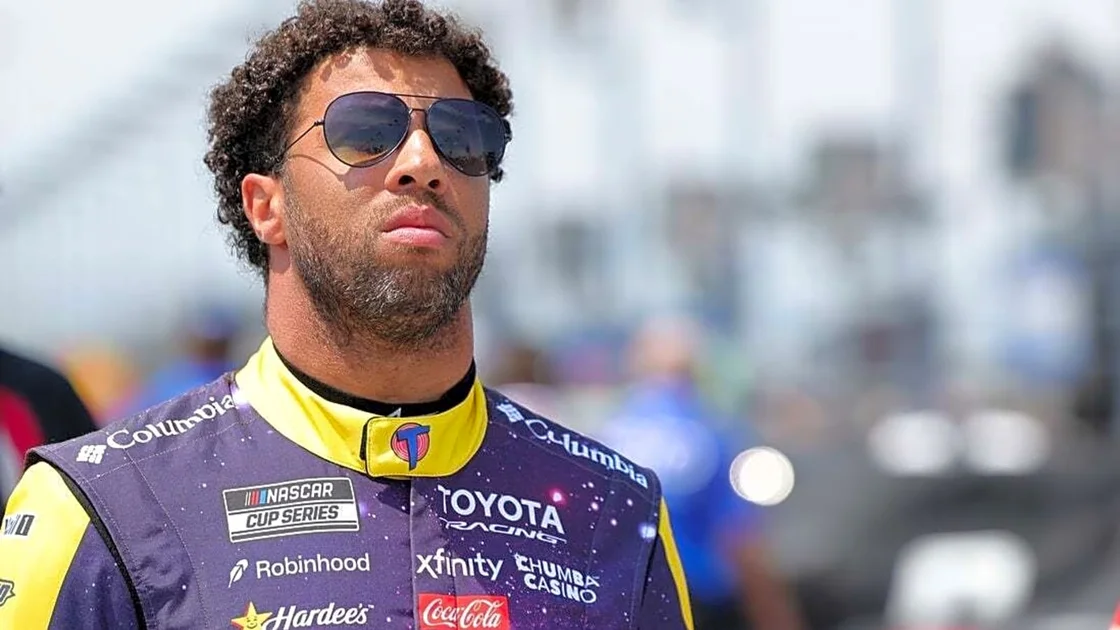
Bubba Wallace Penalty Strips Runner-Up Finish, Sparks Rule-Book Fury
Bubba Wallace believed he had secured one of the biggest finishes of his 2026 NASCAR Cup Series season Sunday night at EchoPark Speedway. Instead, the No. 23 Toyota driver climbed from his car to learn that NASCAR had issued a post-race penalty for advancing his position below the double yellow line on the final lap. The ruling erased what appeared to be a runner-up finish, dropped Wallace to 29th in the official results, and cost him 27 valuable championship points.
The penalty, which NASCAR officials confirmed is not subject to appeal, trimmed Wallace’s cushion above the provisional playoff cutline from 82 points to just 55 points—a swing that could prove critical as the regular season winds toward the Chase for the Championship. The controversial call has reignited debate over the wording of NASCAR’s rule governing the double yellow line, with Wallace and his 23XI Racing team insisting he did not gain a position.
The Final-Lap Incident: What Happened at EchoPark
The controversial moment unfolded on the final lap of the Quaker State 400 as Wallace chased race leader Ryan Blaney alongside Carson Hocevar. Wallace dove below the double yellow line entering the backstretch while attempting to avoid contact and maintain his position. NASCAR officials ruled he had advanced his position beneath the out-of-bounds line, triggering a penalty under Section 8.3.2.A of the NASCAR Rule Book.
Wallace strongly disagreed with that interpretation after the race. “It says advancing your position, which I did not do,” Wallace said. “I stayed third, and I was all over the brakes to make sure I did not advance. As soon as I turned, I was like, ‘I’m going to wreck,’ and got on the brakes, kept it underneath me and still ended up side-by-side. That move should have propelled me to the lead, and it didn’t because I knew it was wrong because my car did not like that move.”
He added: “We’ll see what we can do, but I did not advance my position. I stayed third from the entry of (Turn) 3 all until 50 yards away.” Following the race, Wallace met with NASCAR officials, but Cup Series Managing Director Brad Moran confirmed the penalty is not subject to appeal because it falls under an on-track judgment call governed by the rule book.
The 27-Point Swing: A Crushing Blow to Playoff Hopes
The immediate consequence extended far beyond the finishing order. Instead of leaving EchoPark Speedway with a runner-up finish and a major boost in the standings, Wallace was officially scored 29th. NASCAR said the penalty alone represented a 27-point swing. Without it, Wallace would have exited the weekend 82 points above the provisional cutline. Instead, he leaves with a 55-point advantage while remaining 13th in the standings.
Combined with points lost after being spun by Ty Gibbs at the end of Stage 2, Wallace managed just nine points on a night he spent much of the race running near the front, including 11 laps leading the field. “That’s massive for us,” Wallace said. “Everybody behind us in points is like, licking their chops.” The penalty could prove significant as the regular season winds toward its conclusion, trimming his cushion and creating another layer of drama heading into next weekend.
How the Rule Book Wording Fuels the Controversy
The key point of contention is the exact wording of the rule. The NASCAR rule states: “Vehicles must race above the double yellow lines around the entire race track. If in NASCAR’s judgement, the vehicle(s) goes beneath the double yellow lines to improve its position, vehicle(s) will be black-flagged. If in NASCAR’s judgement a vehicle forces another vehicle beneath the double yellow lines (in an effort to stop the advancement/pass) the vehicle may be black-flagged.”
The wording “to improve its position” is the sticking point for many. Wallace and his team argue that he did not improve his position, as he remained third when he went below the line and came back up still third. Jeff Gluck of The Athletic, speaking on The Teardown podcast, echoed this sentiment: “Now, he made a very sweeping move. He goes below the double yellow line briefly, he was third when he went below the double yellow line, and he came back up and was still third. He did not gain a position, but the rule is that they always talk about was improve your position. So can you clarify? Is improving your position in NASCAR’s judgment, does that just mean you got ahead of where you were before?”
The Teardown co-host and fellow writer for The Athletic, Jordan Bianchi, offered a different take. “He clearly went below the yellow line. He maintained he was in it, and he went forward and put him in a position to carry that momentum forward to move into the second spot.” Gluck disagreed: “That’s not what I saw. I thought that he made the sweeping move, right? So you’ve got Hocevar and Blaney. Bubba goes low to put himself three wide, and he’s third. And when he gets back on the track, he’s still third. Now, maybe he gained a position.”
Wallace and 23XI Protest: Meeting with NASCAR Yields No Change
Wallace and his 23XI Racing team, including crew chief Charles Denike and director of competition Dave Rogers, reviewed the team’s data before meeting with NASCAR officials for roughly 31 minutes following the race. The meeting did not change the outcome. “A penalty is a penalty,” Wallace said as he left the series hauler. NASCAR Cup Series managing director Brad Moran later confirmed the penalty could not be appealed, as in-race penalties are considered final.
Wallace defended his case using data from the team’s SMT (Sports Medicine Timing) system. “You can go back and look at the SMT. I was all over the brakes trying to just get the spot back,” he said. “It says don’t go below the yellow line to gain a position, which I didn’t. I was still third, and I got a shove from the 54 (Ty Gibbs) to go to second. So, technically, no positions were gained doing that.”
Broader Implications: A Defining Moment for NASCAR’s Rule Enforcement
This controversy goes beyond a single race. It raises fundamental questions about how NASCAR interprets and enforces its rules, and whether the language of the rule book is precise enough to avoid such disputes. The fact that the penalty is not appealable, because it is considered an on-track judgment call, leaves drivers and teams frustrated.
The incident echoes previous high-profile penalties for going below the double yellow line, but the specific question of whether a driver can go below the line without gaining a position has rarely been tested so clearly. The next time a similar situation arises, drivers may be forced to decide between avoiding contact and staying above the line, even if that risks a wreck.
With the regular season winding down, every point matters. For Wallace, the 27-point swing adds pressure to perform in the coming weeks. For the sport, the debate over rule wording may lead to clarification or revision in the off-season. For now, Wallace and his team must look ahead, knowing that a runner-up finish that could have been a playoff game-changer is now a painful memory—and a 29th-place result.
The controversy also highlights the fine margins that separate victory from defeat in NASCAR. In a sport where hundredths of a second can decide a race, a split-second decision below a painted line can erase weeks of hard work. As Wallace summed up, his competitors are now licking their chops—and the playoff picture is suddenly much tighter.
Comments