
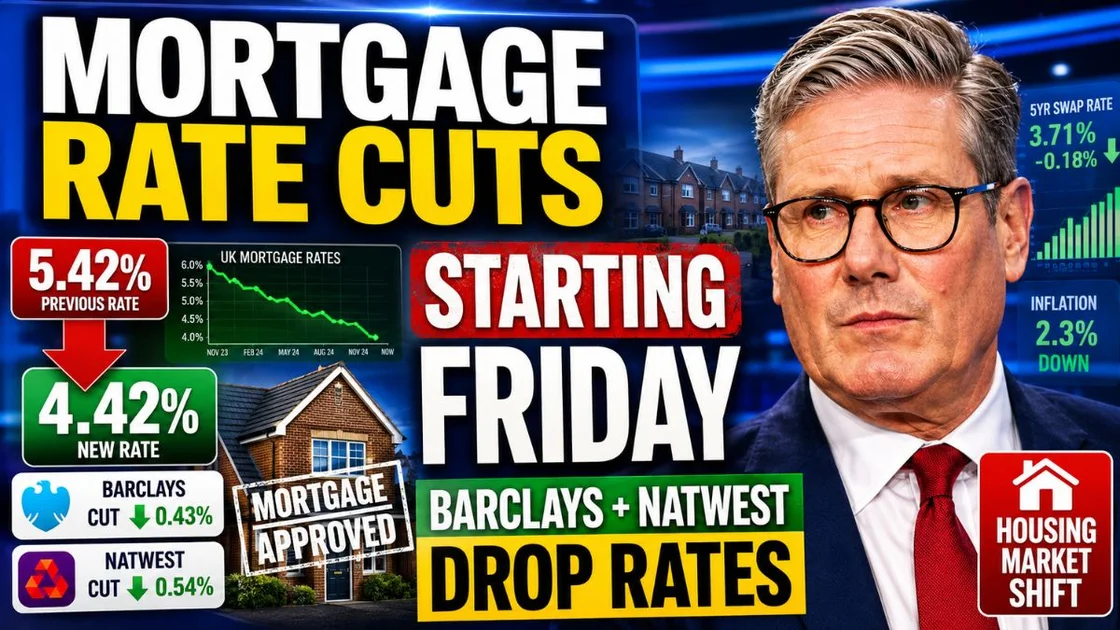
Barclays and NatWest Lead Mortgage Rate Cuts as Summer Buying Season Begins
Barclays and NatWest have announced significant mortgage rate reductions effective from Friday, May 29, 2026, marking one of the most coordinated rounds of price cuts from major high-street lenders this year. The moves come as wholesale borrowing costs — known as swap rates — have eased, and as competition intensifies ahead of the traditional summer property buying season.
Barclays has slashed rates across its range by up to 0.43 percentage points. The headline reduction is on its three-year fixed purchase mortgage at 95% loan-to-value (LTV), which drops from 5.85% to 5.42%, carrying an £899 fee and a maximum loan of £570,000. Other notable cuts include the two-year fixed purchase deal at 60% LTV with an £899 fee, falling from 4.60% to 4.39%, and the fee-free version at the same LTV, which drops from 4.79% to 4.64%.
NatWest has gone slightly further, trimming rates by up to 0.54 percentage points. Its standout product is a two-year tracker remortgage at 80% LTV with a £995 fee, now priced at 4.42%. For first-time buyers, the bank cut its two-year fix at 90% LTV with no fee from 5.56% to 5.35%, while the version with a £995 fee fell from 5.15% to 5.05%. Buy-to-let and Help to Buy products have also been reduced.
Coventry Building Society has followed suit, announcing cuts across its range, while Santander reduced rates by up to 0.23% the previous week and Gen H trimmed rates by up to 0.3% earlier this week. This cascade of reductions suggests a broader repositioning by lenders, rather than isolated adjustments.
Why These Cuts Matter: Borrowing Costs and Geopolitical Context
The timing of the cuts is notable. They come amid easing tensions in the Iran conflict, which had previously unsettled global bond markets and pushed swap rates higher. As geopolitical risks recede, swap rates — which underpin fixed mortgage pricing — have fallen, allowing lenders to pass on savings to borrowers.
Justin Moy, managing director of Chelmsford-based EHF Mortgages, told Newspage: "Some significant cuts from a number of high street lenders, as swap rates improve and the likelihood of base rate increases in 2026 recedes. But it's so important for borrowers to act 'quickly' just in case, as we have seen so many times this year, rates can increase with little notice."
This caution is echoed by Jack Tutton, director of Fareham-based SJ Mortgages, who described "growing optimism" among brokers. He added: "This marks a significant shift in the market, with many lenders reducing some of their rates today. These widespread cuts are set to increase competition in the mortgage market as summer approaches, bringing welcome news for those planning to move in the coming months."
The cuts are also a response to changing expectations around the Bank of England base rate. Earlier this year, markets had priced in potential rate hikes, but softer economic data and cooling inflation have reduced the likelihood of further increases. This has given lenders more confidence to lower pricing, particularly for fixed-rate products.
The Role of Swap Rates in Mortgage Pricing
Swap rates are the primary driver of fixed mortgage costs in the UK. They reflect the cost for lenders to lock in funding for a set period. Over the past month, these rates have trended downward, enabling lenders to reduce margins on new deals. However, swap rates remain volatile, and any renewed geopolitical shocks or inflationary surprises could reverse the trend quickly.
Industry observers note that mortgage pricing is now more responsive to short-term swap movements than in previous cycles. This means that even a modest uptick in swap rates could trigger a rapid repricing of retail products.
Broader Implications: Competition Heats Up as Lenders Vie for Market Share
With multiple lenders cutting rates in quick succession, the mortgage market is entering a more competitive phase. This is good news for borrowers, particularly first-time buyers and those remortgaging, but it also places pressure on lenders to maintain profitability.
Dariusz Karpowicz, director of Doncaster-based Albion Financial Advice, described the cuts as "welcome news" and noted that summer is traditionally a "buying season." He added: "The trend is encouraging, but borrowers should not assume rates will keep falling. Locking in a good deal now, rather than waiting, is often the safest strategy."
The reductions also highlight the divergence between different segments of the market. While best-buy rates for borrowers with high equity (low LTV) have fallen sharply, deals for those with smaller deposits (high LTV) remain more expensive. For example, Barclays' new 95% LTV three-year fix at 5.42% is still more than a full percentage point above the best two-year fixes available at 60% LTV (around 4.39%). This gap reflects the higher risk lenders attach to high-LTV lending, even in a falling rate environment.
Impact of Recent Economic and Geopolitical Events
The recent rate cuts have been partly attributed to improved sentiment following de-escalation in the Iran conflict. Earlier this year, rising geopolitical tensions had pushed up oil prices and bond yields, spilling over into mortgage costs. As the situation stabilised, swap rates recovered, allowing lenders to cut prices.
For a deeper look at how global peace hopes have influenced bond markets, see our article on how Mortgage Rates Drop as US-Iran Peace Hopes Boost Bond Markets.
However, experts caution that this could be temporary. The geopolitical landscape remains fragile, and any escalation could reverse the current trend almost overnight. This unpredictability is why brokers are urging borrowers to act swiftly rather than wait for further cuts.
Outlook: What Borrowers Should Expect in the Coming Weeks
Looking ahead, most analysts expect further mortgage rate reductions, but with caveats. The direction of swap rates will be key. If economic data continues to support a stable or lower base rate outlook, lenders may continue to trim pricing. But if inflation proves sticky or new geopolitical tensions emerge, rates could rise again.
Simon Webb, director of London-based Finance Advice, commented: "We're seeing the early stages of a price war, which is great for borrowers. But lenders are also managing capacity — they can pull deals at any time if they get too many applications. Borrowers who are ready to proceed should not delay."
For those considering a move or remortgage, the current environment offers genuinely competitive rates not seen in several months. However, with the Bank of England yet to signal a definitive end to its tightening cycle, and global risks persisting, the window for these deals may be narrow.
Advice for Homeowners and Buyers
Mortgage brokers advise the following steps for anyone looking to take advantage of the current cuts:
- Get your documents ready: Lenders are processing applications quickly, and having payslips, bank statements, and identification ready can speed up the process.
- Compare total costs: The lowest rate is not always the best deal if it comes with high fees. Calculate the total cost over the initial rate period.
- Consider fixing vs. tracking: With swap rates falling, tracker products (like NatWest's 4.42% tracker) may offer short-term savings, but fixed rates provide certainty. The choice depends on your risk appetite and how long you plan to stay in the property.
- Act quickly: As brokers repeatedly warn, rates can change with little notice. If you find a deal that works, lock it in.
Key Takeaways
The combined rate cuts from Barclays and NatWest, supported by Coventry Building Society, Santander, and Gen H, represent the most significant repricing of mortgage products since the start of 2026. Driven by falling swap rates and reduced geopolitical tensions, the move has injected optimism into the housing market just as the summer buying season begins.
However, the backdrop remains uncertain. Swap rates are sensitive to economic data and global events, and the Bank of England's next moves are not set in stone. Borrowers are advised to act decisively, while keeping an eye on the broader economic picture.
As the market evolves, staying informed through trusted sources and professional advice will be essential. For those ready to buy or remortgage, the current window offers some of the most attractive rates in months — but it may not stay open for long.
Comments