
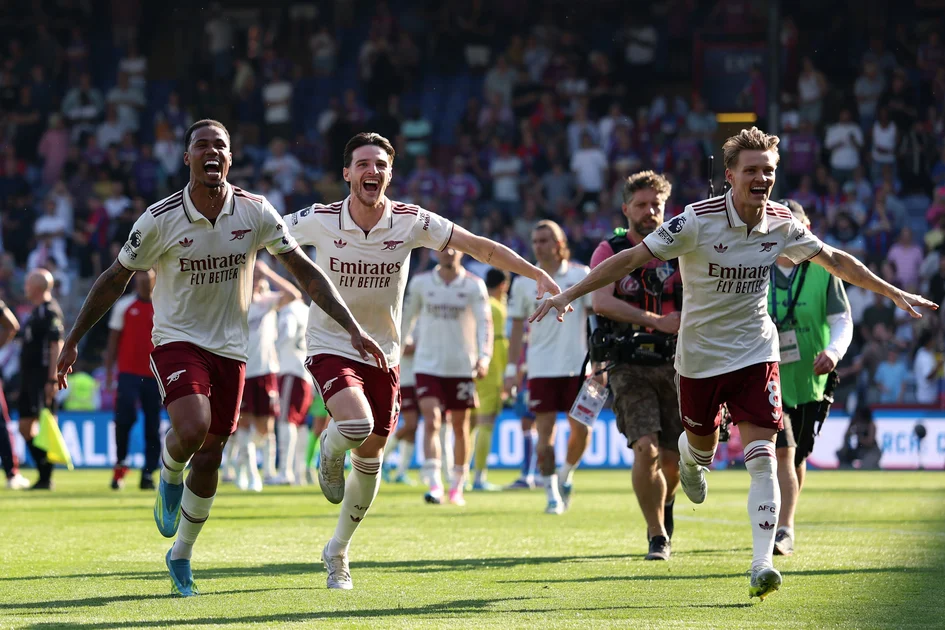
Arsenal lift Premier League trophy at Selhurst Park after final-day win
Arsenal have capped a dominant 2025-26 Premier League campaign by lifting the trophy in front of their traveling supporters at Selhurst Park on Sunday, May 24, 2026. The Gunners defeated Crystal Palace on Championship Sunday to add a final flourish to a season that saw them clinch the title with days to spare.
Captain Martin Odegaard hoisted the silverware as Arsenal players, staff, and fans celebrated a moment 22 years in the making — the club’s first Premier League crown since 2004. The scene was one of jubilation, with red smoke flares lighting up the away end and chants of “Champions” ringing around the South London ground.
Arsenal had secured the title midweek after Manchester City’s draw at Bournemouth mathematically confirmed Mikel Arteta’s side as league winners. The squad watched City’s slip-up together before venturing into London for impromptu celebrations, but Sunday’s formal ceremony marked the official coronation.
The trophy lift followed a carefully choreographed sequence. Arsenal wore their white third kit for the match against Crystal Palace, who play in red and blue, but changed into their iconic red home shirts before returning to the pitch for the presentation. Players received their winner’s medals before Odegaard raised the trophy as confetti rained down.
Arteta: ‘We needed to connect with the people’
Speaking ahead of the match, Arteta emphasized the importance of sharing the moment with supporters. “On Sunday, we’ll have a little window there again to celebrate, to lift the trophy in a manner that deserves it, to connect with the people that we have constantly around us,” he said.
The manager also looked ahead to a potential double, with Arsenal set to face Paris Saint-Germain in the UEFA Champions League final on Saturday, May 30. “And then we’ll have six days that we need to write a new history in this football club,” he added.
Why this title matters: the end of a long wait
Arsenal’s Premier League triumph ends a 22-year drought — the longest in the club’s modern history. The last time the Gunners finished top of English football’s top flight was the “Invincibles” season of 2003-04, when Arsène Wenger’s side went unbeaten across 38 matches.
Since then, Arsenal have endured near-misses, transitional periods, and years of rebuilding. The arrival of Mikel Arteta in December 2019 signaled a shift in philosophy, focusing on youth, tactical discipline, and a strong club culture. Over six seasons, Arteta has guided Arsenal from mid-table obscurity to the summit of English football.
The 2025-26 title represents the culmination of that project. Arsenal have combined a solid defense with an explosive attack, and key players such as Odegaard, Bukayo Saka, and Gabriel Martinelli have developed into world-class talents. The club also made shrewd signings — including a record-breaking summer window in 2025 — that added depth and experience.
The title race was decided with days to spare, thanks to Manchester City’s slip at Bournemouth. City’s draw handed Arsenal an unassailable lead, sparking scenes of celebration across North London. The Gunners finished the season with the best defensive record in the league and the second-highest goal tally.
For the fans, this title carries deep emotional weight. The club’s stadium, the Emirates, has often been a place of frustration and unfulfilled promise. Now it stands as a fortress — and a launchpad for further ambitions.
The legacy of the Invincibles and a new era
While comparisons to the 2003-04 side are inevitable, this Arsenal team has forged its own identity. Where the Invincibles were defined by flair and resilience, Arteta’s side is built on structure, pressing, and collective effort.
Players like Ethan Nwaneri — who made history as Arsenal’s youngest-ever Premier League appearance — represent the club’s commitment to homegrown talent. Nwaneri has since joined the England pre-World Cup camp as part of his rapid rise, a sign of the pipeline Arteta has fostered.
The final-day experience: from kit swap to trophy lift
The trophy presentation at Selhurst Park was meticulously planned. Arsenal’s players entered the pitch after changing into their red home kits, ensuring the iconic images of the trophy lift would showcase the club’s traditional colors rather than the white third strip worn during the match.
Crystal Palace conducted their own lap of appreciation for their fans before the ceremony, with manager Oliver Glasner waving goodbye as he prepares for the Europa Conference League final. That allowed Arsenal’s moment to take center stage.
The traveling supporters — who had waited years for this day — were in full voice. As Odegaard lifted the trophy, chants of “We’ve got our Arsenal back” echoed across the stadium. Players took turns lifting the trophy, and Arteta was lifted onto the shoulders of his coaching staff.
A season of resilience and dominance
Arsenal’s campaign was not without challenges. They lost key players to injury at various points, including a midseason spell without Saka and Martinelli. But the squad’s depth — boosted by smart recruitment — proved decisive.
The Gunners also navigated a demanding Champions League schedule, reaching the final in Paris. That achievement, combined with domestic success, has elevated the club’s status on the continent.
Arteta’s tactical flexibility was a hallmark of the season. He shifted between a 4-3-3, a 3-2-5 build-up shape, and even a box midfield to counter different opponents. His ability to adapt in-game kept Arsenal ahead of rivals Manchester City and Liverpool, who finished second and third respectively.
Broader implications: Premier League power shift and Arsenal’s double chance
Arsenal’s title win signals a potential shift in the balance of power in English football. For the past several seasons, Manchester City have dominated under Pep Guardiola, winning multiple titles and setting records. Guardiola’s future at City has been a subject of speculation — with Sunday’s finale also marking an emotional goodbye for the Catalan manager at the Etihad.
Arsenal’s rise provides a counter-narrative: a historic club rebuilding through patient investment and a clear vision. If the Gunners can complete the double by beating PSG next week, they will have achieved a feat few predicted at the start of the season.
The wider Premier League saw other dramatic moments on the final day. West Ham were relegated, European places were resolved, and Tottenham secured a win over Everton. But all eyes were on Selhurst Park for the trophy lift.
What comes next: the Champions League final and beyond
Arsenal now face a decisive week ahead of the Champions League final against PSG in Munich. Arteta has stressed the need to quickly refocus after the celebrations. “We had 48 hours to enjoy the success. Now we’re going to prepare really well,” he said.
A victory against PSG would complete a historic double — only the third time an English club has won both the Premier League and Champions League in the same season. It would cement Arsenal’s revival as one of the great stories in modern football.
For the fans, the journey continues. But on this Sunday in May 2026, they paused to savor a moment 22 years in the making, as the trophy was lifted high above Selhurst Park, and North London — and all of world football — took note.
A city united: Arsenal’s triumph inspires beyond football
Arsenal’s title win has resonated far beyond the Emirates Stadium. In North London, fans flooded the streets, pubs stayed open late, and the club’s iconic crest was projected onto landmarks. The victory brought a sense of unity to a community that has often faced economic and social challenges.
Local businesses reported a surge in sales of Arsenal merchandise and celebratory drinks. The club’s charitable foundation also used the moment to highlight community programs, with players making appearances at local schools and hospitals in the days leading up to the trophy lift.
The title has also reignited debates about financial fairness in football. Arsenal have spent heavily but have operated within financial fair play rules. Their success could serve as a model for other historic clubs seeking to challenge cash-rich rivals.
In a wider sports context, Arsenal’s achievement adds to a busy weekend of headlines. From the emotional Indy 500 to cricket’s playoff drama and football’s ongoing transfer rumors, May 24, 2026, will be remembered as a landmark day in sport.
For now, though, it belongs to Arsenal. The trophy is lifted, the confetti has settled, and the party is just beginning.
Comments