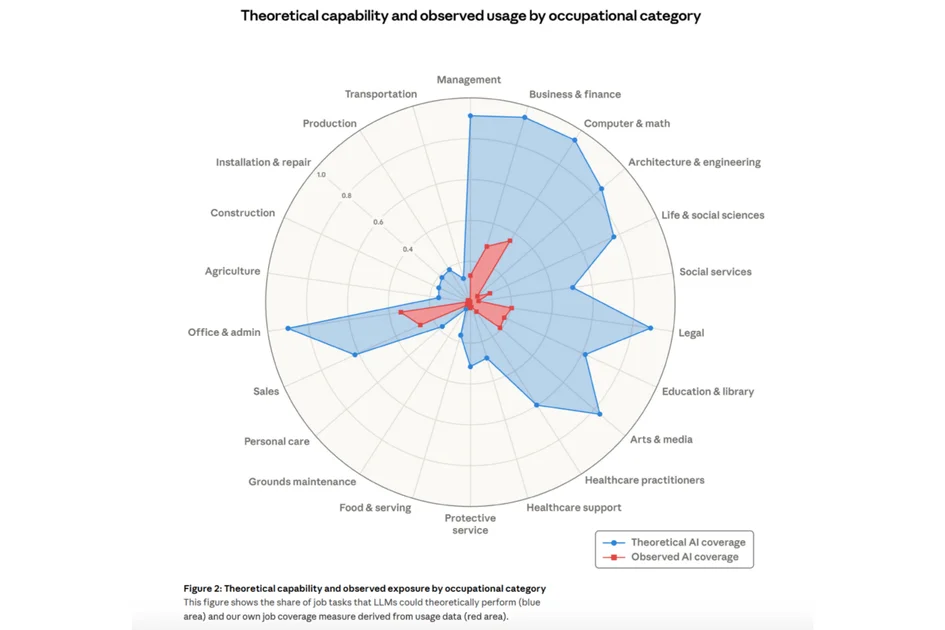
A landmark study published by Anthropic in March 2026 offers the most granular look yet at how artificial intelligence is reshaping the workforce — and the conclusions are both more reassuring and more unsettling than previous warnings suggested. While AI tools are currently being used at only a fraction of their theoretical capacity, the research makes clear that when adoption catches up with capability, the consequences could be severe for a very specific type of worker: educated, experienced, and well-compensated.
A New Metric for Measuring AI's Real-World Reach
The report, titled "Labor market impacts of AI: A new measure and early evidence," was co-authored by researchers Maxim Massenkoff and Peter McCrory. At its core, the study introduces a concept called "observed exposure" — a metric designed to compare what AI systems are technically capable of doing with how much they are actually being used in professional environments. The data was drawn directly from real workplace interactions with Anthropic's Claude model, giving the findings an unusually concrete empirical foundation.
The headline finding is striking: in most sectors, actual AI usage represents only a small fraction of what the technology could theoretically handle. Entire categories of professional work — including business and finance, management, legal services, computer science, mathematics, and office administration — fall within AI's theoretical reach. But real-world deployment remains limited, held back by regulatory constraints, software integration challenges, model limitations, and the continued need for human oversight and review.
According to the researchers, those barriers are unlikely to last. The implication is that a significant wave of AI-driven job disruption may be building slowly but steadily beneath the surface of current labor market data.
The Unexpected Face of AI Displacement
Perhaps the most counterintuitive element of the study is who it identifies as most at risk. Popular narratives around automation have long focused on manual laborers and low-wage service workers. The Anthropic research paints a very different picture.
The occupational group most exposed to AI displacement is 16 percentage points more likely to be female, earns on average 47% more than the least exposed group, and is nearly four times as likely to hold a graduate degree. In other words, the workers with the most to lose are lawyers, financial analysts, software developers, and data professionals — not warehouse workers or delivery drivers.
Among the most exposed specific roles, the study highlights computer programmers, customer service representatives, and data entry keyers. Yet even these occupations have not yet experienced widespread displacement, suggesting the reckoning — if it comes — remains on the horizon rather than already underway.
This framing aligns with warnings that have been circulating among business and tech leaders for months. Anthropic CEO Dario Amodei stated last year that AI could disrupt as much as half of all entry-level white-collar work. Microsoft's AI chief Mustafa Suleyman went further, suggesting that most professional tasks could be automated within one to eighteen months. Those projections now appear to have some empirical grounding.
Historical Parallels and the Scale of What's Coming
To understand the potential scale of disruption, it helps to look at history. The invention of electricity made entire job categories — lamplighters, elevator operators, human alarm callers — disappear almost entirely. The rise of personal computing rendered switchboard operators, file clerks, and data entry workers largely obsolete over the course of a generation.
AI may be engineering a similar shift, but faster and aimed at a different stratum of the workforce. Some economists have begun using the phrase "Great Recession for white-collar workers" to describe the scenario that Anthropic's data implicitly outlines — not a sudden collapse, but a prolonged and painful structural adjustment concentrated among college-educated professionals who have historically been insulated from automation.
This context matters especially when viewed alongside broader labor market trends. As the June Jobs Report Beats Expectations: US Economy Adds More Jobs Than Forecast illustrated, headline employment figures can mask deep structural shifts happening beneath the surface. Strong job numbers do not necessarily signal that the workforce is adapting smoothly to technological change.
What Comes Next
The Anthropic study does not offer policy prescriptions, but its implications are hard to ignore. The gap between AI's theoretical capabilities and its actual usage is not a permanent safety buffer — it is a delay. Legal systems, enterprise software infrastructure, and workplace culture are catching up, and as they do, the pressure on white-collar professions will likely intensify.
For individuals in highly exposed fields, the study serves as an early warning. For policymakers and business leaders, it underscores the urgency of rethinking education, retraining frameworks, and labor protections before the gap closes entirely. The electricity analogy may be apt in one final sense: the disruption it caused was inevitable, but societies that prepared for it fared considerably better than those that did not.
Comments