
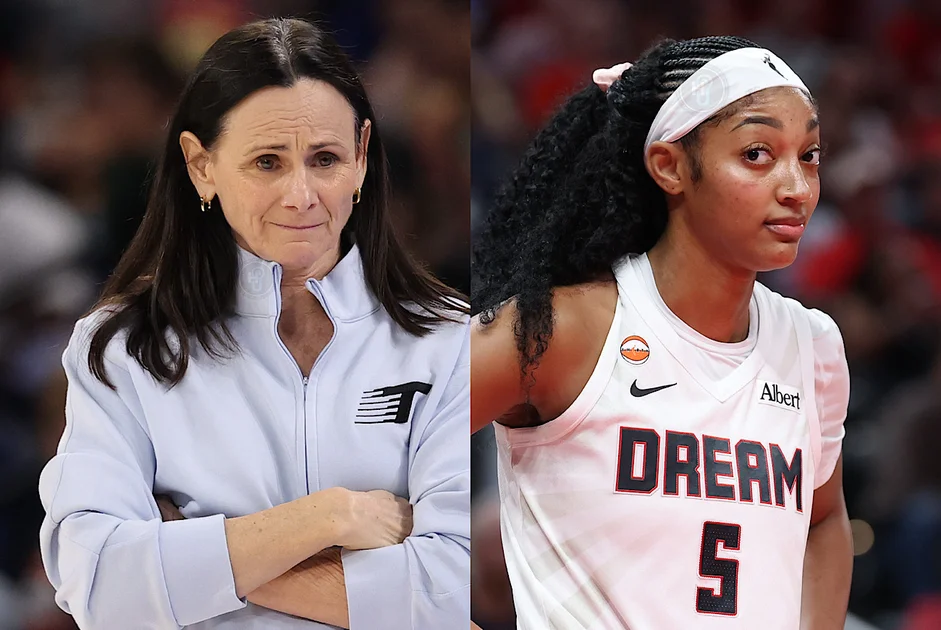
Angel Reese Accepts Apology, Thanks WNBA for Suspension of Sandy Brondello
Atlanta Dream forward Angel Reese publicly addressed the inflammatory comment made by Toronto Tempo head coach Sandy Brondello for the first time on Sunday, stating she appreciated both Brondello’s apology and the WNBA’s swift disciplinary action. The league suspended Brondello for one game without pay after she referred to Reese as a “protected species” during Friday night’s matchup in Toronto.
Speaking before the Dream’s 93-91 victory over the Chicago Sky on Sunday, Reese emphasized that there is no room for such language in the league. “First, I appreciate Sandy’s apology, but I also appreciate the love and support that I’ve had for the last 48 hours,” Reese said. “It has been very overwhelming. A lot of love, and also other things. I am grateful that the league did take action… There is no place for discrimination or hate in this league from anyone — from fans to coaches to players.”
The WNBA announced Brondello’s suspension on Saturday, deeming her remark an “inappropriate comment.” Brondello issued a public apology on X (formerly Twitter) and Instagram the same morning, and later told reporters she had tried to reach Reese through Dream general manager Dan Pandover immediately after the game.
Context: The Incident and the Fallout
The controversy erupted late in the fourth quarter of Friday’s game between the Dream and the expansion Toronto Tempo. Atlanta guard Nyara Sabally was called for a defensive foul on Reese after the two collided. While Sabally remained on the floor receiving medical attention for an apparent injury, Brondello yelled at official Toni Patillo: “Angel, she’s a protected species.”
Reese quickly responded on social media, sharing video of the exchange with the caption: “ARE WE SURPRISED?! @SBrondello” along with a clown face emoji. The post went viral, drawing immediate scrutiny and calls for league intervention.
Brondello, an Australian native and veteran coach with 27 years of experience in the WNBA, later explained that the phrase is a “common expression in Australia” and was not intended as a racial or discriminatory dig. “It was an emotional statement. It’s a statement that’s very common in Australia. It wasn’t directed at Angel. I’d never do that to any kind of player,” Brondello said on Sunday. “I made a comment that Australians, we say all the time, and unfortunately I should have taken a breath and realized where I am in America because I know racism is such a big issue here.”
The WNBA’s decision to suspend Brondello, even for just one game, signals a heightened sensitivity to language that could be perceived as racially charged. The league has faced repeated criticism in recent years over how it handles incidents involving player safety and respect, particularly amid rising tensions around officiating and star treatment.
This incident comes at a time when the WNBA’s profile has never been higher. Rookie sensation Caitlin Clark recently scored 45 points in a game, and the league’s All-Star rosters were just finalized. The league is also grappling with broader conversations about player protection and the treatment of its stars—conversations that have been fueled in part by the success of players like Reese and Clark.
Reese, a polarizing and dominant forward for the Dream, has been at the center of debates about physical play and officiating bias throughout the season. The phrase “protected species” implies that Reese receives preferential treatment from officials, a charge that has been levelled against other superstars in the league’s history.
Perspective: Broader Implications for the WNBA
While Brondello’s apology was accepted by Reese, the incident has reignited a critical conversation about race, language, and accountability in women’s basketball. Brondello’s defense—that the phrase is a harmless Australian colloquialism—highlights the cultural gaps that can lead to misunderstandings in an increasingly international league. Yet the WNBA’s quick response shows that context does not immunize coaches or players from consequences.
Reese’s measured public statement focused on moving forward and returning to basketball. “The WNBA is supposed to be positive, and we are going in a great light right now, so I just want to continue that and move forward,” she said. Her willingness to accept the apology and thank the league for its action could serve as a model for how high-profile conflicts can be resolved without long-term acrimony.
The suspension also places the league’s officiating culture under renewed scrutiny. Fans and analysts have long debated whether certain players—particularly those who draw fouls at a high rate—are “protected” by referees. Reese is one of the league’s most aggressive paint players, and she leads the WNBA in free throw attempts per game. This statistical reality fuels perception, but Brondello’s choice of words crossed a line that the league was unwilling to tolerate.
This story also intersects with broader trends in sports. Recent controversies in the NBA and MLB have shown that leagues are increasingly willing to punish public figures for remarks that could be interpreted as racist or discriminatory. The WNBA, with its diverse player base and progressive stance on social justice, has been particularly sensitive to such issues.
As the regular season continues, the Dream and the Tempo are unlikely to meet again until the playoffs, potentially defusing immediate tensions. But Brondello’s remark will remain a cautionary tale for coaches and players about the power of words—especially in an era when every sideline comment can be captured on camera and shared globally within minutes.
The incident also underscores the unique pressures faced by the Toronto Tempo in their inaugural season. The expansion franchise has been competitive but has struggled with consistency. Injuries to key players like Sabally have tested the team’s depth and Brondello’s composure.
For Reese, the focus now returns to the court. She enters the All-Star break as one of the league’s most productive forwards, and the Dream are positioning themselves for a deep playoff run. With the league’s support behind her, she has turned a potentially divisive moment into one of unity and forward momentum.
In a season defined by rising attendance, record-breaking performances, and heightened media attention, this episode may ultimately be remembered as a test the WNBA passed—one that reaffirmed its commitment to respect and inclusion, even when the stakes are personal and the emotions run high.
Comments