
De Zerbi Arrives at a Crisis Club, Invoking Postecoglou's Name
Roberto De Zerbi has wasted no time in setting out his vision for Tottenham Hotspur — and the name he keeps returning to is Ange Postecoglou. Appointed as the north London club's fourth head coach in just nine months, the 46-year-old Italian has pledged to restore the free-flowing, possession-based football that Postecoglou brought to Spurs during his first season in charge, a style supporters quickly dubbed "Ange-ball."
"I want to keep the ball," De Zerbi said ahead of his first match in charge. "I want to see again the Tottenham I watched with Postecoglou because, in my second season in Brighton, there was Postecoglou here with a lot of these players and it was one of the best teams in terms of quality of play. With Pedro Porro, with Udogie, with Van de Ven, with Romero — I would like to see it again."
Those words, warmly received by a beleaguered fanbase, were quickly put to the test. On April 12, De Zerbi's first match in charge ended in a 1-0 defeat away at Sunderland. Worse still, captain Cristian Romero left the pitch in tears with 25 minutes remaining, apparently nursing a knee injury, in a moment that seemed to crystallize the depth of the crisis engulfing the club.
A Season in Freefall: The Context Behind the Crisis
From Trophy Glory to the Brink of the Championship
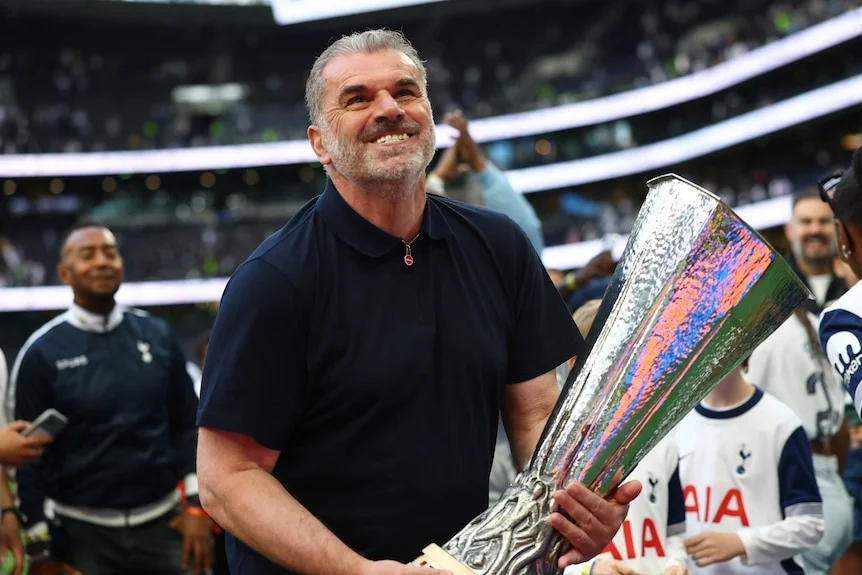
The scale of Tottenham's collapse this season is difficult to overstate. Postecoglou, who was sacked weeks after leading Spurs to Europa League glory last summer — ending a 17-year trophy drought — has gradually been rehabilitated in the eyes of supporters as the season has deteriorated under his successors. His 17th-place Premier League finish, which at the time represented the club's worst-ever top-flight season, now looks like a minor blemish compared to what followed.
Thomas Frank was hired last summer and, bewilderingly, declared in his opening press conference that Tottenham would lose matches. They did. He was replaced by Igor Tudor, whose appointment lasted just 44 days before De Zerbi was brought in on a reported £12 million-a-year, five-year contract with no relegation break clause.
As of April 14, 2026, Spurs sit in 18th place in the Premier League — the relegation zone — with seven games remaining and no league victory since December 28 against Crystal Palace. That is a run of 14 games without a win, a statistic that reads less like a slump and more like a structural collapse.
The Weight of What Postecoglou Built — and What Was Lost
Postecoglou's legacy at Spurs has become more complex with the passage of time. While critics pointed to the defensive vulnerabilities inherent in his high-pressing, attack-at-all-costs philosophy, his supporters — and now De Zerbi himself — argue that the foundation he built, particularly in his first season, represented genuine quality. The Australian coach's willingness to play brave, uncompromising football, regardless of circumstance, has become something of a benchmark against which his successors have been unfavourably measured.
For many Spurs supporters, the turgid pragmatism introduced under Frank and Tudor felt like an erasure of identity that not only failed on the pitch but alienated the fanbase. De Zerbi's explicit desire to reconnect with the Postecoglou era is as much a cultural statement as a tactical one — an acknowledgement that the club lost something important when it moved away from that style.
This mirrors a broader pattern in elite football, where clubs increasingly oscillate between identity-driven coaches and results-focused pragmatists, often discovering that the latter option delivers neither results nor engagement. As Lamine Yamal at 18 demonstrates in Barcelona's case, clubs that invest in a coherent footballing philosophy tend to build more sustainable competitive structures over time.
Can De Zerbi Actually Save Spurs — and What Happens Either Way?
The Immediate Challenge Is Psychological, Not Tactical
De Zerbi has been refreshingly candid about the limits of his tactical influence in this short window. With fewer than two weeks before his first game, he opted to keep his ideas simple, focusing on two or three core principles rather than overwhelming players with complexity. More pointedly, he has framed his immediate role as psychological rather than technical.
"My job now is not to coach a style, with or without the ball, but to try to give the players what they need in terms of mentality," he said after the Sunderland defeat. The fear of relegation, he acknowledged, may be consuming the squad — a self-fulfilling cycle of anxiety that no tactical blueprint alone can break.
The injury to Romero complicates matters further. The Argentine captain is a central figure both on and off the pitch, and his tearful exit at Sunderland was, as BBC Sport's chief football writer Phil McNulty noted, potentially the defining image of the entire season.
The Longer View: A Five-Year Bet on Identity Football
Despite the immediate turmoil, De Zerbi has signed a contract through 2031 and has stated his ambition to eventually place Tottenham at the top of the Premier League. He insists money was not the motivation — pointing to his history of walking away from lucrative situations — and frames the Spurs job as a long-term project rather than a firefighting exercise.
Whether or not Tottenham survive relegation this season, the club's trajectory over the past year raises urgent questions about managerial continuity, recruitment strategy, and what kind of football identity the club wants to project. De Zerbi's invocation of Postecoglou is telling: it suggests that, for all the chaos of the intervening months, the Australian's brief tenure left a blueprint that the club has been struggling to replace ever since.
If De Zerbi succeeds in keeping Spurs up and genuinely rebuilding around an expansive, possession-based style, Postecoglou may come to be remembered not as a flawed manager who finished 17th, but as the coach who showed Tottenham what they could be.
Comments