
Allegiant Air Expands 2027 Network with 21 New Domestic Routes
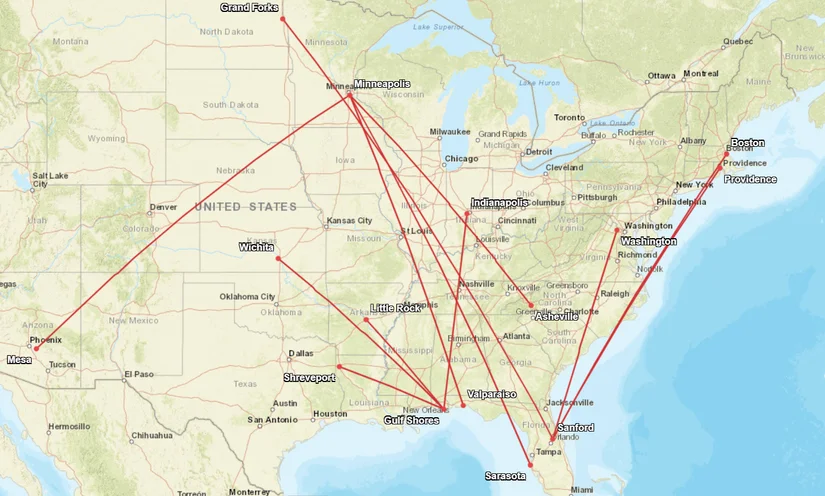
Allegiant Air is set to launch 21 new domestic routes in 2027, according to scheduling data from aviation analytics firm Cirium. The ultra-low-cost carrier, known for connecting smaller cities to leisure destinations, will begin service on these routes primarily in the first half of the year, with some flights extending into the summer. The expansion, reported on November 28, 2026, underscores Allegiant's continued focus on secondary airports and vacation markets, with every new route being domestic.
Key Airports and Start Dates
The new routes are spread across several bases. Minneapolis/St. Paul International Airport (MSP) will see four new routes: three starting in April to Phoenix/Mesa, Sarasota, and Destin/Fort Walton Beach, followed by Asheville in May. Gulf Shores will also gain four routes, all beginning in May, to Indianapolis, Little Rock, Shreveport, and Wichita. Orlando Sanford International Airport will add four routes, with Boston, Grand Forks, and Providence starting in February, and Washington Dulles in May. Fort Lauderdale-Hollywood International Airport (FLL) will add two routes in February to Portsmouth and Providence. Additionally, Philadelphia International Airport will operate flights to Destin/Fort Walton Beach from May to August 2027. Other airports with two new routes each include Flint Bishop International and Boston Logan, though details were not fully specified in the source excerpts.
Aircraft and Frequency
The routes will be served by Allegiant's Airbus A319 and A320 aircraft, as well as its Boeing 737 MAX 8-200 fleet. The 737 MAX 8-200 will be used on some routes from Fort Lauderdale and Shreveport. Peak frequency on some routes will reach four flights per week, while the Philadelphia to Destin/Fort Walton Beach route will peak at three weekly flights. Allegiant's fleet includes 27 A319-100s, 77 A320-200s, and 23 737 MAX 8-200s, with 29 737 MAX 8s on order, according to ch-aviation data cited by Simple Flying.
Context: Allegiant's Strategy and the Leisure Travel Market
The new routes reflect Allegiant's long-standing business model of connecting underserved secondary airports with popular leisure destinations, particularly in Florida. By avoiding head-to-head competition at major hubs, the airline can stimulate demand from smaller markets where nonstop options are limited. This approach has proven resilient, especially as leisure travel continues to recover and budget-conscious travelers seek affordable nonstop flights.
The expansion comes amid a broader trend of ultra-low-cost carriers (ULCCs) reshaping domestic air travel. Allegiant's growth is part of a larger wave of route announcements for 2027. For instance, JetBlue recently unveiled 16 new nonstop routes, with a significant focus on Fort Lauderdale, where it has overtaken New York JFK as its most-served market. JetBlue's expansion includes 11 domestic routes and leverages the void left by Spirit Airlines' reduction in service. Meanwhile, Qantas announced five new international routes for 2027, including the much-anticipated Sydney-London Heathrow nonstop.
Allegiant's decision to add 21 routes—with more likely to be announced—signals confidence in sustained demand for leisure travel, particularly to warm-weather destinations. The timing of the routes, with many starting in February and April, positions the airline to capture spring break and summer vacation traffic. Travelers in markets like Minneapolis/St. Paul, Gulf Shores, and Orlando Sanford will gain new nonstop options, potentially driving down fares and increasing connectivity.
Perspective: Implications for Travelers and the Industry
The expansion solidifies Allegiant's role as a niche player in the domestic market, focusing on point-to-point leisure routes that larger carriers often overlook. For travelers in secondary markets, the new routes offer greater convenience and potentially lower fares, as Allegiant's ULCC model emphasizes unbundled pricing. However, the airline's reliance on leisure traffic means it is sensitive to economic downturns and seasonal fluctuations. The success of these routes will depend on sustained consumer confidence and the ability to fill seats at profitable yields.
From an industry perspective, Allegiant's growth contributes to the ongoing segmentation of the U.S. airline market. While major carriers focus on hubs and international networks, ULCCs like Allegiant, Frontier, and a resurgent JetBlue are aggressively expanding domestically, often targeting markets where they can stimulate new demand. This competition could lead to lower fares and more choices for consumers, but also to overcapacity in certain leisure markets. The fate of Spirit Airlines, which has scaled back significantly, serves as a cautionary tale about the risks of aggressive expansion in a crowded ULCC space.
As 2027 approaches, all eyes will be on whether Allegiant's bet on secondary airports and leisure destinations pays off. With more routes potentially on the horizon, the airline's network strategy will be closely watched by industry analysts and travelers alike. For now, the 21 new routes represent a significant vote of confidence in the resilience of domestic leisure travel.
Comments