
The New Face of Ad Fraud: From Botnets to AI and Beyond
The digital advertising ecosystem is confronting a wave of fraud schemes that are more sophisticated—and more pervasive—than ever before. This week alone, three separate developments have reshaped the landscape: the Federal Trade Commission's lawsuit alleging Amazon manipulated its ad auctions for seven years, the discovery of malware that turns car infotainment screens into click-fraud bots, and mounting legal questions about whether AI platforms like OpenAI could be liable for monetizing invalid traffic.
Together, these stories signal a turning point. Ad fraud is no longer just a problem of third-party botnets inflating impressions on obscure websites. It has moved into the core infrastructure of the internet—search auctions, AI-driven chat interfaces, and even the dashboard of your car.
Amazon Accused of Rigging Its Own Ad Auction
The most significant development comes from the FTC and 22 state attorneys general, who filed a lawsuit alleging that Amazon secretly manipulated its search ad auctions for more than seven years, extracting an additional $20 billion from advertisers. According to the complaint, Amazon used an internal algorithm to systematically increase the amount advertisers paid beyond what competitive bidding would have produced. In a legitimate second-price auction, an advertiser pays one cent more than the next-highest bid, keeping costs tied to actual competition. The FTC alleges Amazon broke that connection by adding a hidden surcharge to winning bids, disconnecting prices from market dynamics. The case is a stark reminder that platform-reported metrics and auction mechanics can no longer be taken at face value.
Car Infotainment Screens Hijacked for Click Fraud
Meanwhile, cybersecurity researchers at Kaspersky have uncovered a novel strain of Android malware—dubbed "DoFun"—that targets aftermarket car head units. The malware, traced to the cybercrime syndicate behind the "BadBox" botnet, exploits a legitimate system app called TWCore, which handles routine software updates for DoFun units. Once hijacked, the attackers drop a stealthy background service called JarService, which quietly decrypts a payload and launches a malicious downloader. With control over the infotainment unit, hackers can force the screen to serve fraudulent ads and use the car's internet connection as a proxy server to route shady web traffic. While the driver is listening to Spotify, the car could be generating ad revenue for criminals halfway across the world.
AI Chat Platforms and the New Legal Frontier
The third development is more theoretical but potentially more consequential: the intersection of AI-driven advertising and federal wire fraud statutes. Following the departure of key talent from OpenAI—including former researchers who publicly warned that the company's shift toward advertising mirrored Facebook's early monetization problems—questions are emerging about the ad-tech stack powering conversational AI. Advertisers testing newly minted AI ad platforms report instances of invalid inventory, non-human engagement, and ghost conversions. This raises a critical question: if an AI platform systematically monetizes invalid traffic while charging on a cost-per-click or cost-per-mille basis, does the platform itself become the source of fraud?
The Mechanics of Inventory Misrepresentation
In traditional ad networks, click fraud often stems from third-party botnets inflating publisher impressions. However, AI chat interfaces present a unique structural risk. Unlike a webpage where bots simulate human clicks, an AI platform could theoretically generate automated prompts, artificially simulate engagement, or fail to implement basic fraud filtering while still charging advertisers. Under U.S. federal law—specifically 18 U.S.C. § 1343 for Wire Fraud—criminal liability does not require a foreign address or an illicit underground operation. It requires two elements: a scheme to defraud involving material misrepresentations (e.g., selling "human engagement" while delivering automated traffic), and intent or reckless disregard regarding the falsity of the inventory being sold. If an AI platform's leadership is made aware by internal teams or external audits that its ad metrics consist of invalid or fake inventory, and continues to bill advertisers without remediation, executives could face civil class actions, FTC enforcement, or criminal investigations.
Deepfakes: The Creative Layer's Fraud Vector
While AI platforms struggle with click quality, deepfakes have emerged as a primary vector for fabricated celebrity endorsements distributed as paid social advertising. A deepfake is synthetic audio, image, or video produced with AI that depicts a real person doing or saying something they never did, convincingly enough to pass as authentic. These are created using generative architectures like autoencoders, GANs, and diffusion models. Fraudulent advertisers produce a video showing a celebrity appearing to endorse a product, then submit it through self-serve interfaces like Meta Ads Manager or Google Ads, targeting audiences likely to trust the impersonated figure. Clicking the ad routes viewers to a cloned landing page, where victims pay a nominal fee or submit financial details directly. This pattern—fabrication, paid promotion, redirection—has become the dominant structure of deepfake-enabled ad fraud, forcing Google, Meta, and Microsoft to rebuild advertiser enforcement systems.
The Trust Deficit in Platform Advertising
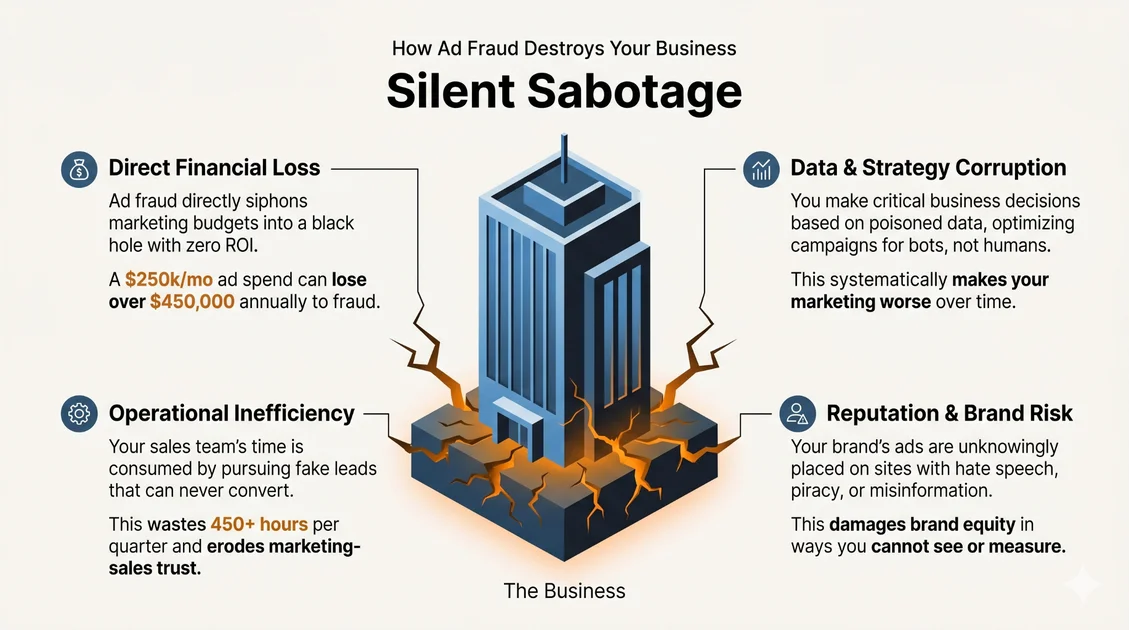
The Amazon case, the car malware, and AI-related fraud all point to the same underlying issue: the erosion of trust in digital advertising platforms. For media buyers and agency professionals, the FTC's allegations against Amazon are particularly alarming because they suggest that a platform can rig its own auction for years without detection. This doesn't just seek damages; it forces a reckoning with how much faith advertisers can place in platform-reported results, period. The lawsuit also rewrites assumptions about programmatic spending. If Amazon's auction pricing was unreliable for seven years, every platform contract negotiation now needs verification mechanisms that didn't previously exist.
Contract Negotiations in the Age of Distrust
As platforms grow more powerful, advertisers are increasingly demanding transparency clauses, third-party verification, and independent audits. The old model of trusting platform dashboards is no longer viable. This is especially true as new platforms like OpenAI's ChatGPT ad business scale up. ChatGPT's ad business recently crossed a $1 billion annualized revenue run rate and launched self-serve access across Europe, but its ad infrastructure is unproven. Early tests by PPC experts have yielded troubling results, with reports of invalid inventory and non-human engagement. These issues are not necessarily evidence of intentional fraud, but they highlight the risks of rushing into new ad platforms without proper safeguards.
The Legal and Reputational Stakes
For tech CEOs, the stakes are high. Historically, federal law enforcement has treated systematic ad fraud as an extradition-worthy criminal offense. Cases involving international operations—such as the DOJ prosecutions of Russian and Italian nationals behind botnets like 3xx1 and Methbot—demonstrated that misrepresenting ad inventory and charging clients for artificial clicks constitute federal wire fraud and money laundering. Now, the legal question being whispered in digital media circles is whether American tech executives could face similar exposure if their platforms systematically monetize invalid traffic. While the Amazon case is civil, criminal investigations could follow if evidence of intent emerges. OpenAI's leadership, including CEO Sam Altman, could theoretically be exposed if the company's ad business continues to grow without addressing invalid traffic concerns.
Broader Implications: Ad Fraud as a Systemic Threat
The confluence of these stories reveals a systemic threat that spans the entire digital advertising supply chain. From the creative layer (deepfakes) to the bidding layer (Amazon's auction) to the delivery layer (car malware), fraud is becoming more embedded, more automated, and harder to detect. The rise of AI has accelerated this trend in two ways. First, AI enables fraudsters to create more convincing fake content at scale—whether that's a deepfake video of a celebrity or a simulated click from a bot. Second, AI platforms themselves may be unwittingly (or wittingly) generating invalid traffic, as seen in early tests of ChatGPT's ad platform. The result is a battlefield where advertisers are fighting an enemy that can adapt in real time, and where the tools designed to combat fraud—like verification services—are often one step behind.
The Rise of Proxy Botnets in Everyday Objects
The car malware case illustrates another troubling trend: the expansion of ad fraud into the Internet of Things. The DoFun trojan is particularly insidious because it affects a device that is always on, always connected, and rarely monitored. Unlike a PC or smartphone, a car infotainment screen is not something users regularly scan for malware. This allows hackers to run undetected click-fraud schemes for extended periods, siphoning ad revenue from legitimate publishers. As more everyday devices—from cars to refrigerators to wearable tech—gain internet connectivity, they become potential nodes in proxy botnets. The car in your garage could be quietly working a side hustle for criminals, just as your smart TV might be. Security researchers have long warned that IoT devices are a weak link in cybersecurity, and ad fraud is now a major exploit vector.
What This Changes for Advertisers and Regulators
For advertisers, the lesson is clear: verification is no longer optional. The days of relying on platform-reported metrics are over. Advertisers must demand third-party verification, on both the impression and click level, and should push for contractual language that holds platforms accountable for invalid traffic. For regulators, the FTC's lawsuit against Amazon signals a new willingness to take on platform manipulation, but civil penalties may not be enough. Criminal prosecution of executives who knowingly profit from fraudulent activity could become a deterrent. The Department of Justice has the tools—wire fraud statutes, RICO—to go after bad actors, and the ad industry should brace for more aggressive enforcement.
The Road Ahead: Trust as the New Currency
In the end, the ad industry's most valuable asset is not its data or its reach—it's trust. Advertisers trust that their budgets are reaching real humans, that auctions are fair, and that metrics are accurate. When that trust is broken, even by a single platform, it casts a shadow over the entire ecosystem. The recent developments—Amazon's alleged auction manipulation, the car malware, and the uncertainties of AI ad platforms—are not isolated incidents. They are symptoms of a structural problem: the inability of current systems to verify authenticity in a digital world filled with bots, fakes, and hidden algorithms.
As we move forward, the platforms that will thrive are those that embrace transparency, not just in their marketing but in their infrastructure. The ones that don't will face not only legal consequences but also a more immediate punishment: the loss of advertiser trust. And in the world of digital advertising, that loss is the most expensive form of fraud of all.
The digital advertising landscape is evolving at breakneck speed, and with it, the nature of fraud. From Amazon's alleged auction rigging to AI chatbots generating ghost clicks, the industry is facing challenges that were unimaginable just a few years ago. For advertisers, the message is stark: trust, but verify. The tools are available—third-party audits, anti-fraud services, and contract safeguards—but they must be used with intentionality. As the NFL season kicks off, bringing billions of dollars in ad spend, and as tech stars navigate fame, the stakes have never been higher.
One thing is certain: the silent threat in Silicon Valley is no longer silent. It's front-page news, and it's coming for every advertiser's bottom line.
Comments